
Mexico 5 Pesos 2010 Bicentennial (Miguel Hidalgo): Value & How to Sell
Prices updated: August 2026
Bicentennial of Mexican Independence: Miguel Hidalgo y Costilla, proof.
Bicentennial of Mexican Independence: Miguel Hidalgo y Costilla, proof.
Design
Banxico
Obverse
Bicentennial of the Independence of Mexico: Miguel Hidalgo y Costilla, proof.
How much is the Mexico 5 Pesos 2010 Bicentennial (Miguel Hidalgo): Value & How to Sell worth?
The market value of the Mexico 5 Pesos 2010 Bicentennial (Miguel Hidalgo): Value & How to Sell is not yet documented with enough data to give a firm range. Weigh and measure your piece, compare it against the specifications, and check the forum for a second opinion.
The real price depends on four factors: the grade of preservation (a circulated piece is worth the low end of the range; an uncirculated one, or one still in its official blister pack, the high end), the finish (satin vs mirror/proof), the rarity within the series based on the mintage, and the metal spot price on the day of the deal when the piece is silver or gold. Check the value-by-grade table above and compare with equivalent pieces before buying or selling.
Where to buy or sell this coin?
Browse the national directory of numismatic shops or the community forum to trade directly with other collectors.
Description
If you inherited or found a 2010 Mexican 5 pesos coin showing Miguel Hidalgo, here is the honest answer first: in circulated condition it is worth a small premium over face value, roughly a few US dollars. The version that carries real value is the proof issue from Banco de México sets, and even that trades in the tens of dollars, not the hundreds. This is not a rare coin, and no version of it is "worth thousands."
Let's break down what you actually have.
What this coin is
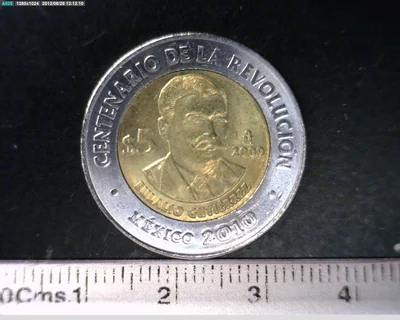
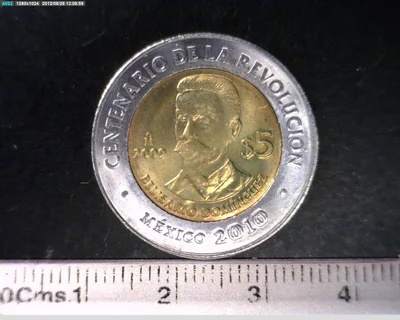
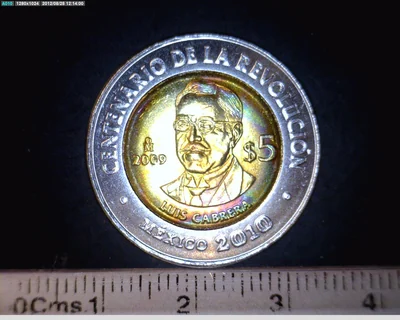
This is one of the 5 Pesos Bicentennial commemoratives Mexico issued in 2010 to mark 200 years of independence. The design honors Miguel Hidalgo y Costilla, the priest who launched the independence movement in 1810. It belongs to the broader 5 Pesos Bicentenario Independencia y Centenario Revolución series, a large program of dozens of different reverses released the same year.
Because the program was so broad, these coins are common. Millions of the circulation pieces went out through banks. That matters for value: a coin the mint made in quantity almost never becomes valuable just because it is a few years old.
Specifications (verify yours against these)
| Spec | Detail |
|---|---|
| Denomination | 5 pesos |
| Year | 2010 (single year of issue) |
| Weight | 9.76 grams |
| Diameter | 30.52 mm |
| Composition | Bimetallic (inner core and outer ring) |
| Edge | Plain (smooth) |
| Finish | Circulation strike, plus a limited proof version |
The proof version has mirror-like fields and frosted raised design, and it originally came in a Banco de México presentation holder. If yours is loose, dull, and shows wear, you have a circulation coin, not a proof.
What it is actually worth in USD
Here is the realistic picture:
| Condition | Approximate value (USD) |
|---|---|
| Circulated, worn | Around face value to a few dollars |
| Uncirculated (no wear, luster intact) | A few dollars to about 10 dollars |
| Proof in original Banxico holder | Roughly 20 to 40 dollars, depending on demand |
| Certified proof (NGC/PCGS PF69 or PF70) | Can reach 50 to 80 dollars |
These are ranges, not fixed prices, because demand for the individual Bicentennial designs shifts. The Hidalgo reverse is one of the more recognizable in the series, which helps a little on the collector side, but it does not make the coin scarce.
The myth to kill: listings that price this coin at hundreds of dollars are wishful thinking, not sales. A price someone asks is not a price someone paid. What matters is what similar pieces have actually sold for, and for this issue that stays in the low double digits at most.
Is it silver? No
A common assumption with older or commemorative Mexican coins is that they contain silver. This one does not. It is bimetallic (base metals), so it has no bullion floor. Its value is entirely collector-driven, which is another reason condition and the original packaging matter more than metal content here.
If you are specifically hunting for silver Mexican coins, that is a different category, and worth understanding before you sort a whole inherited box. See our guide to Mexican silver coins to check what actually contains precious metal.
Errors and varieties
Genuine mint errors (off-center strikes, die rotation, doubled dies) can multiply the value of any coin. But be realistic: most "errors" people spot on modern Mexican coins are post-mint damage, scratches, corrosion, or handling marks, not factory errors. Damage lowers value. A true error is verifiable and rare.
If you think you have a genuine error, do not clean the coin and do not assume. Photograph it and get a second opinion before you count on any premium.
How to tell if yours is genuine
Counterfeits of a low-value modern coin are uncommon, but here is how to confirm:
- Weigh it. It should be 9.76 grams. A meaningful deviation is a red flag.
- Measure it. Diameter should be 30.52 mm.
- Check the relief. Compare the sharpness of the Hidalgo portrait and lettering against official Banco de México images. Fakes tend to look flat and soft.
- Examine the edge. It should be plain and cleanly finished.
- For anything you believe is a valuable proof, certification by NGC or PCGS is the definitive answer. It confirms authenticity and assigns a grade in one step.
Where to sell it
For a coin in this value range, keep it simple and avoid paying grading fees that cost more than the coin is worth. Your realistic options:
- A verified numismatic shop in the Pesoteca directory, which can appraise it in person.
- The Pesoteca buy-and-sell forum, where you deal directly with collectors.
- General marketplaces work too, but photograph the front, back, and edge, and state the weight so buyers trust the listing.
Before you sell, confirm your grade against our coin grading guide. A coin's condition is the single biggest factor in what a buyer will pay.
Have a 2010 Bicentennial set, or a whole box of inherited Mexican coins you are trying to sort? Post clear photos in the Pesoteca forum and let collectors help you tell the common from the keepers.
Historical context
Miguel Gregorio Antonio Ignacio Hidalgo y Costilla Gallaga Mandarte y Villaseñor: priest of Dolores and initiator of the War of Independence
Miguel Gregorio Antonio Ignacio Hidalgo y Costilla Gallaga Mandarte y Villaseñor (1753-1811) was the priest of Dolores and initiator of the War of Independence during the War of Independence.
This entry corresponds to the variant with the abbreviated MÉXICO legend on the Miguel Hidalgo reverse. In the early hours of September 16, 1810, the bells of the Dolores parish rang the alarm and Hidalgo called on the people to rise against the bad viceregal government. That act is the official starting point of the War of Independence.
Context of the year. The piece is from 2010 and is part of the die variants recorded by Banxico in its official catalog. It differs from the standard Hidalgo entry in minor engraving details.
The reverse of the coin. The reverse of this 5-peso piece shows the portrait of Miguel Gregorio Antonio Ignacio Hidalgo y Costilla Gallaga Mandarte y Villaseñor, his engraved signature, and the year 2010, in accordance with the official catalog of the Bank of Mexico for the commemorative series of the Bicentennial of the start of Independence (1810-2010).
Legacy. Hidalgo is the Father of the Nation. The state of Hidalgo and the Miguel Hidalgo borough in Mexico City bear his name. Every September 15 the Grito is reenacted from the central balcony of the National Palace.
This piece belongs to the era
Nuevos Pesos y actualidad →Explore all the Mexican coins of this era, their historical context and how they connect to the monetary system of the period.
Value range of this piece
Value range without enough data for this piece.
See the full breakdown by grade (VG, F, VF, EF, AU, MS-60, MS-63, MS-65) for the whole series →
Other denominations from 2010
5 Pesos Bicentenario Independencia y Centenario Revolución · Bimetálica
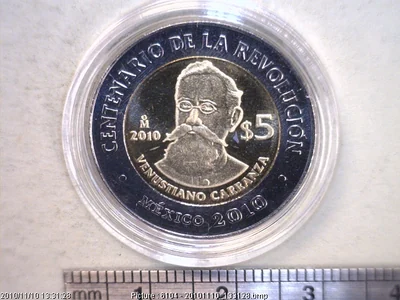
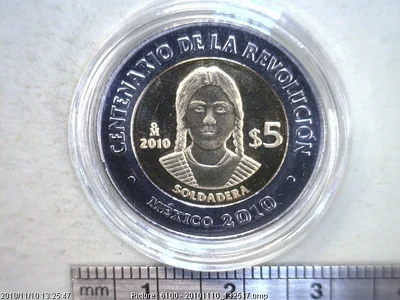
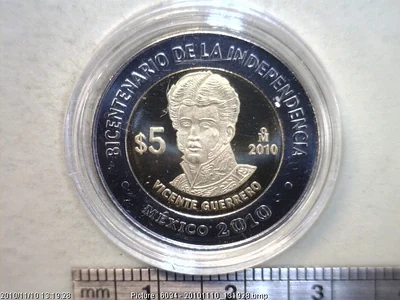
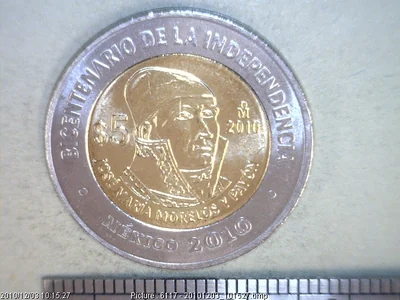
Same denomination, other years
5 pesos Bimetálica · 5 Pesos Bicentenario Independencia y Centenario Revolución
Official sources
Frequently asked questions
How much is the 2010 Mexico 5 Pesos Miguel Hidalgo coin worth?
In circulated condition it is worth roughly face value to a few US dollars. An uncirculated example runs a few dollars up to about 10. The proof version in its original Banco de México holder trades around 20 to 40 dollars, and a certified PF69 or PF70 can reach 50 to 80. It is not a rare coin, and asking prices in the hundreds are not real sales.
Is the 2010 Bicentennial 5 Pesos rare?
No. It was part of a large 2010 program with dozens of designs, and the circulation version was struck in quantity, so it is common. The proof issue from official sets is scarcer and slightly more collectible, but this coin's value comes from condition and packaging, not rarity.
Where can I sell my 2010 Mexico 5 Pesos coin?
The safest routes are a verified numismatic shop from the Pesoteca directory, which appraises it in person, or the Pesoteca buy-and-sell forum where you deal directly with collectors. Photograph the front, back, and edge, and note the 9.76 gram weight. Avoid dumping it to the first bidder on general social media.
How do I know if my coin is genuine?
It should weigh 9.76 grams and measure 30.52 mm across. Compare the sharpness of the Miguel Hidalgo portrait and lettering to official Banco de México images; counterfeits look flat and soft. The edge is plain. For any proof you believe has real value, NGC or PCGS certification confirms authenticity and grade at once.
Conversation
0 comments
Loading comments…