
50 Centavos 1951: Value, Silver Content & How to Sell
The 50 Centavos 1951: Value, Silver Content & How to Sell is worth between $145 and $214 MXN depending on its grade of preservation.
Prices updated: August 2026
Old peso era · Silver
Old peso era · Silver
Design
Banxico
Reverse
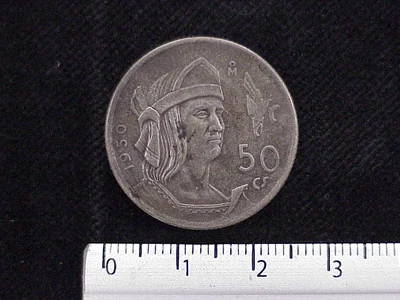
Bust of Cuauhtemoc facing right with an Aztec warrior helmet, an eagle descending to his left (an allusion to his name, "eagle that descends"), the value "50 Cs", the Mo mint mark (Mexico City) and the year 1951 in a vertical arrangement.
Obverse
Mexican National Coat of Arms with the inscription "ESTADOS UNIDOS MEXICANOS".
The 50 Centavos 1951: Value, Silver Content & How to Sell is worth between $145 and $214 MXN depending on its grade of preservation.
Prices updated: August 2026
How much is the 50 Centavos 1951: Value, Silver Content & How to Sell worth?
The estimated value of the 50 Centavos 1951: Value, Silver Content & How to Sell ranges from $145 (circulated, XF) up to $214 (official blister pack), with $189 as a reference for an uncirculated (UNC) piece. The estimate is based on the official mintage and the historical behavior of the family.
The real price depends on four factors: the grade of preservation (a circulated piece is worth the low end of the range; an uncirculated one, or one still in its official blister pack, the high end), the finish (satin vs mirror/proof), the rarity within the series based on the mintage, and the metal spot price on the day of the deal when the piece is silver or gold. Check the value-by-grade table above and compare with equivalent pieces before buying or selling.
Where to buy or sell this coin?
Browse the national directory of numismatic shops or the community forum to trade directly with other collectors.
Description
If you inherited a 1951 Mexican 50 centavos coin and hoped for a payday, the honest answer is this: it's worth a few dollars, not a fortune. In circulated condition it trades for roughly 3 to 4 USD, and even a well-preserved uncirculated example runs around 9 to 10 USD in 2026. The metal value floor sits near 5 to 6 USD.
The biggest misconception about this coin, repeated across the internet, is the silver content. It is not high-grade silver. The 1951 50 centavos is only 30 percent silver (0.300 fine), with the rest being copper, nickel, and zinc. That matters a lot when someone tries to sell it "as silver."
What the 1951 50 Centavos actually is
"Centavos" are the Mexican equivalent of cents, one hundred of them make one peso. So this is a half-peso piece from the era when México still put a little silver into small change. It was struck at the Casa de Moneda de México (the Mexican Mint) under the Monetary Law of December 29, 1949, in a short series that ran only two years: 1950 and 1951.
Here are the exact specifications, useful both for value and for authentication:
| Feature | Detail |
|---|---|
| Catalog number | KM-449 |
| Metal | 30% silver, 50% copper, 10% nickel, 10% zinc |
| Fineness | 0.300 silver |
| Weight | 6.66 g |
| Pure silver content | approx. 2 g (0.0642 troy oz ASW) |
| Diameter | 26 mm |
| Edge | plain (smooth) |
| Mint | Casa de Moneda de México (Mo mint mark) |
| 1951 mintage | 3,650,000 |
A note on the 0.720 figure: some listings, including older Mexican sources, describe this coin as 0.720 silver. That figure belongs to earlier and heavier silver pesos and fractions of the 1940s. The 1951 50 centavos KM-449 is the debased 0.300 type. If someone is pricing your coin as if it were 0.720 or higher, that's the mistake to catch.
How much is it worth in 2026
This is a common circulation coin, so grade is what separates a few dollars from a slightly-more-than-a-few dollars:
- Circulated (worn, flat relief): about 3 to 4 USD. Most surviving examples fall here because the coin saw heavy daily use.
- Uncirculated / Mint State (original luster, sharp high points): about 9 to 10 USD.
- Melt value (intrinsic silver): roughly 5 to 6 USD, based on 0.0642 troy oz of pure silver at current spot prices.
The silver value gives it a floor, but a low floor. Compare that to a modern Onza Libertad, a one-troy-ounce coin of pure 0.999 silver, and you can see why collectors don't buy the 1951 for its metal. There simply isn't much silver in it.
Is it rare?
No. The 1951 issue had a mintage of 3,650,000 pieces. That's smaller than the 13.57 million struck in 1950, so within this two-year series the 1951 is the slightly scarcer date, but "scarcer" here still means millions of coins. It is easy to find and easy to buy.
Real scarcity only shows up in high, well-struck Mint State grades. Because these coins circulated hard, clean uncirculated examples with full luster are the ones that command the top of the range. If yours is worn smooth, it is worth about melt.
What's on the coin
The reverse shows Cuauhtémoc, the last Aztec (Mexica) ruler, who led the resistance against the Spanish conquest in 1521. He faces right, wearing a warrior's helmet, with an eagle descending beside him, a reference to his name in Nahuatl (roughly "descending eagle"). You'll also see the Mo mint mark, the value "50 Cs," and the date. It's one of the more recognizable Mexican designs of the period, which is part of why beginners like the series.
How to tell if yours is genuine
Counterfeits of a 3-dollar coin are uncommon, but it's still worth a quick check:
- Weight: should be 6.66 g. A significant deviation is a red flag.
- Diameter: 26 mm.
- Edge: plain and smooth. If the edge has reeding (ridges), be suspicious.
- Design: Cuauhtémoc facing right with the descending eagle, Mo mint mark, cataloged as KM-449.
A kitchen scale and a caliper will settle most doubts.
Where to sell it
Since this is a common piece, you don't need an auction house. Your realistic options:
- A local coin dealer or an established numismatist, who will pay near the market range above.
- The Pesoteca shop directory to find a reputable buyer.
- Online marketplaces, if you're comfortable shipping and grading it yourself.
One thing to know: the Banco de México does not appraise numismatic pieces. For a real market value, a dealer or the Sociedad Numismática de México is your source. If you have a roll or a bag of these, selling as a lot is usually simpler than piece by piece.
Do you have a box of old Mexican coins and want to know which ones are actually worth setting aside? Post clear photos of both sides in the Pesoteca forum and we'll help you sort the common from the keepers.
Historical context
Circulating centavo coins in Mexico during the second half of the 20th century were struck in alloys that changed according to metal costs: copper, bronze and brass in the low denominations (1¢, 5¢, 20¢); cupronickel for the intermediate denominations (25¢, 50¢, late 10¢); and .720 silver for some 25¢ and 50¢ pieces in the 50s. Each alloy change produced a distinct variant of the same face value. 1951 corresponds to the period when this variant was in circulation, before the transition to Nuevos Pesos in 1992. The Mexico City Mint kept the basic design of the National Coat of Arms on the obverse and the numeric value on the reverse throughout this era.
This piece belongs to the era
México Moderno (pre-1992) →Explore all the Mexican coins of this era, their historical context and how they connect to the monetary system of the period.
Value range of this piece
Market estimate: $145 - $214 MXN depending on the grade of preservation (typical range between a circulated and an uncirculated piece).
See the full breakdown by grade (VG, F, VF, EF, AU, MS-60, MS-63, MS-65) for the whole series →
Same denomination, other years
50 centavos Plata 0.720 · Centavos Mexicanos
Frequently asked questions
How much is a 1951 Mexican 50 centavos silver coin worth?
In circulated condition it's worth about 3 to 4 USD, and in uncirculated Mint State around 9 to 10 USD in {{AÑO}}. Its intrinsic silver value is roughly 5 to 6 USD, based on 0.0642 troy oz of pure silver at current spot. It's an affordable coin except in top grades.
How much silver is actually in this coin?
It's only 30 percent silver (0.300 fine), not high-grade silver. The full alloy is 30% silver, 50% copper, 10% nickel, and 10% zinc. Its 6.66 g weight contains about 2 g of pure silver, equal to 0.0642 troy ounces (ASW). That's why its metal value is low compared to pure-silver Onza Libertad coins.
Is the 1951 50 centavos rare?
No, it's common. The 1951 mintage was 3,650,000 pieces, fewer than the 13.57 million struck in 1950, so it's the slightly scarcer date in this two-year series, but still abundant and easy to find. Real scarcity appears only in well-preserved uncirculated grades.
Where can I sell my 1951 50 centavos coin?
Because it's a common piece, your best options are an established coin dealer or the Pesoteca shop directory at /tiendas. The Banco de México does not appraise numismatic pieces; a dealer or the Sociedad Numismática de México will give you a real market price. Selling multiples as a lot is usually simplest.
Conversation
0 comments
Sources
Images for informational and educational purposes, attributed to their original source. Reference values; the real price depends on the grade, the specific variant and demand.
Loading comments…