
1747 Mexico 8 Escudos Gold Coin (Fernando VI): Value & How to Sell
The 1747 Mexico 8 Escudos Gold Coin : Value & How to Sell is worth between $51,308 and $86,414 MXN depending on its grade of preservation.
Prices updated: August 2026
Viceroyalty · Mexico City Mint · Assayer MF
Viceroyalty · Mexico City Mint · Assayer MF
The 1747 Mexico 8 Escudos Gold Coin : Value & How to Sell is worth between $51,308 and $86,414 MXN depending on its grade of preservation.
Prices updated: August 2026
How much is the 1747 Mexico 8 Escudos Gold Coin (Fernando VI): Value & How to Sell worth?
The estimated value of the 1747 Mexico 8 Escudos Gold Coin (Fernando VI): Value & How to Sell ranges from $51,308 (circulated, XF) up to $86,414 (official blister pack), with $73,648 as a reference for an uncirculated (UNC) piece. The estimate is based on the official mintage and the historical behavior of the family.
The real price depends on four factors: the grade of preservation (a circulated piece is worth the low end of the range; an uncirculated one, or one still in its official blister pack, the high end), the finish (satin vs mirror/proof), the rarity within the series based on the mintage, and the metal spot price on the day of the deal when the piece is silver or gold. Check the value-by-grade table above and compare with equivalent pieces before buying or selling.
Where to buy or sell this coin?
Browse the national directory of numismatic shops or the community forum to trade directly with other collectors.
Description
If you inherited a 1747 8 escudos gold coin from colonial Mexico, here is the honest answer first: it is worth real money. This is a large gold coin, and even a worn example has a hard floor at its melt value, which sits north of 2,000 USD at recent gold prices. Certified high-grade examples of early Fernando VI gold have crossed the 20,000 USD mark at auction. This coin is not the kind of "old coin worth a few dollars" you read about elsewhere.
In 2026, the 8 escudos remains one of the most sought-after gold denominations from Spanish colonial Mexico, and 1747 is the first year of Fernando VI's reign after Fernando's father, Felipe V, died. That first-year status matters to collectors.
What this coin actually is
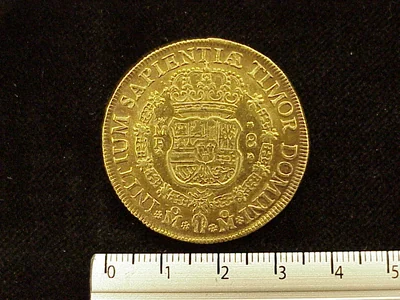
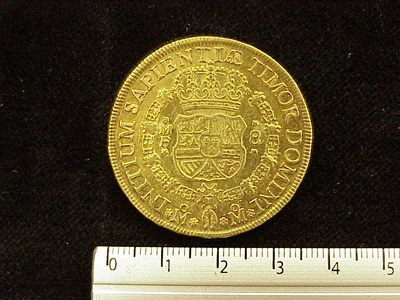
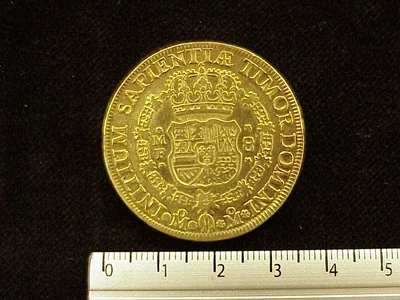
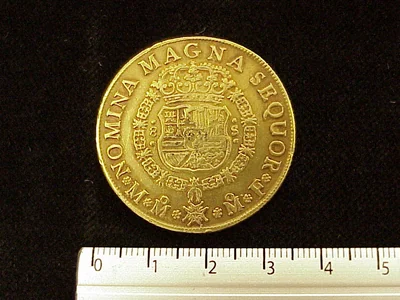
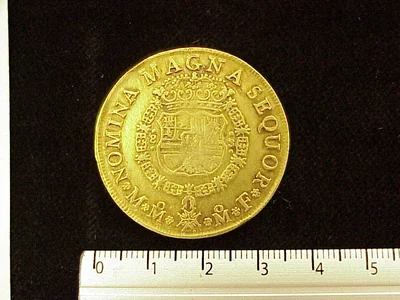
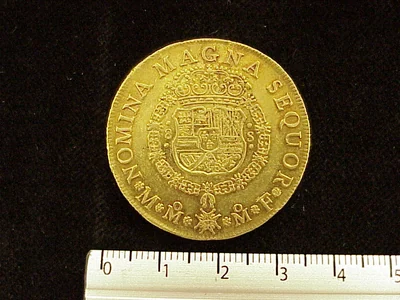
The "8 escudos" was the largest regular gold denomination struck in colonial Mexico, often called a "doubloon" in English. Yours was minted at the Mexico City mint (the Casa de Moneda, the oldest mint in the Americas) under Fernando VI, a Bourbon king who ruled Spain from 1746 to 1759. The 1747 date means it was struck early in his reign.
Here are the exact specifications. Check them against your coin, because they are the fastest authenticity screen:
| Specification | Value |
|---|---|
| Metal | Gold, .875 fine (21 karat) |
| Weight | 26.98 grams |
| Diameter | 37 mm |
| Edge | Reeded (grooved) |
| Mint | Mexico City (Casa de Moneda) |
| Assayer mark | MF |
| Denomination | 8 escudos |
| Reign | Fernando VI |
| Year | 1747 |
The assayer initials (MF) are the mark of the official who certified the gold content. On genuine coins these letters appear in the legend, and their absence or the wrong initials for the date is a red flag.
What it is worth
Value on this coin breaks into two layers.
Gold floor (melt value). At 26.98 grams of .875 fine gold, this coin contains about 23.6 grams (0.76 troy ounces) of pure gold. That alone is worth roughly 2,000 to 2,300 USD depending on the daily gold price. No 8 escudos in genuine gold sells below this, ever. That is your safety net.
Numismatic premium. Above melt, price is driven by grade, eye appeal, and how clean the strike is. A heavily worn, damaged, or mount-marked example may trade close to melt, in the 2,000 to 3,000 USD range. A clean circulated coin with sharp detail runs several thousand more. Certified Mint State examples of early Fernando VI 8 escudos from Mexico City have sold in the high five figures at major auctions. As a general guide:
| Condition | Approximate value (USD) |
|---|---|
| Worn / damaged / ex-jewelry | 2,000 to 3,000 (near melt) |
| Circulated, clear detail | 3,500 to 8,000 |
| High grade, certified AU/MS | 10,000 to 25,000+ |
These are ranges, not quotes. The only way to get a firm number is to have your specific coin graded, which we cover below.
Watch for the jewelry trap
A huge share of surviving 8 escudos coins were mounted as pendants at some point. Solder marks, a removed bezel, a drilled hole, or filed edges cut the numismatic premium sharply, often dropping the coin back toward melt value. Look closely at the edge and rim under good light. If the reeding is smooth in one spot, it was probably a mount point.
How to tell if yours is genuine
Gold fakes exist, and this coin is a target because of its value. Run these checks before you celebrate or panic:
- Weigh it. A genuine coin is 26.98 grams. A digital jewelry scale settles most cases in seconds. Underweight or overweight means fake or a problem coin. Most counterfeits use lower-purity gold or base metal cores and cannot hit the exact weight and size together.
- Measure it. 37 mm diameter. Off measurements are a fast disqualifier.
- Check the edge. It should be reeded. Cast fakes often show a seam or mushy reeding.
- Read the marks. Mexico City mint mark and the MF assayer initials should be present and correct for 1747.
- Get it certified. For a coin worth thousands, professional grading by NGC or PCGS is the definitive answer. They authenticate, grade, and seal the coin in a tamper-evident holder. The fee is small next to the coin's value and it makes selling far easier.
Where to sell it
Because this is a high-value gold coin, sell where buyers are serious and where you can verify the transaction. Options that make sense:
- Major auction houses. Heritage Auctions and Stack's Bowers both run world and ancient coin sales and handle Spanish colonial gold regularly. This is where record prices happen, and it is the right venue for a certified high-grade example.
- Established coin dealers. A reputable dealer will make an offer on the spot, though usually below auction hammer since they resell for a margin.
- The Pesoteca buy-and-sell forum, where you can reach collectors directly.
Whatever the venue, get it graded first if it might be above-average condition. A raw coin sells for less and invites lowball offers because the buyer carries the authenticity risk. Never ship a coin worth thousands without insured tracking, and photograph the obverse, reverse, and edge before it leaves your hands.
Context worth knowing
This coin belongs to the colonial escudos gold series struck during the Viceroyalty of New Spain, the era when Mexico was a Spanish colony. If you want to compare it with related pieces, see other Mexican 8 escudos and other coins dated 1747. The 8 escudos was the workhorse of transatlantic trade, and coins like yours physically traveled between the Americas and Europe. That history is part of why demand stays strong.
Got one in a drawer or an inherited box? Post clear photos of both sides and the edge on the Pesoteca forum and we will help you read the marks and gauge condition before you take it to a dealer.
Historical context
Eight escudos Fernando VI, 1747, Mexico mint, assayer MF, Krause KM#149. First full year of the reign of Fernando VI, son of Felipe V and brother of Carlos III. Fernando VI ascended the throne in July 1746 after the death of his father. His reign was characterized by external neutrality and internal administrative reforms. In Mexico, Francisco de Guemes y Horcasitas, count of Revillagigedo, governed as viceroy from 1746 to 1755. His administration included the introduction of stamped paper and the strengthening of coastal defense against English privateering. The ounce weighs 27.06 grams with a fineness of 0.916. Produced by mill with a round planchet, with the classic pillar reverse. Krause references KM#149 as the first type of Fernando VI in New Spain, distinguished from Felipe V's KM#148 by the change of the royal name in the legend and subtle modifications to the crowned shield of the obverse. The MF signature remains in use in the workshop.
This piece belongs to the era
Colonial / Virreinato →Explore all the Mexican coins of this era, their historical context and how they connect to the monetary system of the period.
Value range of this piece
Market estimate: $51,308 - $86,414 MXN depending on the grade of preservation (typical range between a circulated and an uncirculated piece).
See the full breakdown by grade (VG, F, VF, EF, AU, MS-60, MS-63, MS-65) for the whole series →
Same denomination, other years
8 escudos Oro 0.875 (21k) · Escudos Coloniales (oro)
Frequently asked questions
How much is a 1747 Fernando VI 8 escudos worth?
It has a hard floor at its gold melt value, roughly 2,000 to 2,300 USD, because it holds about 0.76 troy ounces of .875 fine gold. Worn or ex-jewelry examples trade near that floor. Clean circulated coins run 3,500 to 8,000 USD, and certified high-grade pieces have reached 10,000 to 25,000 USD or more at auction. Grade drives everything above melt.
How can I tell if my 1747 8 escudos is genuine?
Start with weight and size: a real coin is exactly 26.98 grams and 37 mm across, with a reeded edge and the MF assayer mark from the Mexico City mint. Most fakes fail on weight because they use lower-purity gold. For a coin worth thousands, professional certification by NGC or PCGS is the definitive test and makes it far easier to sell.
Where can I sell a 1747 8 escudos gold coin?
For a high-value gold coin, the best venues are major auction houses like Heritage or Stack's Bowers, established coin dealers who buy Spanish colonial gold, or the Pesoteca buy-and-sell forum. Get it graded first if the condition looks above average, since raw coins invite lowball offers. Always ship insured and photograph the obverse, reverse, and edge.
Does it lose value if it was made into jewelry?
Yes, significantly. Many 8 escudos were mounted as pendants. A solder mark, drilled hole, removed bezel, or filed edge can drop the numismatic premium and push the coin back toward its melt value of around 2,000 to 2,300 USD. Check the rim and edge under good light for smooth spots that reveal a former mount.
Conversation
0 comments
Sources
Images for informational and educational purposes, attributed to their original source. Reference values; the real price depends on the grade, the specific variant and demand.
Loading comments…