
8 Escudos Fernando VII 1809 Gold Coin: Value & Prices
The 8 Escudos Fernando VII 1809 Gold Coin: Value & Prices is worth between $51,365 and $86,510 MXN depending on its grade of preservation.
Prices updated: August 2026
Viceroyalty · Mexico City Mint · Assayer HJ
Viceroyalty · Mexico City Mint · Assayer HJ
The 8 Escudos Fernando VII 1809 Gold Coin: Value & Prices is worth between $51,365 and $86,510 MXN depending on its grade of preservation.
Prices updated: August 2026
How much is the 8 Escudos Fernando VII 1809 Gold Coin: Value & Prices worth?
The estimated value of the 8 Escudos Fernando VII 1809 Gold Coin: Value & Prices ranges from $51,365 (circulated, XF) up to $86,510 (official blister pack), with $73,730 as a reference for an uncirculated (UNC) piece. The estimate is based on the official mintage and the historical behavior of the family.
The real price depends on four factors: the grade of preservation (a circulated piece is worth the low end of the range; an uncirculated one, or one still in its official blister pack, the high end), the finish (satin vs mirror/proof), the rarity within the series based on the mintage, and the metal spot price on the day of the deal when the piece is silver or gold. Check the value-by-grade table above and compare with equivalent pieces before buying or selling.
Where to buy or sell this coin?
Browse the national directory of numismatic shops or the community forum to trade directly with other collectors.
Description
If you inherited an 1809 8 Escudos with a portrait of Fernando VII, you are holding roughly 24 grams of pure gold. That alone puts a hard floor of around 2,000 USD or more on the piece at current gold prices, before any collector premium. In 2026, a genuine, well-preserved example can bring several thousand dollars at auction.
This is one of the classic Spanish colonial gold coins struck at the Mexico City mint, and it is a real coin with real weight behind it. Unlike most old coins people bring us hoping for a fortune, this one has a built-in value because of its gold content. The question is not whether it is worth money. It is how much above melt your specific piece is worth.
What This Coin Actually Is
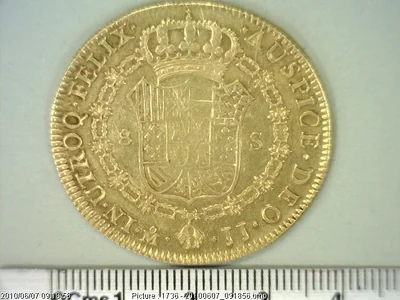
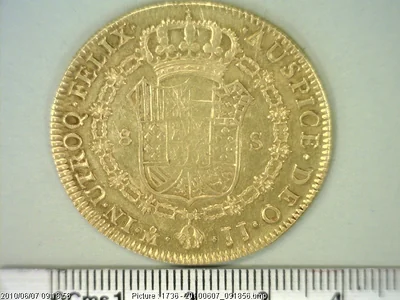
The "8 Escudos" was the largest gold denomination of Spain's colonial coinage, often called a "doubloon" in English. This one shows Fernando VII, the Spanish king who took the throne in 1808, and it was struck in 1809 at the Casa de Moneda de México (the Mexico City mint), then the most important mint in the Spanish Empire.
The technical facts, which matter for both value and authentication:
- Metal: Gold, 0.875 fine (21 karat)
- Weight: 27.01 grams total, about 23.6 grams of pure gold
- Diameter: 37 mm
- Edge: Diagonally reeded
- Mint: Mexico City
- Assayer mark: HJ
- Year: 1809 (single year for this specific type)
That gold weight is the reason this coin is never worth "just a few dollars." It has a bullion floor that moves with the gold market.
What It Is Worth
Value breaks into two layers: the metal and the collector premium.
The metal floor. With about 23.6 grams (0.759 troy ounces) of pure gold, the melt value alone runs into the low thousands of dollars at typical gold prices. No genuine example trades below that. This is your safety net.
The collector premium. Above melt, price is driven by grade (condition), eye appeal, and demand for early Fernando VII colonial gold. A worn, cleaned, or damaged example may sell close to melt. A sharp, original piece with strong detail commands a clear premium over gold value.
| Coin | Year | Approx. value (USD) | Notes |
|---|---|---|---|
| 8 Escudos Fernando VII | 1809 | ~2,000+ (melt floor) | Worn or damaged, sold for gold |
| 8 Escudos Fernando VII | 1809 | ~2,500 to 4,000 | Circulated but problem-free, ungraded |
| 8 Escudos Fernando VII | 1809 | 4,000 to 8,000+ | Certified NGC or PCGS, higher grades |
These are working ranges for the type, not a fixed quote. Spanish colonial 8 Escudos have crossed international auction houses like Heritage and Stack's Bowers regularly, and premium examples of Mexico City gold in this era have sold in the four to five figure range depending on grade and rarity. Get your exact date and assayer combination graded before assuming a top figure.
The Myth to Kill: "Old Spanish Gold = A Fortune"
People hear "1809" and "doubloon" and picture pirate-treasure money worth six figures. That is not this coin. The 8 Escudos was a common trade coin struck in large numbers across Spanish America. It is valuable because it is gold, not because it is rare in the way a unique pattern coin is rare.
The official mintage for this specific 1809 issue is not cleanly documented, which is normal for colonial coinage. Do not let a seller quote you a "super rare, only X made" figure to justify a wild price. For most examples, gold weight plus condition tells the whole story.
How to Tell If Yours Is Genuine
Gold fakes, mostly from overseas, are common with high-value coins like this. The good news is that gold is hard to fake convincingly, and the specs give it away.
- Weigh it. A genuine coin weighs 27.01 grams. Fakes are almost always underweight or made of lower-purity metal to save on gold. If the weight is off by more than a fraction of a gram, be suspicious.
- Measure it. It should be 37 mm across.
- Check the edge. The edge should show diagonal reeding, not a smooth or seam-showing edge (a cast fake often shows a seam).
- Look for the details. The assayer mark (HJ), mint mark, and portrait should be crisp on an original strike.
If you are planning to buy or sell above a few thousand dollars, do not rely on your own eye. Send it to NGC or PCGS for certification, the two grading services collectors trust. A certified slab is the single best protection against both fakes and lowball offers.
Where to Sell It
Because this is a precious-metal coin, you always have a buyer, but you want to avoid selling gold at melt when your piece is worth a premium.
- Certified first, then sell. A graded coin sells faster and higher. The cost of grading is small next to a four-figure coin.
- Reputable dealers. Use a verified dealer from the Pesoteca directory who values the piece on the spot and can appraise it properly.
- Collector-to-collector. The Pesoteca buy-and-sell forum puts you in front of people who know what this coin is and pay accordingly.
- International auction. For a high-grade example, houses that handle world gold reach the widest pool of serious bidders.
Whatever route you pick, photograph the obverse, reverse, and edge, and confirm the weight. Never sell precious-metal coins to a buyer who will not let you verify the piece in hand first.
This coin is part of the Colonial Escudos gold series and the broader Colonial / Viceroyalty era. You can also browse other Mexican 8 Escudos and other coins from 1809.
Have an 1809 8 Escudos and want a second opinion on the grade before you sell? Post clear photos of both sides and the edge in the Pesoteca forum and let collectors weigh in.
Historical context
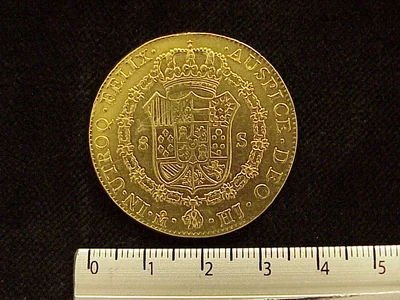
Eight escudos Fernando VII, 1809, Mexico mint, assayer HJ, Krause KM#160. A full year under the Spanish War of Independence against the Napoleonic occupation. In Mexico the ruler was Francisco Javier de Lizana y Beaumont, archbishop and viceroy from July 1809, succeeding Garibay. His administration sought to calm creole tempers but was read as weak by the peninsular elite. Change of signature: HJ replaces the previous year's TH, a sign of rotation in the capital's workshop. The imaginary bust of Fernando VII (KM#160) was still in use because the king was imprisoned in France and no updated royal portrait was available. The ounce weighs 27.06 grams at 0.875 fineness. Produced by mill with a round planchet. In New Spain the first conspiracies that would lead to the Grito de Dolores a year later were beginning. The piece is a numismatic testament to the last stable year of the viceregal order.
This piece belongs to the era
Colonial / Virreinato →Explore all the Mexican coins of this era, their historical context and how they connect to the monetary system of the period.
Value range of this piece
Market estimate: $51,365 - $86,510 MXN depending on the grade of preservation (typical range between a circulated and an uncirculated piece).
See the full breakdown by grade (VG, F, VF, EF, AU, MS-60, MS-63, MS-65) for the whole series →
Same denomination, other years
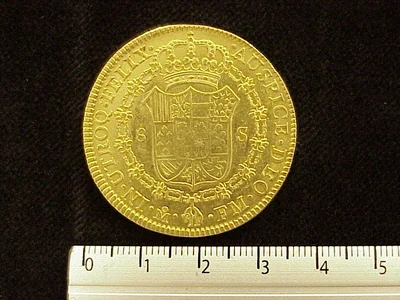
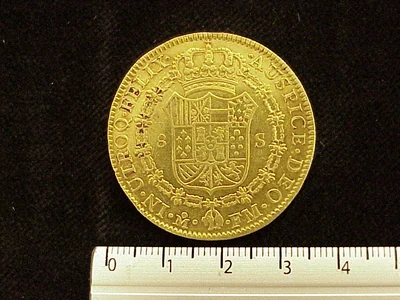
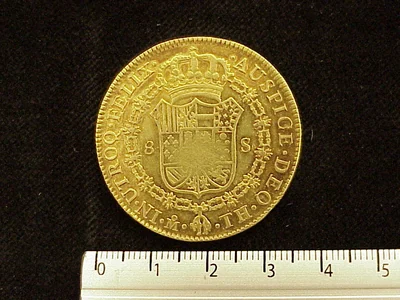
8 escudos Oro 0.875 (21k) · Escudos Coloniales (oro)
Frequently asked questions
How much is an 1809 8 Escudos Fernando VII worth?
It has a gold floor of roughly 2,000 USD or more at current prices, since it contains about 23.6 grams of pure gold. Circulated, problem-free examples typically run 2,500 to 4,000 USD, and certified higher-grade pieces can reach 4,000 to 8,000 USD or more. Condition and certification drive the premium above melt.
Is the 1809 8 Escudos rare?
Not truly rare. The 8 Escudos was a widely struck trade coin across Spanish America, and the exact 1809 mintage is not cleanly documented. Its value comes from its gold content and condition, not from extreme scarcity. Be skeptical of any seller quoting a wild price based on rarity claims.
How can I tell if my 1809 8 Escudos is genuine?
Weigh it: a real one is 27.01 grams and 37 mm across. Underweight or undersized pieces are almost always fakes, since counterfeits use less or lower-purity gold. Check for diagonal reeding on the edge and a crisp assayer mark (HJ). For a coin worth this much, send it to NGC or PCGS for certification before buying or selling.
Where can I sell an 1809 8 Escudos?
Use a verified dealer from the Pesoteca directory who can appraise it on the spot, or the Pesoteca buy-and-sell forum to reach collectors. For a high-grade coin, an international auction house that handles world gold gets the best price. Grade it first, photograph both sides and the edge, and never sell to a buyer who won't let you verify the piece in hand.
Conversation
0 comments
Sources
Images for informational and educational purposes, attributed to their original source. Reference values; the real price depends on the grade, the specific variant and demand.
Loading comments…