
1827 Mexico 8 Escudos Gold Coin: Value & How to Sell
The 1827 Mexico 8 Escudos Gold Coin: Value & How to Sell is worth between $52,872 and $75,134 MXN depending on its grade of preservation.
Prices updated: August 2026
The 1827 Mexico 8 Escudos Gold Coin: Value & How to Sell is worth between $52,872 and $75,134 MXN depending on its grade of preservation.
Prices updated: August 2026
How much is the 1827 Mexico 8 Escudos Gold Coin: Value & How to Sell worth?
The estimated value of the 1827 Mexico 8 Escudos Gold Coin: Value & How to Sell ranges from $52,872 (circulated, XF) up to $75,134 (official blister pack), with $67,039 as a reference for an uncirculated (UNC) piece. The estimate is based on the official mintage and the historical behavior of the family.
The real price depends on four factors: the grade of preservation (a circulated piece is worth the low end of the range; an uncirculated one, or one still in its official blister pack, the high end), the finish (satin vs mirror/proof), the rarity within the series based on the mintage, and the metal spot price on the day of the deal when the piece is silver or gold. Check the value-by-grade table above and compare with equivalent pieces before buying or selling.
Where to buy or sell this coin?
Browse the national directory of numismatic shops or the community forum to trade directly with other collectors.
Description
If you inherited or found an 1827 Mexican 8 Escudos gold coin, the short answer is yes, it is worth real money. This is a large gold coin (nearly a full ounce of gold), so it has a hard floor of well over 1,500 USD just in metal, and a well-preserved example can bring several thousand dollars to collectors. Here is what drives the price and how to check yours.
What this coin actually is
The 8 Escudos was the largest gold denomination struck in Mexico. This one dates to 1827, from the early years of the República Federal Mexicana (Mexican Federal Republic), the period right after independence from Spain. It belongs to the 8 Escudos Octaval series.
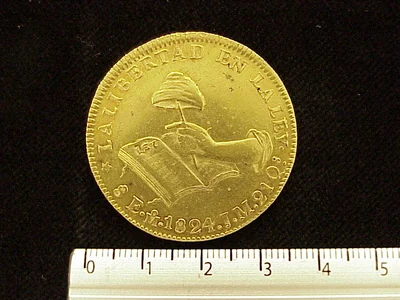
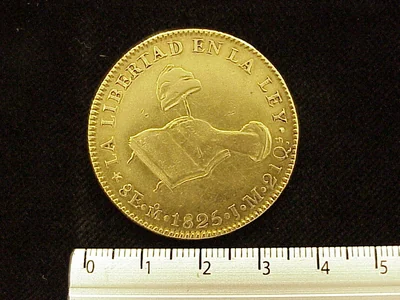
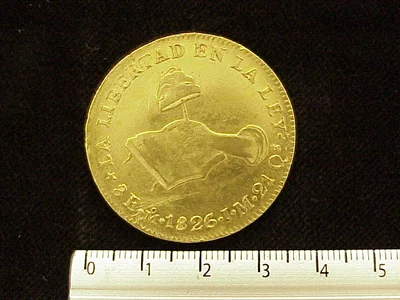
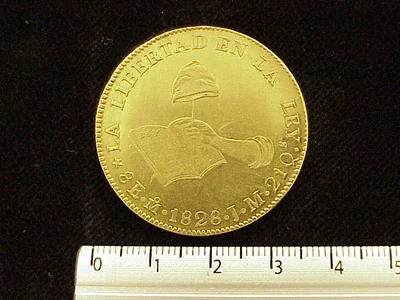
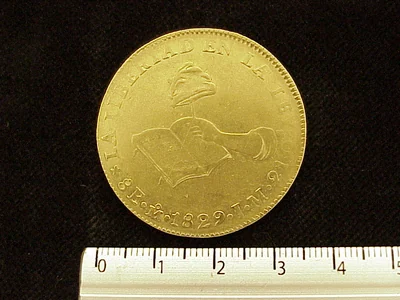
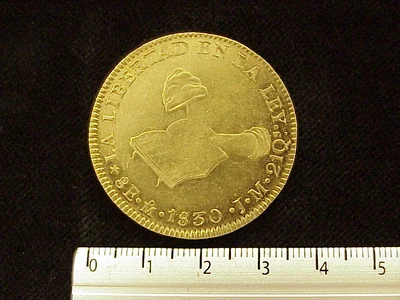
Collectors sometimes call this design the "hand-on-book" or cap-and-rays type. The obverse shows an eagle; the reverse carries the radiant liberty cap. Because it was hand-struck at colonial-era standards, small differences in mint, assayer initials, and die style matter a lot for value and authenticity.
Specifications (verify yours against these)
| Spec | Value |
|---|---|
| Denomination | 8 Escudos |
| Year | 1827 |
| Weight | 27.03 grams |
| Diameter | 36.4 mm |
| Metal | Gold, .900 fine (90% gold) |
| Edge | Diagonally reeded |
| Era | República Federal Mexicana |
The .900 fineness means the coin contains about 24.3 grams of pure gold, roughly 0.782 troy ounces. That gold content is your price floor. Even a worn, damaged coin is worth its melt value, which at typical gold prices runs well over 1,500 USD.
What it is worth
Value for this coin comes from two things stacked together: the gold inside it, and the collector premium for a scarce early-republic issue.
- Circulated / worn: trades close to gold melt value, generally 1,600 to 2,200 USD depending on the gold spot price the day you sell.
- Better circulated to lightly worn: a clear collector premium appears above melt, often 2,500 to 4,000 USD for an honest, problem-free coin.
- High grade / mint state: the strongest examples of early 8 Escudos types have sold for well into five figures at major auctions, especially for scarce mint-and-assayer combinations.
Early Mexican 8 Escudos gold has performed strongly at Heritage Auctions and Stack's Bowers, where choice examples of the 1820s cap-and-rays type regularly clear 3,000 to 10,000 USD, and top-grade rarities go higher. The exact figure for a 1827 depends heavily on which mint struck it (the mint mark) and the coin's grade.
Because the price swings so much by grade and mint, do not accept a single flat number from anyone. Compare against recent sales for your specific mint mark and condition. Our coin grading guide walks you through assessing wear.
The myth: "it's from the 1800s, so it's worth a fortune"
Age alone does not make a coin valuable. What makes this piece worth money is a real combination: high gold content, a limited early-republic mintage, and steady collector demand. A common-mint 1827 in worn condition is essentially a gold bar with history, valued near melt. A rare-mint 1827 in mint state is a genuine trophy coin. Same year, very different price, and the mint mark and grade tell you which one you have.
How to tell if yours is genuine
High-value gold coins are heavily counterfeited, so verify before you celebrate or sell.
- Weigh it. Use a jewelry scale. It must be very close to 27.03 grams. A light coin is a red flag.
- Measure it. Diameter should be 36.4 mm on a caliper.
- Check the edge. It should show diagonal reeding, not a plain or seam-lined edge.
- Read the mint mark and assayer initials. These small letters place the coin at a specific mint and assayer. Fakes often get the style, spacing, or letter forms wrong.
- Beware bargains. Any offer well below the coin's gold value is a warning sign, not a deal.
For a coin at this value level, professional authentication by NGC or PCGS is worth it. A graded, encapsulated coin sells faster and for more, because the buyer trusts it.
Where to sell it
Sell where you can verify the buyer and the coin changes hands in person or through an escrowed process.
- A verified numismatic dealer from the Pesoteca shop directory can appraise and buy it on the spot, by city, without a middleman markup.
- The Pesoteca buy-and-sell forum connects you directly with collectors, who often pay more than a quick-flip dealer.
Before you list it, photograph the obverse, reverse, and edge in good light, and note the weight and mint mark. Never dump a gold coin at the first Facebook offer. And because it is precious metal, only complete a deal where you can confirm weight and authenticity before money moves.
Not sure which mint struck your 1827, or whether that mark under the eagle is rare? Post clear photos in the Pesoteca forum and let collectors who handle these coins weigh in.
Historical context
Eight escudos octaval República Mexicana, 1827, Mexico mint. The year the first royalist conspiracy to restore Spanish power in Mexico was discovered, led by the Capuchin friar Joaquin Arenas. It was suppressed and led to the first laws expelling peninsular Spaniards in 1827 and 1829, a definitive rupture with the resident Iberian community. Guadalupe Victoria continued as president in his third year in office. The ounce weighs 27.06 grams with fineness 0.875. Krause maintains KM#383.9 for the Mexico mint. Produced by mill with a round planchet. The obverse shows the republican eagle atop a nopal with a serpent and the reverse the arm with sword and book over a Phrygian cap, French liberal iconography adapted to the first Mexican republican context. The assayer's signature appears in the field. Pieces from 1827 carry symbolic weight: they are republican coinage struck as the political bond with peninsular Spain was being definitively closed through the expulsion laws. The eagle atop the nopal would be among the first republican depictions of the Mexica founding myth on a monetary medium.
This piece belongs to the era
República Federal Mexicana →Explore all the Mexican coins of this era, their historical context and how they connect to the monetary system of the period.
Value range of this piece
Market estimate: $52,872 - $75,134 MXN depending on the grade of preservation (typical range between a circulated and an uncirculated piece).
See the full breakdown by grade (VG, F, VF, EF, AU, MS-60, MS-63, MS-65) for the whole series →
Same denomination, other years
8 escudos Oro 0.900 · 8 Escudos Octaval
Frequently asked questions
How much is an 1827 Mexican 8 Escudos gold coin worth?
It contains about 0.78 troy ounces of gold, so its floor is the melt value, generally over 1,600 USD at current gold prices even when worn. Problem-free collector examples bring roughly 2,500 to 4,000 USD, and high-grade or scarce-mint pieces have sold for well into five figures at Heritage and Stack's Bowers. Grade and mint mark decide the exact figure.
Is the 1827 8 Escudos rare?
It depends on the mint mark. This early-republic gold type had limited mintages, and certain mint-and-assayer combinations from 1827 are genuinely scarce and command strong premiums. Others are more available and trade closer to gold value. Identify the mint mark under the design before assuming it is rare.
How do I tell if my 1827 8 Escudos is genuine?
Weigh it (should be about 27.03 grams) and measure it (36.4 mm) with a jewelry scale and caliper, then confirm the diagonally reeded edge. Check the mint mark and assayer initials against known examples, since fakes often get the lettering wrong. For a coin this valuable, professional authentication by NGC or PCGS is strongly recommended.
Where can I sell an 1827 8 Escudos gold coin?
Use a verified dealer from the [Pesoteca shop directory](/tiendas) for an on-the-spot appraisal, or the [Pesoteca buy-and-sell forum](/foro/compra-venta) to reach collectors directly, who often pay more. Photograph the obverse, reverse, and edge, note the weight and mint mark, and only complete a deal where authenticity and weight are verified first.
Conversation
0 comments
Sources
Images for informational and educational purposes, attributed to their original source. Reference values; the real price depends on the grade, the specific variant and demand.
Loading comments…