
1810 Mexican 8 Reales with Counterstamps: Value Guide
The 1810 Mexican 8 Reales with Counterstamps: Value Guide is worth between $681 and $2,867 MXN depending on its grade of preservation.
Prices updated: August 2026
Independence · Mexico City Mint · Assayer HJ
Independence · Mexico City Mint · Assayer HJ
The 1810 Mexican 8 Reales with Counterstamps: Value Guide is worth between $681 and $2,867 MXN depending on its grade of preservation.
Prices updated: August 2026
How much is the 1810 Mexican 8 Reales with Counterstamps: Value Guide worth?
The estimated value of the 1810 Mexican 8 Reales with Counterstamps: Value Guide ranges from $681 (circulated, XF) up to $2,867 (official blister pack), with $2,072 as a reference for an uncirculated (UNC) piece. The estimate is based on the official mintage and the historical behavior of the family.
The real price depends on four factors: the grade of preservation (a circulated piece is worth the low end of the range; an uncirculated one, or one still in its official blister pack, the high end), the finish (satin vs mirror/proof), the rarity within the series based on the mintage, and the metal spot price on the day of the deal when the piece is silver or gold. Check the value-by-grade table above and compare with equivalent pieces before buying or selling.
Where to buy or sell this coin?
Browse the national directory of numismatic shops or the community forum to trade directly with other collectors.
Description
If you inherited a large silver Mexican coin dated 1810 with strange stamps punched into it, here is the honest answer: most circulated examples trade from roughly 80 to 400 USD, and the extra stamps (counterstamps) can either add value or mean nothing, depending on which government or authority applied them. This is a colonial silver dollar from Spanish Mexico, and a few are worth serious money. Most are not.
In 2026, a plain worn 1810 Mexico City 8 Reales sits near its silver value plus a modest collector premium. The pieces that jump to four figures are the ones with a documented, identifiable counterstamp and strong grade.
What you actually have
The 8 Reales was the Spanish colonial silver dollar, the coin that circulated worldwide and became the basis for the US dollar. This particular type was struck in 1810 in Mexico City (then New Spain), the year the Mexican War of Independence began.
Specifications that matter for authentication:
- Metal: silver, .900 fine (90% pure)
- Weight: 24.74 grams
- Diameter: 40 mm
- Edge: reeded (grooved)
- Mint: Mexico City
- Assayer mark: HJ
A counterstamp (also called a countermark, or resello in Spanish) is a small stamp punched into the coin after it left the mint. Governments across Asia, the Caribbean, and Latin America did this to authorize a foreign silver coin to circulate in their own territory, or to revalidate it during political change. On an 1810 8 Reales, the counterstamp is usually the story that decides the price.
Why the counterstamp changes everything
A counterstamped 1810 8 Reales is really two coins in one: the base silver dollar plus a stamp from wherever it later circulated. Some of those stamps are common and add a few dollars. Others are rare and command a strong premium from specialist collectors who chase a specific issuing country.
1. The base coin (no meaningful counterstamp, worn)
A circulated 1810 Mexico City 8 Reales with heavy wear and only bag marks trades on its silver content plus a small history premium: roughly 80 to 250 USD depending on how much detail survives.
2. Mid-grade with clear detail
An example with sharp detail, good eye appeal, and no problems (holes, cleaning, corrosion) can bring 300 to 800 USD.
3. A rare, identifiable counterstamp
When the stamp ties the coin to a scarce issuing authority, and specialists want it, prices climb to 1,000 USD and up. Documented counterstamped Spanish colonial dollars have sold in the low thousands at major auction houses. The exact figure depends entirely on which country applied the mark and how few survive.
| Version | Condition | Typical value (USD) |
|---|---|---|
| 1810 8R, worn, no notable stamp | Circulated | 80 to 250 |
| 1810 8R, sharp, problem-free | VF to XF | 300 to 800 |
| 1810 8R, rare identifiable counterstamp | Any, verified | 1,000 and up |
| Cleaned, holed, or corroded | Any | Silver value only, near 20 to 25 USD |
Silver value: the floor under this coin
At 24.74 grams of .900 silver, this coin contains about 0.716 troy ounces of pure silver. That means even a badly damaged example has a hard floor equal to its melt value, which follows the silver spot price. This is the number you fall back on if the coin is cleaned, holed, or otherwise ruined for collectors. It will never be worth less than its silver.
The myths to ignore
"It's from 1810, the year of independence, so it's worth a fortune." Age and a famous date do not equal value. Millions of 8 Reales were struck. Rarity, grade, and the specific counterstamp drive price, not the year on the coin.
"Every stamp on it makes it more valuable." Some marks are damage, not counterstamps. A random scratch, a jeweler's test mark, or corrosion is not a countermark and can lower value. Only a genuine, identifiable official counterstamp adds a premium.
"Shiny means better." A coin someone polished to look bright is usually worth less. Cleaning strips original surfaces and knocks a coin down to silver value. Never clean a coin before selling it.
How to tell if yours is genuine
Colonial silver dollars are among the most faked coins in the world, so check before you celebrate.
- Weigh it. Genuine pieces are 24.74 grams. A digital scale under it: if it's well off, be suspicious.
- Measure it. Should be 40 mm across.
- Check the edge. It should be reeded (grooved), not smooth or seamed. A visible casting seam is a red flag.
- Ping test. Real .900 silver rings with a high, sustained tone when gently balanced and tapped. A dull, short clunk suggests a fake or a base-metal core.
- For anything you think is worth over 500 USD, get it certified. Send it to NGC or PCGS (the two major US grading services). They authenticate, grade, and seal the coin, which is the only way to sell a valuable counterstamped piece with full confidence.
If the counterstamp is the reason you think it's valuable, professional grading matters even more, because attribution of which country issued the mark is exactly what specialists pay for.
Where to sell it in the US
- Auction houses (Heritage Auctions, Stack's Bowers): best for a genuine rare counterstamp or a high-grade certified coin. They reach the specialist buyers who pay top dollar.
- Certified coin dealers who handle world and colonial coins: faster, offers a bit under retail, but reliable.
- Get the coin certified first if you believe it's over 500 USD. A raw (uncertified) coin sells for a fraction of what the same coin brings in an NGC or PCGS holder.
- Avoid pawn shops and general "we buy gold" storefronts. They'll pay silver value at best and ignore the collector premium entirely.
Photograph the front (obverse), back (reverse), and the edge in good light before you talk to anyone. Clear photos of the counterstamp are what a specialist needs to give you a real quote.
Got a large silver coin with a stamp you can't identify? Post clear photos of both sides and the counterstamp in the Pesoteca forum and let collectors who chase these pieces tell you what you're holding.
Historical context
This piece belongs to the category of counterstamps and countermarks applied over already-struck pieces of eight, a practice used by both insurgents and royalists during the War of Independence.
The government of New Spain in 1810 was in the hands of Francisco Javier Venegas, who faced the start of Hidalgo's insurgency on September 16.
The piece belongs to the category of counterstamps and countermarks, punches applied over already-struck pieces of eight to officially revalidate them, move them to another jurisdiction, or mark them with an insurgent or royalist symbol. Each counterstamp carries a political reading: Morelos's crowned M, the seal of Zongolica, the M.V.A., and other families documented in colonial catalogs.
The declared minting origin is: counterstamp over a previously struck piece of eight. The initials HJ that accompany the counterstamp identify the official or commander who authorized the re-marking of the earlier piece.
The Krause catalog references this piece under KM#202.3, useful for cross-checking the entry against international auction listings.
Year of the Grito de Dolores on September 16, the formal start of the Mexican War of Independence.
This piece belongs to the era
Colonial / Virreinato →Explore all the Mexican coins of this era, their historical context and how they connect to the monetary system of the period.
Value range of this piece
Market estimate: $681 - $2,867 MXN depending on the grade of preservation (typical range between a circulated and an uncirculated piece).
See the full breakdown by grade (VG, F, VF, EF, AU, MS-60, MS-63, MS-65) for the whole series →
Other denominations from 1810
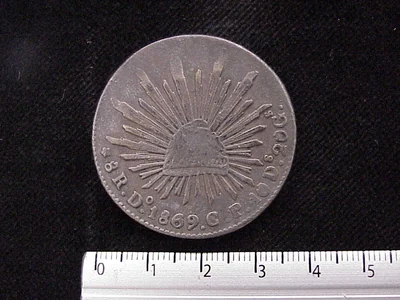
8 Reales Coloniales · Plata 0.900
Same denomination, other years
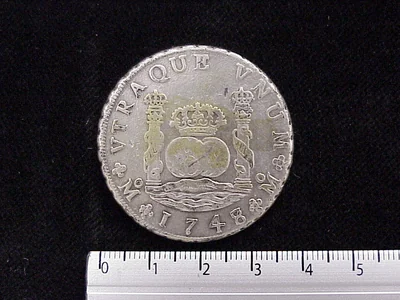
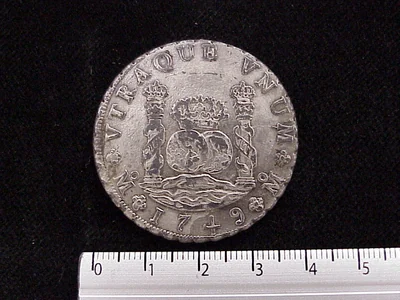
8 reales Plata 0.900 · 8 Reales Coloniales
Frequently asked questions
How much is an 1810 Mexican 8 Reales with counterstamps worth?
It depends heavily on grade and the counterstamp. A worn, circulated example trades around 80 to 250 USD, close to its silver value plus a small premium. Sharp problem-free coins bring 300 to 800 USD, and pieces with a rare, identifiable counterstamp can reach 1,000 USD and up. A cleaned or holed coin drops to silver value, near 20 to 25 USD. For a firm figure on your exact coin, get it certified by NGC or PCGS.
Is the 1810 8 Reales rare?
The base coin is not rare. Millions of 8 Reales circulated as the world's silver dollar. What can be rare is the counterstamp: if the stamp ties your coin to a scarce issuing country, specialist collectors will pay a strong premium. The mark, not the 1810 date, is what determines scarcity and value here.
How do I tell if my 1810 8 Reales is genuine?
It should weigh 24.74 grams and measure 40 mm, with a reeded (grooved) edge, not a smooth edge or casting seam. Real .900 silver rings with a clear, sustained tone when gently tapped, while fakes sound dull and short. Colonial dollars are heavily counterfeited, so for anything you believe is worth over 500 USD, send it to NGC or PCGS for authentication and grading.
Where can I sell an 1810 8 Reales in the US?
For a rare counterstamp or a high-grade coin, use a major auction house like Heritage Auctions or Stack's Bowers, which reach specialist buyers. Certified world-coin dealers are a faster option. Get the coin graded by NGC or PCGS first if it may be worth over 500 USD, since a certified coin sells for far more than a raw one. Avoid pawn shops, which pay silver value only.
Conversation
0 comments
Sources
Images for informational and educational purposes, attributed to their original source. Reference values; the real price depends on the grade, the specific variant and demand.
Loading comments…