
8 Reales Resplandor Culiacán 1882: Value & Real Prices
The 8 Reales Resplandor Culiacán 1882: Value & Real Prices is worth between $745 and $1,961 MXN depending on its grade of preservation.
Prices updated: August 2026
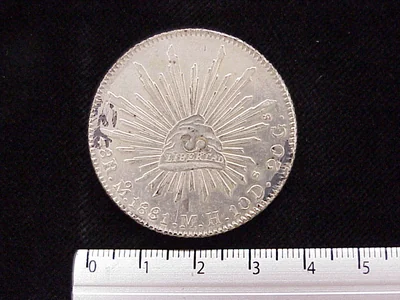
Strong silver peso .9028, Culiacán Mint, struck in 1882.
Strong silver peso .9028, Culiacán Mint, struck in 1882.
Design
Banxico
Reverse
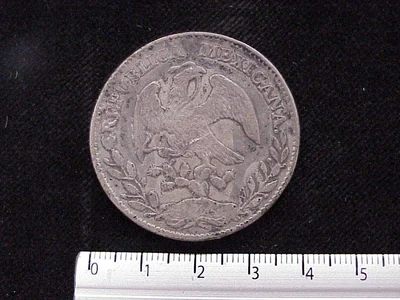
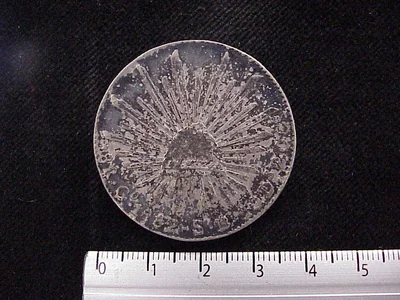
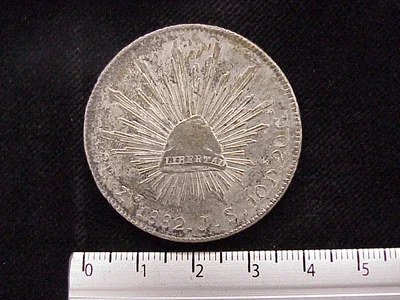
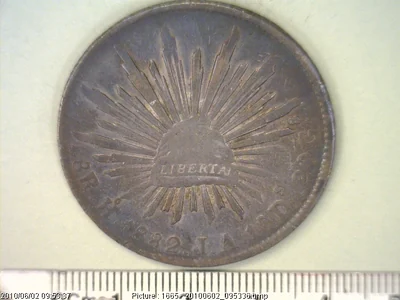
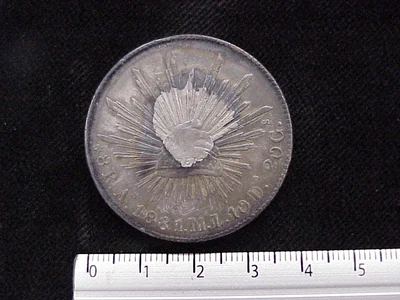
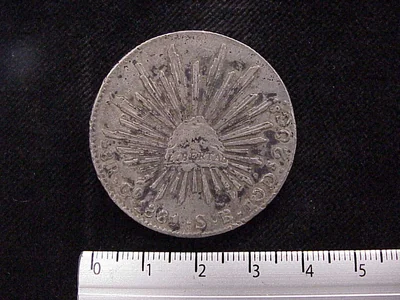
Reverse: Phrygian cap (of liberty) radiating rays, the design called "resplandor". Around it, the legend LIBERTAD on the cap's band and the inscription with value, mint, year, assayer and fineness: 8R, Cn, 1882, assayer's initials, 10 Ds. 20 Gs. (The republican eagle with REPÚBLICA MEXICANA appears on the OBVERSE, not the reverse; the database had them reversed.)
Obverse
Obverse with a Phrygian cap over solar rays (resplandor) and the legend "LIBERTAD". Struck in .9028 silver according to the republican octal standard in force until the monetary reform of 1905.
The 8 Reales Resplandor Culiacán 1882: Value & Real Prices is worth between $745 and $1,961 MXN depending on its grade of preservation.
Prices updated: August 2026
How much is the 8 Reales Resplandor Culiacán 1882: Value & Real Prices worth?
The estimated value of the 8 Reales Resplandor Culiacán 1882: Value & Real Prices ranges from $745 (circulated, XF) up to $1,961 (official blister pack), with $1,519 as a reference for an uncirculated (UNC) piece. The estimate is based on the official mintage and the historical behavior of the family.
The real price depends on four factors: the grade of preservation (a circulated piece is worth the low end of the range; an uncirculated one, or one still in its official blister pack, the high end), the finish (satin vs mirror/proof), the rarity within the series based on the mintage, and the metal spot price on the day of the deal when the piece is silver or gold. Check the value-by-grade table above and compare with equivalent pieces before buying or selling.
Where to buy or sell this coin?
Browse the national directory of numismatic shops or the community forum to trade directly with other collectors.
Price today
How much is the gold in a Centenario worth?
The Centenario is Mexico's main gold investment piece. Its price follows the gold spot in USD adjusted for MXN.
Description
If you inherited an old Mexican silver dollar-sized coin marked "8R" with a strange radiant cap on the back, you have a real silver coin worth money. The 1882 Culiacán 8 Reales isn't a million-dollar rarity, but it holds about 0.79 troy ounces of silver and trades from around 100 to 150 USD circulated, with certified AU examples reaching close to 390 USD. Grade decides everything.
What this coin is
The 8 Reales "Resplandor" is the large silver piece Mexico minted throughout the 1800s, the direct descendant of the Spanish colonial "piece of eight" that circulated as a global trade currency. "Resplandor" (Spanish for radiance or sunburst) is the nickname for the reverse design: a Phrygian cap, the cap of liberty, with rays shooting out in all directions like a sun. That burst of rays gives the whole series its name.
This particular one was struck at the Culiacán Mint in Sinaloa, in northwest Mexico. In the catalogs it carries the reference KM#377.3 from the standard Krause guide. Specs:
- Weight: 27.07 grams
- Diameter: 39 mm
- Edge: reeded
- Fineness: 0.903 silver (written on the coin the old colonial way as "10 Ds. 20 Gs.", meaning 10 Dineros 20 Granos, or 90.3 percent silver)
- Mint mark: Cn (Culiacán), sometimes listed as Ce in older catalogs
How much is it worth in 2026?
This coin has two floors of value, and you need to understand both.
The silver floor. At 27.07 grams of 0.903 silver, the coin contains about 24.4 grams of pure silver, roughly 0.79 troy ounces. That metal has real melt value that moves with the silver spot price. No matter how worn the coin is, it should never sell below its melt value when silver is at a normal price.
The collector premium. On top of the silver, condition adds a premium. Here is what the market actually shows:
| Coin | Year | Condition | Typical price (USD) | Where |
|---|---|---|---|---|
| 8 Reales Culiacán (Cn) | 1882 | Circulated | 100 to 150 | eBay comparables |
| 8 Reales Culiacán (Cn) | 1882 | Certified AU | near 390 | eBay comparables |
| 8 Reales Culiacán (Cn) | 1882 | Melt value only | ~40 to 45 | based on silver spot |
Grade is the whole game. A worn, cleaned, or scratched example sits near the low end. A sharp, original coin with crisp rays and eagle detail, especially one graded by NGC or PCGS, pulls the strong premium.
Is Culiacán a rare mint?
Culiacán is less common than the big Mexican mints. México City (Mo) and Zacatecas (Zs) produced enormous quantities of 8 Reales, so those are the ones most people find. Culiacán ran as a provincial mint from the mid-1800s until 1897, at smaller volume. A Culiacán coin from a given year usually asks a premium over an equivalent México City piece of the same date. That said, it is not among the scarcest mints of the period, so temper expectations: this is a solid, collectible silver coin, not a headline rarity.
How to read the marks on your coin
- Cn next to the denomination is the Culiacán mint mark.
- The letters beside the mint mark are the initials of the assayer on duty when the coin was struck. These change over time and matter to specialists.
- 8R is the denomination: 8 Reales.
- The date should read 1882.
How to tell if yours is genuine
Counterfeits of 8 Reales exist, so check the basics before you pay or sell:
- Weight and size. It should weigh close to 27.07 grams and measure 39 mm with a reeded edge. A coin that is noticeably light or the wrong diameter is a red flag.
- The magnet test. Silver is not magnetic. If it sticks to a magnet, it is not silver.
- Strike quality. The rays of the sunburst and the eagle detail should be sharp and struck, not soft or blurry the way a cast fake looks.
- When in doubt, get eyes on it. Have an experienced dealer or a certified numismatist examine it before money changes hands. Certification by NGC or PCGS both confirms authenticity and locks in the grade that drives the price.
Where to sell it
Work with established coin dealers and numismatic shops rather than a random buyer, and compare offers before you accept one. Any legitimate dealer will pay at least melt value and more for condition. For a strong, original coin, getting it certified first can pay for itself in the higher price it commands.
Think you might have a Culiacán 8 Reales, or a sharper example than the ones described here? Post clear photos of both sides in the Pesoteca forum and let the community help you pin down the grade and a fair price.
Historical context
In 1882 Manuel Gonzalez was in power, a close ally of Porfirio Diaz, during the 1880-1884 term. A period of financial crisis and of the debate over nickel as fractional currency.
The Culiacan Mint (Cn) was established in 1846 to strike silver from the Rosario and Cosala mines. It was one of the last to close (1905), by then under the gold standard of the late Porfiriato.
Cn pieces are in demand due to the numismatic market of the northwest. Late mintages (1896-1897) are scarcer.
In catalog reference, the variant of this mint is listed as KM#377.3 in Krause. The piece is silver of .9028 fineness with a reeded edge and a theoretical weight of 27.07 grams. The 1882 example from Culiacan, Sinaloa corresponds to the middle stage of the mint (1846-1905) and is identified on the coin by the mint mark Cn.
The collector who builds the series by mint usually hunts the Cn examples from the 1880s cycle in lots or peer-to-peer trades, avoiding middleman resale. It is worth confirming that the piece has a weight close to 27 grams (minting tolerance) and a diameter of 39 millimeters. Pieces resurfacing from local hoards appear periodically on the market and are the best window to obtain a high grade without overpaying.
This piece belongs to the era
República Restaurada y Porfiriato →Explore all the Mexican coins of this era, their historical context and how they connect to the monetary system of the period.
Value range of this piece
Market estimate: $745 - $1,961 MXN depending on the grade of preservation (typical range between a circulated and an uncirculated piece).
See the full breakdown by grade (VG, F, VF, EF, AU, MS-60, MS-63, MS-65) for the whole series →
Other denominations from 1882
8 Reales Republicanos (Resplandor) · Plata 0.900
Same denomination, other years
8 reales Plata 0.900 · 8 Reales Republicanos (Resplandor)
Frequently asked questions
How much is an 1882 Culiacán 8 Reales worth?
It has two floors of value. By silver alone, its 27.07 grams of 0.903 fineness give about 24.4 grams of pure silver (0.79 troy ounces), worth roughly 40 to 45 USD in metal at a normal silver price. On top of that comes the collector premium: circulated Culiacán examples run about 100 to 150 USD, and certified AU pieces have reached close to 390 USD. Grade decides the price.
Is the Culiacán mint rare or common?
Culiacán is less common than the large mints like México City (Mo) or Zacatecas (Zs), which produced huge quantities. A Culiacán coin of the same year usually asks a premium over an equivalent México City piece, though it is not among the very scarcest mints of the period.
How can I tell if my 8 Reales is genuine?
It should weigh close to 27.07 grams and measure 39 mm with a reeded edge; a very light coin or an odd diameter is suspicious. Silver does not stick to a magnet. Check that the sunburst rays and eagle detail are sharp and struck rather than soft or cast. When in doubt, have an experienced dealer examine it before you pay or sell.
Where can I sell this coin?
Work with established coin dealers and numismatic shops rather than an unknown buyer, and compare buy and sell offers before deciding. For a strong original coin, getting it certified by NGC or PCGS first can raise the price it commands. You can also post photos in the Pesoteca forum to get a read on grade and fair value first.
Conversation
0 comments
Sources
- Ejemplar de la Coleccion Numismatica Banco de Mexico . inv. 6033
- Ejemplar de la Coleccion Numismatica Banco de Mexico . inv. 6032
- Ejemplar de la Coleccion Numismatica Banco de Mexico . inv. 6031
- Ejemplar de la Coleccion Numismatica Banco de Mexico . inv. 6030
- Ejemplar de la Coleccion Numismatica Banco de Mexico . inv. 6029
Images for informational and educational purposes, attributed to their original source. Reference values; the real price depends on the grade, the specific variant and demand.
Loading comments…