
En resumen
Designing a full family of Mexican banknotes takes about eight years. Series G was authorized in May 2013 and wrapped up in 2021. Here is the process behind the note in your wallet.
The note that took eight years to exist
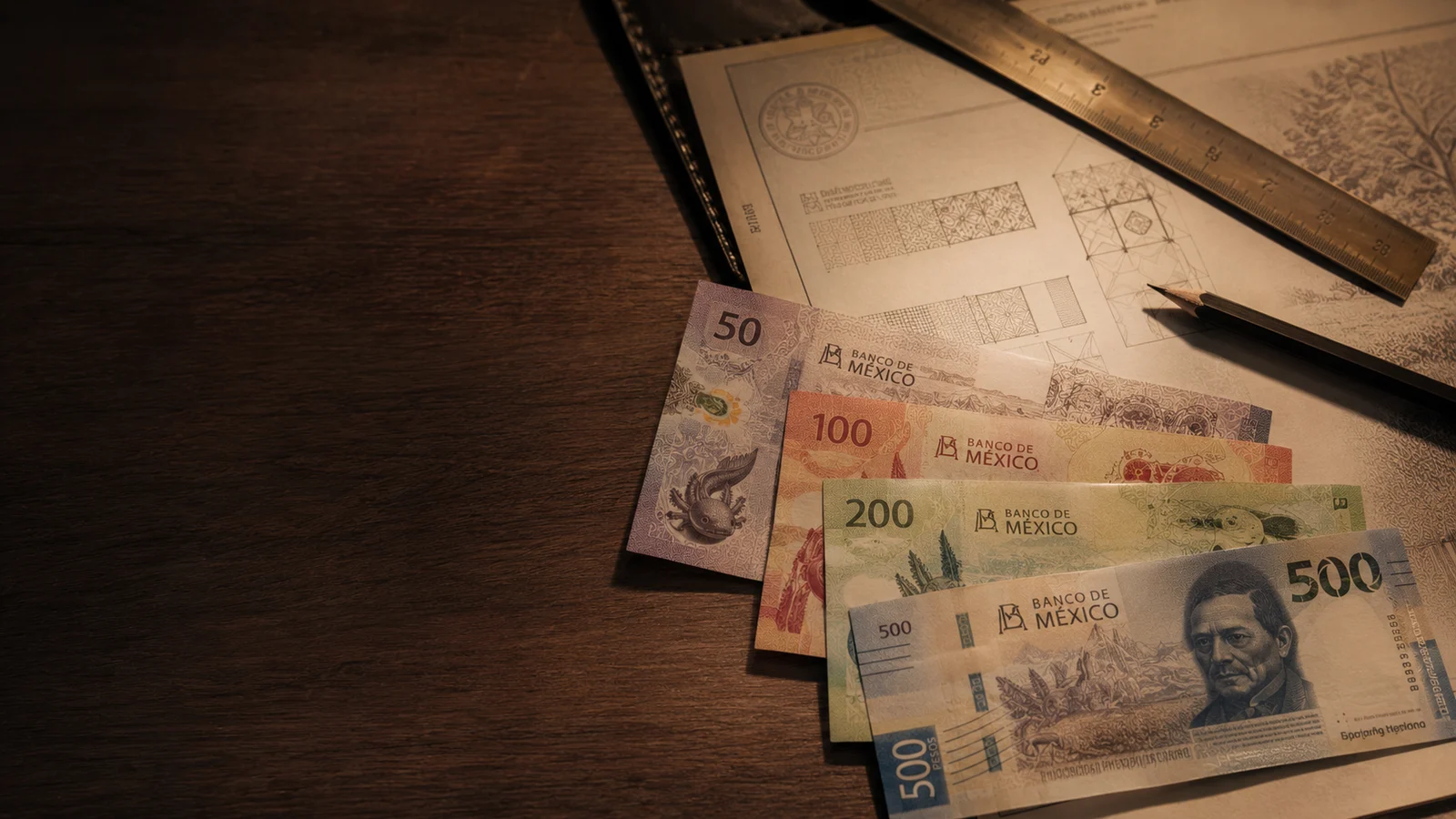
The 500-peso note in your wallet started its design phase before the iPhone 6 ever hit shelves. The Governing Board of the Bank of Mexico (Banco de México, or Banxico, the country's central bank) approved the Series G program in its May 2013 session, and the final denomination, the 50-peso note, was not fully issued until 2021. Eight years of work so that a few rectangles of paper and polymer could change their faces.
That is not exaggeration or bureaucratic delay. According to Banxico's own official documentation, designing and manufacturing a new family of banknotes takes about eight years on average. That is normal. A fast rollout would be the strange thing.
If you inherited or found a stack of modern Mexican notes and want the quick answer: Series G notes are current legal tender and worth their face value in circulation. What collectors chase are printing errors, low serial numbers, and uncirculated grades. The history below explains why these notes exist and which ones stand out.
Why eight years and not eight months
The number sounds absurd until you break it down. Series G ran from 2013 to 2021, and the first sub-project had nothing to do with drawing faces. It was titled, literally, "Research into the general characteristics of banknotes, security features and design guidelines." Before deciding whose portrait would go on a note, Banxico spent an entire phase defining how the substrate should behave, what it had to withstand, and which security features it would carry.
This was not the first time. Since 1969, when the first banknote factory opened, Banxico has issued six families, labeled AA through F. Family F, the series that Series G replaced, began its design in 2003 and was issued from 2006 to 2010. The same near-decade discipline, family after family.
One detail helps show the scale of the project: in 2018 a second banknote factory came online, located in the state of Jalisco. This is not one artist sitting down to sketch. It is national industrial infrastructure working on a long horizon.
What the Governing Board approved in 2013
When the Governing Board gave the green light in May 2013, it did not approve a pretty layout. It approved a program with three concrete objectives, and the order matters.
The first, and the one that drives everything else, was to replace the family then in circulation in order to add security features that make counterfeiting harder. The other two objectives were to increase durability based on the substrate (paper or polymer) and to add graphic elements that represent the country in a broad and diverse way.
Notice the hierarchy. First, make it hard to fake. Second, make it last. Third, make it show Mexico. The aesthetics that collectors love sit last on the official list. On the higher denominations that translated into features like the multicolor denomination numeral and the dynamic thread, elements far harder to copy than they look at a glance.
The release order: 500 first, 50 last
Here is a detail collectors like to track: the issue order was not by ascending or descending denomination. Series G started with the 500-peso note and closed with the 50-peso note.
That schedule explains why, for years, notes from different families lived side by side in the same wallet. While the new 500 was already circulating, other denominations were still Family F. For anyone collecting by year and by family, that long transition is exactly the interesting part: there is a window where both worlds coexist.
Paper for some, polymer for others
Not every Series G note is made of the same material. Two denominations, the 50 and 100 peso notes, were printed on polymer. The rest were printed on cotton paper. That choice was not about preference. It ties directly to the second objective of the program: durability depends on the substrate, and the denominations that circulate most and take the most abuse benefit from polymer, which holds up better under rough handling.
Polymer also showed up outside the regular catalog. The commemorative 20-peso note for the Bicentennial was printed on that material. That 20-peso note also marks the end of an era: the denomination is being retired in favor of a coin. If you want to see the piece that takes over from the 20-peso note, look at the 20-peso Kukulcán 2026 coin.
The ghost of the program: the 2000-peso note
Inside the Series G plan there is a denomination that exists on paper but may never appear in real life. The 2000-peso note is part of the program, but with an explicit condition: it will only be issued if it is deemed necessary to meet the needs of users.
It is a note on pause, authorized in theory and frozen in practice. We covered that oddity in full in the 2000-peso note, the ghost of Series G, because few topics spark as much curiosity among collectors as a denomination that may or may not ever be printed.
What is behind a rectangle
All of this comes from Banxico's public document "New family of banknotes." What stands out most is the patience. Eight years, two factories, and a clear hierarchy of priorities where security outranks beauty. Collectors buy, gather, and hunt these pieces in minutes, and behind each one sits nearly a decade of quiet work.
The next time you pull a Series G note out of your wallet, take a second to look at it differently.
Which Series G note do you like best, for its design or for what it represents? Tell us in the forum.
Loading comments…