
100 Pesos Banknote (Miguel Hidalgo): Value Guide
Familia MOD · algodón
Period: México Contemporáneo
Design
Banxico
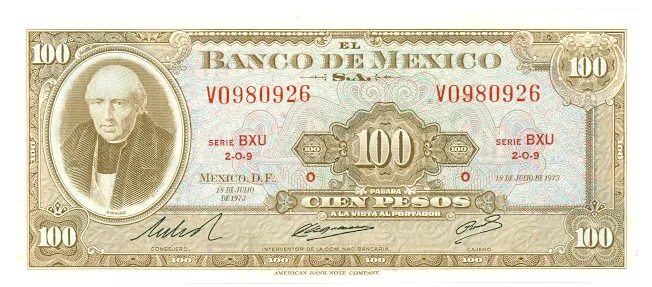
Obverse
Miguel Hidalgo
Portrait of Miguel Hidalgo y Costilla
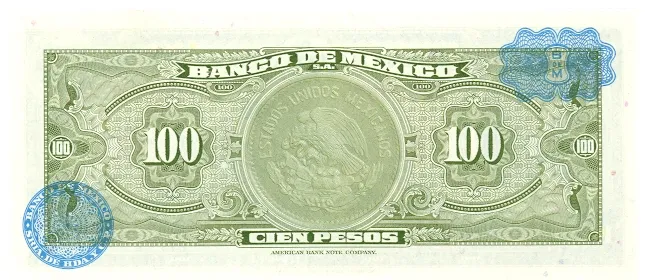
Reverse
The National Coat of Arms
About this banknote
Most Mexican 100 pesos notes featuring Miguel Hidalgo are worth face value if they still circulate, and only a modest premium as collector items. The ones that bring real money are uncirculated examples, notes with low or radar serial numbers, and genuine printing errors. Here is how to tell which kind you have.
What this note is
The Mexican 100 pesos banknote shows Miguel Hidalgo y Costilla on the front, the priest from the town of Dolores who launched Mexico's War of Independence in 1810. Mexicans call him the Father of the Nation (Padre de la Patria). The back carries the National Coat of Arms (Escudo Nacional): the eagle devouring a serpent atop a nopal cactus, the same emblem on the Mexican flag. It is a plain, formal design issued by the Banco de México, the country's central bank.
Mexican peso notes are organized into "families" (design series), each marked with a letter. If you are trying to identify exactly which 100 pesos note you hold, the family letter, the issue date, and the signatures printed on the note are the details that pin it down. Compare them against the official Banco de México reference images.
What it's worth in 2026
Here is the honest breakdown for a US collector or someone who inherited a stack of these.
If the design is still legal tender in Mexico: the note is worth its face value, 100 pesos, roughly 5 to 6 US dollars depending on the exchange rate. A circulated common note is a spending note, not a collectible.
If the design has been withdrawn from circulation: now it is a collector item, and condition drives everything. An uncirculated note (no folds, no stains, crisp corners, original paper snap) is worth several times more than a worn one. A creased, soft, thumbed note from the same series is worth very little above face.
Premium features that raise value:
- Low serial numbers (folios), like 0000012, from the first print runs.
- Radar / palindrome serials (capicúa), which read the same forwards and backwards, such as 1234321.
- Solid or repeated digits in the serial.
- Genuine printing errors: miscuts, ink smears, factory folds, misaligned or off-center serials, missing color.
Any one of these turns an ordinary 100 pesos note into something collectors will chase.
| Note type | Typical condition | Approximate collector value (USD) |
|---|---|---|
| Circulating design, worn | Circulated | Face value (about 5 to 6) |
| Withdrawn design, worn | Circulated | A few dollars above face |
| Withdrawn design, uncirculated | UNC | Several times face, varies by family |
| Low or radar serial number | UNC | A meaningful premium over a plain UNC note |
| Genuine printing error | Any | Several times face, sometimes much more |
Ranges are wide on purpose. The exact figure depends on which family (series) your note belongs to and how many survive in top grade. Ignore the inflated "worth thousands" listings you see on marketplace sites; a common circulated 100 pesos is not a windfall.
The ones people think are worth a fortune but aren't
A plain, folded 100 pesos note that has simply gotten old is not rare. Age alone does not create value in paper money; survival in high grade does. Millions of these were printed. Normal wear, a signature written across the note by a previous owner, tape repairs, and general handling all reduce value, they do not add it. If a note is soft, limp, and creased, treat it as face-value currency unless it carries a special serial or a real error.
How to check what yours is worth
- Grade it honestly. Hold it flat under good light. Any fold, even a light center bend, drops it out of the uncirculated category. Check the corners and edges for softness.
- Read the serial number. Look for low numbers, radar/palindrome patterns, or repeated digits.
- Look for errors. Compare the cut, the alignment, and the ink against a normal example. A genuine factory error is consistent and clearly not post-print damage.
- Confirm the family and date. Match the family letter, issue date, and signatures to official Banco de México images to identify exactly which note you have.
For authenticity, inspect the security features: the watermark held to the light, the security thread, microprinting, raised intaglio texture you can feel with a fingertip, and, on the polymer notes, the clear transparent window. On older paper notes, compare the paper, colors, and signatures to official references. Reproductions usually have smooth paper and flat, lifeless colors.
Where to sell
World paper money (notaphily) is an active English-language collecting market, so a genuinely scarce Mexican note has real buyers. Photograph both sides in good, even light, then get it in front of people who know the series:
- A verified numismatic dealer from the Pesoteca shop directory, who can value it in person without middleman markup.
- The Pesoteca buy-and-sell forum, where collectors trade directly.
Before you accept any offer, confirm the serial, note the exact condition, and share clear photos of front and back. Do not dump it on a general social media marketplace to the first buyer who messages you. If you think your note has a low serial, a radar serial, or a real printing error, post it in the forum and let the community weigh in. To see which Mexican notes get faked most, read the most counterfeited banknotes in Mexico.
Got a 100 pesos Hidalgo note with an odd serial or still sealed in a bank strap? Post the photos in the forum and we'll help you figure out what it really is.
Historical context
This 100-peso note from the Banco de México, S.A. belongs to the issues of the already consolidated central bank, in the period of monetary stability that followed the chaos of the Revolution. It is money from a Mexico where the peso enjoyed confidence and where design served to exalt the nation's history.
The obverse shows the portrait of Miguel Hidalgo y Costilla, the priest of Dolores who in 1810 ignited the struggle for Independence with his famous 'Grito.' Placing him on the 100-peso denomination gave him a place of honor among the higher-value notes of the era. The reverse bears the National Coat of Arms, with the eagle on the nopal devouring the serpent, the quintessential symbol of the Mexican state.
More than an episode of war, this piece tells of the period in which the Banco de México used its paper money to reinforce the country's identity and historical memory. With Hidalgo on the obverse and the national coat of arms on the reverse, it is a note deeply charged with national symbolism, very representative of twentieth-century Mexican design.
Frequently asked questions
How much is the Mexican 100 pesos Hidalgo banknote worth?
If the design still circulates, it is worth face value, about 5 to 6 US dollars. As a collectible, a withdrawn note in uncirculated condition, or one with a low or radar serial number or a genuine printing error, can be worth several times more. Condition and rarity decide the price.
Is the 100 pesos Hidalgo note rare?
In ordinary circulated condition, no. Millions were printed and age alone does not make it valuable. What is scarce is a crisp uncirculated example, a low or palindrome (radar) serial number, or a factory printing error. Those features are what collectors pay premiums for.
Where can I sell my 100 pesos banknote?
The safest options are a verified dealer from the [Pesoteca shop directory](/tiendas), who can value it on the spot, or the [Pesoteca buy-and-sell forum](/foro/compra-venta) between collectors. Photograph both sides in good light and note the serial, condition, and any error before agreeing on a price.
How do I tell if my 100 pesos note is genuine?
Check the security features: the watermark held to the light, the security thread, microprinting, raised intaglio texture you can feel, and, on polymer notes, the clear transparent window. On older paper notes, compare paper, color, and signatures to official Banco de México images. Reproductions tend to have smooth paper and flat colors. If unsure, ask in the [forum](/foro).
Características Banxico
2-O-9
Familia MOD
This banknote belongs to the BIL-MOD family within the Sistema PSM . Explore all the banknotes that share origin, era and design with this piece.
Ver todos los billetes de la familia MOD →