
Mexico 100 Pesos 1973 (Miguel Hidalgo): Value & Guide
Familia A · algodón
Period: México Contemporáneo
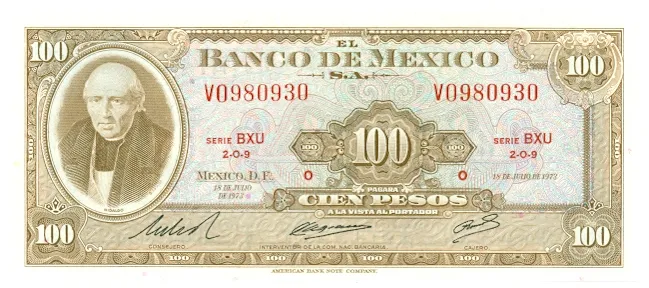
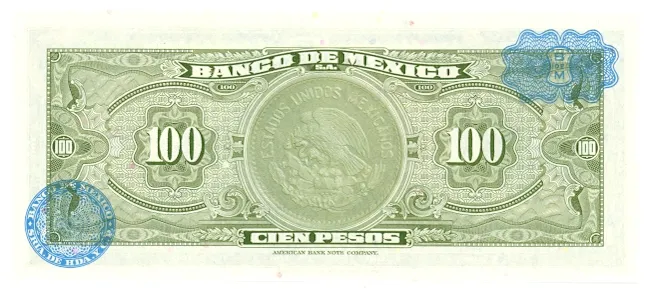
Design
Banxico
Obverse
Miguel Hidalgo
Portrait of Miguel Hidalgo y Costilla
Reverse
The National Coat of Arms
About this banknote
If you inherited or found a 1973 Mexican 100 pesos note with Miguel Hidalgo on the front, here is the honest answer: a worn, circulated example is worth a few US dollars, not a fortune. This is one of the most common notes of the Banco de México "Family A" series, so its collector value depends almost entirely on condition and on special serial numbers or printing errors.
What it's worth today
This note is out of circulation, so its value is collector value, not face value. Condition drives everything. Here is the realistic picture in the world paper money market:
- Circulated (folds, soft corners, handling): roughly 2 to 6 USD.
- Crisp uncirculated (no folds, sharp corners, no stains): commonly 8 to 25 USD, depending on eye appeal and the series letter.
- Fancy serial numbers (very low numbers like 00000123, radar/palindrome numbers that read the same both ways, solid or repeating digits): a premium of several times the base value.
- Genuine printing errors (misaligned cuts, ink smears, factory folds, off-center serials): the rarest outcome, and the only way a common note like this reaches strong prices.
Ignore the inflated listings you see online. Most Family A notes are common. "Old" does not mean valuable here. Real value comes from a note that is both uncirculated and carries something unusual on it.
What this note is
The 1973 issue is a Banco de México note from the series collectors call Family A. The front (obverse) shows Miguel Hidalgo y Costilla, the priest who launched Mexico's independence movement in 1810 and is known there as the Father of the Nation. The back (reverse) shows the Mexican coat of arms (an eagle on a cactus devouring a serpent).
Because huge quantities were printed and many survive, the base note is easy to find. That is good news if you want one and less exciting if you are hoping yours is a rarity.
Quick value reference
| Condition / feature | Typical value (USD) |
|---|---|
| Circulated, average | 2 to 6 |
| Uncirculated, no special features | 8 to 25 |
| Low or radar serial number | Base value x several |
| Genuine printing error | Well above base, note by note |
The myth: "old peso note = big money"
Most people who find one of these expect hundreds or thousands of dollars. That almost never happens with a Family A 100 pesos. It was a workhorse denomination, printed in the millions, and it is plentiful today. The pieces that break out are the exceptions: pristine uncirculated grade, an unusual serial, or a verified factory error. Everything else is a modest collector item.
How to check what yours is worth
- Grade it honestly. Look for folds, stains, tears, pinholes, and rounded corners under good light. A note that has never been folded is worth far more than one that spent time in a wallet.
- Read the serial number. Low numbers, palindromes (radar notes), and solid or repeating digits carry real premiums with collectors.
- Look for genuine errors. Misaligned printing, ink shifts, and factory folds are prized. Normal wear and use damage are not errors.
- Confirm it's real. Check the watermark against the light, the paper texture, the printed detail, and the signatures against official Banco de México references. Reproductions usually have smooth paper and flat, lifeless color.
For context on which Mexican notes are most often faked, see our guide to the most counterfeited banknotes of Mexico.
Where to sell it
World paper money (notaphily) is an active English-language collecting market, so you have options. Photograph both sides in good light before you list anything, and note the serial number and any error. To sell safely, use a verified numismatic dealer from the Pesoteca directory for an on-the-spot appraisal, or the Pesoteca buy-and-sell forum to reach collectors directly. Avoid dumping it to the first bidder on social media before you know what you have.
Think you've got a low serial, a radar number, or a real factory error? Post clear photos of both sides in the Pesoteca forum and let collectors weigh in on it.
Historical context
This 100 pesos of 1973 carries the portrait of Miguel Hidalgo y Costilla, initiator of Independence with the call of Dolores in 1810. The persistence of his figure across several issues of Family A confirms his central place in the Mexican civic pantheon, above almost any other figure.
As on the 1970 issue, the reverse presents the National Coat of Arms, the eagle upon the nopal, a symbol of continuity between the Mexica origin and the modern State. The stability of the design across years was a common practice when the denomination remained in use.
Issued among the "old pesos," this note precedes the 1993 monetary reform that divided all values by a thousand. In 1973 the country still enjoyed relatively stable prices; the inflationary wave that would multiply the denominations would come the following decade.
Frequently asked questions
How much is the 1973 Mexico 100 pesos note worth?
A circulated example is worth about 2 to 6 USD. A crisp uncirculated note usually brings 8 to 25 USD. A note with a low or radar serial number, or a genuine printing error, can sell for several times those figures. Condition and rarity decide the price.
Is the 1973 100 pesos Miguel Hidalgo note rare?
No. It is one of the most common notes of the Banco de México Family A series, printed in large quantities with many survivors today. The only truly scarce examples are pristine uncirculated notes, notes with special serial numbers (low, radar, or repeating digits), and verified factory errors.
Where can I sell my 1973 Mexican 100 pesos note?
The safest routes are a verified numismatic dealer from the Pesoteca directory (/tiendas), who can appraise it in person, or the Pesoteca buy-and-sell forum (/foro/compra-venta) where you reach collectors directly. Photograph both sides in good light and note the serial number and any errors before selling. Don't sell to the first social-media bidder.
How do I tell if my 1973 100 pesos note is genuine?
Check the watermark against the light, the paper texture, the printed detail, and the signatures against official Banco de México references. Genuine notes have textured paper and layered color; reproductions usually feel smooth and look flat. If you're unsure, post clear photos in the Pesoteca forum (/foro) for a second opinion.
Características Banxico
2-O-9
Familia A
This banknote belongs to the BIL-A family within the Sistema PSM . Explore all the banknotes that share origin, era and design with this piece.
Ver todos los billetes de la familia A →