
Mexican 100 Peso Revolution Commemorative Note (2009)
Familia F · polímero · conmemorativo
Period: México Contemporáneo
Design
Banxico
Obverse
Centenario de la Revolución Mexicana
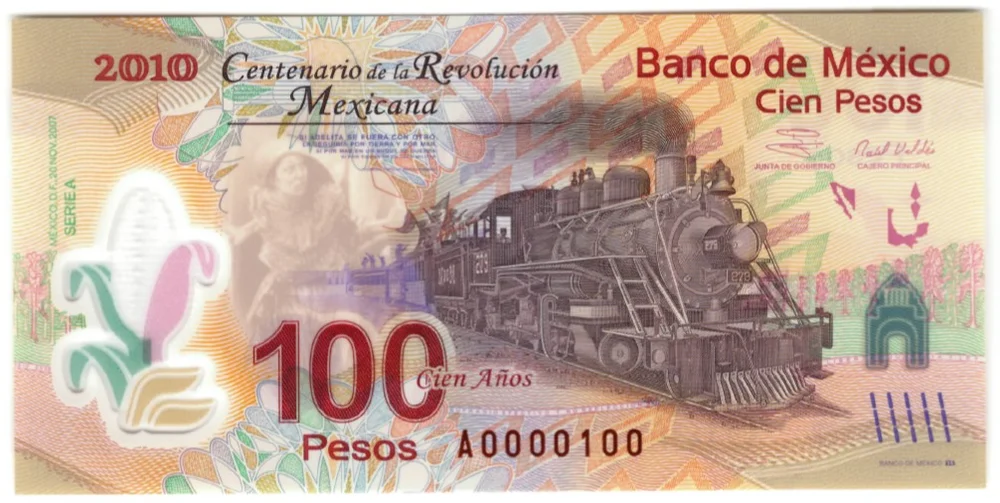
A locomotive with revolutionary troops and a soldadera (Adelita), based on a photograph from the Casasola Archive
Reverse
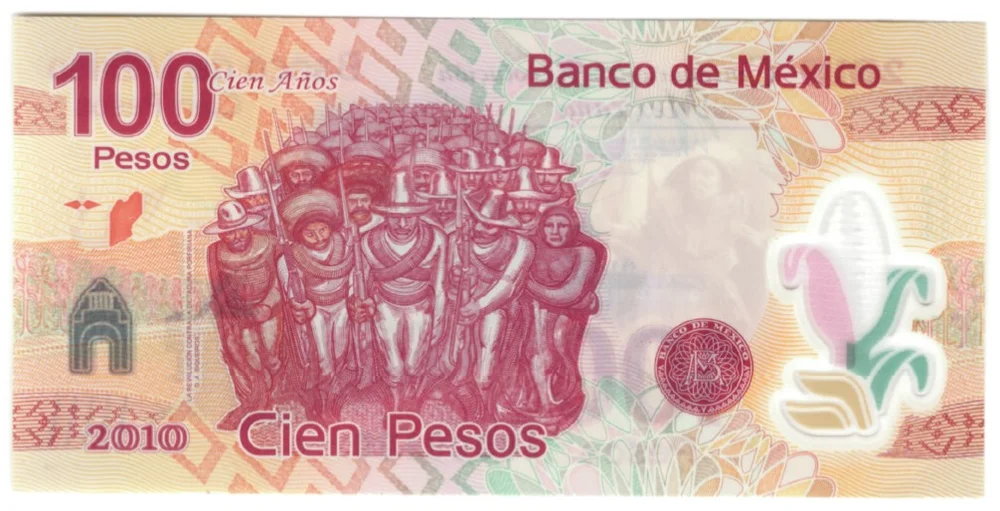
A fragment of David Alfaro Siqueiros's mural 'From Porfirismo to the Revolution'
About this banknote
Most Mexican 100 peso notes from 2009 are worth exactly 100 pesos, about 5 to 6 US dollars at the exchange counter. The commemorative Revolution note with the locomotive is the exception: in crisp uncirculated condition, or with an unusual serial number, it trades among collectors for several times face value. Here is how to tell what you actually have.
What this note is
The 100 peso commemorative note for the Centennial of the Mexican Revolution was issued by Banco de México (Mexico's central bank) on September 23, 2009. It is a polymer note, meaning it is printed on a thin plastic film rather than paper, which makes it more durable and gives it a transparent window.
Do not confuse it with the ordinary 100 peso note of the same period, which shows the poet-king Nezahualcóyotl. This is the one with the train.
The front (obverse) shows a steam locomotive loaded with revolutionary troops, alongside a soldadera, a female soldier popularly known as an Adelita. The image is based on a historic photograph from the Casasola Archive. Railroads were the main way armies moved during the Revolution, and this scene became one of the defining images of the era.
The back (reverse) reproduces a section of the mural "Del Porfirismo a la Revolución" (From Porfirism to the Revolution) by David Alfaro Siqueiros, held in the Revolution Room of the National History Museum inside Chapultepec Castle. It shows the armed populace surrounding the revolutionary leaders.
This note was released as a pair with the 200 peso Bicentennial of Independence note. Both came out together in 2009 to mark the two 2010 anniversaries: 100 years since the Revolution and 200 years since Independence.
What it's worth in 2026
Because this was a limited commemorative issue rather than a standard circulating note, it does not trade at the same level as the common Nezahualcóyotl 100. Condition drives almost everything.
| Condition / feature | Approximate collector value (USD) |
|---|---|
| Circulated, folds and wear | Face value, roughly 5 to 6 dollars |
| Uncirculated, crisp, no folds | 10 to 30 dollars |
| Low serial number (e.g. under 000100) | 30 to 100+ dollars |
| Radar / palindrome serial (reads same both ways) | Premium over the above |
| Genuine printing error | Several times face, case by case |
These are collector-market ranges, not fixed prices. Ignore the inflated listings you see on general marketplace sites, where sellers ask 50 or 100 US dollars for an average circulated example. A common, folded note is worth close to face.
What lifts the value is a truly uncirculated note, a low serial number, a radar or repeater serial, or a factory printing error (misaligned cuts, ink smears, folds that happened before cutting, off-center serials). Normal wear and damage from handling is not an error and adds nothing.
How to tell if yours is genuine
Since this is a polymer note, authentication is straightforward once you know what to feel for:
- Transparent window: real polymer notes have a clear plastic area integrated into the film. On a fake it is often just a printed or thinned patch.
- Raised printing (intaglio): run a fingertip over the main design. Genuine notes have tactile relief. Counterfeits usually feel completely smooth and flat.
- Microprinting: tiny text that stays sharp under a loupe. Fakes blur it.
- Registration and color shift: hold the note to the light and check that front and back elements line up as designed.
A note that feels slick with no relief, or where a security feature looks merely printed rather than built in, should be questioned. When in doubt, post clear photos of both sides in the Pesoteca forum and the community will weigh in.
Where to sell it
World paper money (notaphily) is an active English-language collecting field, so you have real buyers. The safest options:
- A verified numismatic shop from the Pesoteca directory, which appraises the note on the spot with no markup from resellers.
- The Pesoteca buy-and-sell forum, dealing collector to collector.
Before you sell, photograph both faces in good, even light, and check the serial for a low number, a radar pattern, or an error. Those features are the difference between face value and a real premium. Avoid dumping it to the first bidder on social media.
If you want context on how the polymer series protects itself, read our breakdown of the most counterfeited Mexican banknotes and the Banxico figures. Got a clean example or an odd serial? Post it in the forum and let's see what you're holding.
Fun fact
The train was the great transport of the Revolution: it moved troops, weapons, and even the soldaderas. The image on the note comes from a real photograph from the Casasola Archive, the great photographic archive of the era.
Historical context
This commemorative 100-peso note from 2009 was issued by Banco de México to celebrate the Centennial of the Mexican Revolution (1910-2010). Unlike the improvised paper that circulated during the Revolution itself, this is a carefully designed piece, printed on polymer, that pays tribute to that movement a century later.
The obverse shows a locomotive with revolutionary troops and a soldadera (the famous 'Adelita'), inspired by a photograph from the Casasola Archive. The train and the soldaderas are two of the most powerful symbols of the Revolution: the rail lines mobilized armies across the country, and the women who accompanied and fought in the ranks were immortalized in corridos and photographs. The reverse reproduces a fragment of the mural 'From the Porfiriato to the Revolution' by David Alfaro Siqueiros, a great work of Mexican muralism.
This commemorative piece shows how Mexico honors its historical memory through paper money, turning a circulating note into a small tribute to the people in arms and to the art that narrated that epic.
Frequently asked questions
How much is the 2009 Mexican 100 peso Revolution note worth?
A circulated example with folds is worth close to face value, about 5 to 6 US dollars. A crisp uncirculated note runs roughly 10 to 30 dollars among collectors, and a low serial number, radar serial, or genuine printing error can push it well past 100 dollars. Ignore the inflated online listings for average notes.
Which Mexican 100 peso note has a locomotive on it?
The 2009 commemorative note for the Centennial of the Mexican Revolution. The front shows a steam locomotive carrying revolutionary troops with a soldadera (an Adelita), based on a photo from the Casasola Archive. Do not confuse it with the common 100 peso note, which features Nezahualcóyotl.
How can I tell if the note is genuine?
It is a polymer note, so check the integrated transparent window, feel for raised (intaglio) printing on the main design, and look for sharp microprinting under a loupe. Counterfeits usually feel completely smooth and have features that look printed rather than built into the plastic. Post photos of both sides in the Pesoteca forum if unsure.
Where can I sell the 2009 Revolution 100 peso note?
The safest routes are a verified numismatic shop from the Pesoteca directory, which appraises it immediately, or the Pesoteca buy-and-sell forum among collectors. Photograph both faces in good light and check for a low, radar, or error serial before selling, since those raise the value significantly.
Características Banxico
Tipo F conmemorativo