
Mexico 1,000 Pesos Banknote (2002, Series D): Value Guide
Familia D · algodón
Period: México Contemporáneo
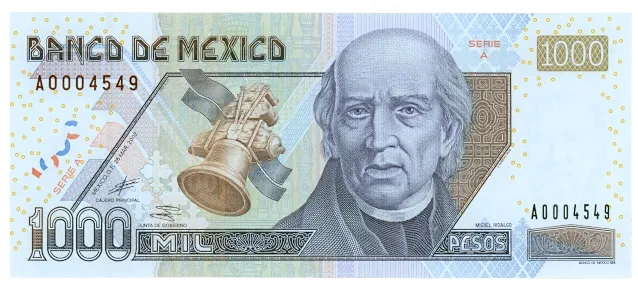
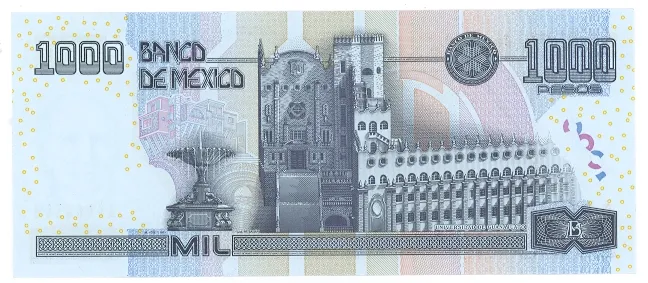
Design
Banxico
Obverse
Miguel Hidalgo
Portrait of Miguel Hidalgo
Reverse
The University of Guanajuato
About this banknote
Most Mexican 1,000 peso notes from the 2002 Series D are worth close to face value in USD, roughly 50 to 55 US dollars at the exchange rate they carried in circulation. The ones that bring real premiums are crisp uncirculated examples, notes with low or radar (palindrome) serial numbers, and genuine printing errors. Here is how to tell which kind you have.
This is the 1,000 peso note from the Banco de México "Family D" series, the paper design that came before the newer Family F polymer and hybrid notes. The front (anverso) shows Miguel Hidalgo y Costilla, the priest who launched Mexico's War of Independence in 1810. The back (reverso) features the University of Guanajuato, one of the country's most recognizable colonial-era buildings. Because it is a high denomination from a retired family, a clean example is a target piece for collectors trying to complete the Family D set.
What it's worth in 2026
A circulated, folded, or stained Family D 1,000 peso note is worth its face value and nothing more. There is no hidden fortune in a common used note, no matter how "old" it looks. What actually moves the price:
- Uncirculated condition (Sin Circular). A note with no folds, no soft corners, no stains, and full original crispness is what collectors pay up for. In notaphily (world paper money collecting), condition is graded on a scale from Good up through Uncirculated (UNC), and graded holders from PMG (Paper Money Guaranty) can carry a premium of their own. A high-grade Family D 1,000 can bring several times face when the market for the retired series heats up.
- Special serial numbers. A low serial (think 00000012), a radar/palindrome serial (reads the same forwards and backwards, like 1234321), a solid serial (all same digit), or a repeater are all sought by serial-number collectors. Any one of these can multiply the value of an otherwise ordinary note.
- Genuine printing errors. Misaligned cuts, ink smears, foldovers from the factory, or off-center serials turn a common note into a rarity worth several times face. Normal wear and handling damage is not an error; a crease from your wallet does not count.
High denominations get more collector attention once they stop being printed, because circulated survivors get spent and destroyed while clean examples become scarce. That is the dynamic pushing demand for uncirculated Family D notes now.
Quick reference
| Attribute | Detail |
|---|---|
| Country | Mexico (Banco de México) |
| Denomination | 1,000 pesos |
| Series / family | Family D |
| Year | 2002 |
| Front (anverso) | Miguel Hidalgo y Costilla |
| Back (reverso) | University of Guanajuato |
| Type | Paper (pre-polymer) |
| Value, circulated | Face value only |
| Value, uncirculated / special serial / error | Several times face, depends on grade and rarity |
The myth to kill
Many people inherit a stack of these and assume a large-denomination Mexican note must be worth a fortune abroad. It usually is not. A worn 1,000 peso Family D note is a face-value note. The premium lives entirely in condition, serial number, or a factory error. Sort your notes into those buckets before you get your hopes up, or before you sell one for face that was actually worth more.
How to tell if yours is genuine
Check the security features built into the note: hold it to the light for the watermark, look for the security thread running through the paper, feel for intaglio relief (raised ink you can feel with a fingertip), and look for microprinting in the design. Compare the portrait, paper texture, and signatures against official Banco de México reference images. Reproductions and fakes usually give themselves away with smooth flat paper and dull, flat colors instead of the sharp printing on a real note. If you are unsure, post clear photos of both sides in the Pesoteca forum and the community will help you check.
How to check value and where to sell
Photograph both sides in good, even light. Note the serial number, look for any error, and honestly assess condition (folds? stains? crisp corners?). For a real appraisal or a sale, a verified numismatic dealer will value it on the spot, and collector-to-collector sales let you reach people who actually want Family D notes. Avoid dumping it to the first buyer on social media, and never sell a note with a low serial or a genuine error for plain face value.
To understand how Mexican paper money gets retired and why that drives collector demand, see why the 20 peso note is leaving circulation. To protect yourself from fakes, read the most counterfeited banknotes in Mexico. Have one with an odd serial or a suspected error? Post it in the forum and let the community weigh in.
Historical context
The 1,000 pesos was the highest denomination of Family D, and its obverse corresponds to Miguel Hidalgo y Costilla, the priest of Dolores who, in the early hours of September 16, 1810, gave the cry that began the war of Independence.
The reverse shows the University of Guanajuato, with its imposing staircase, in the city and state so closely tied to the first steps of the insurgent movement. The obverse and reverse thus share the setting of the independence-minded Bajío region.
Issued starting in 2002, this piece belongs to the series that circulated between 1996 and 2006, with the peso now consolidated without the N$. Reserving the highest value of the family for the Father of the Nation was consistent with the symbolic weight of his figure in the national memory.
Frequently asked questions
How much is the Mexico 1,000 peso (2002, Series D) note worth?
If it is worn or folded, it is worth its face value, roughly 50 to 55 US dollars at circulation exchange rates. As a collectible, an uncirculated example with a special serial number or a genuine printing error can bring several times that. Condition and rarity decide the price.
Is the 1,000 peso Series D note rare?
The note itself is common in circulated grades, so most examples are ordinary. What is scarce is a crisp uncirculated example, a low or radar (palindrome) serial number, or a factory printing error. Any of those makes a note genuinely collectible.
Where can I sell a Mexican 1,000 peso banknote?
Sell through a verified numismatic dealer, who can appraise it in person, or in a collector-to-collector marketplace where buyers actually want Family D notes. Photograph both sides in good light and check for a low serial, a radar serial, or an error, since those raise the value. Avoid selling to the first social-media buyer for face value.
How do I tell if the 1,000 peso Series D note is genuine?
Hold it to the light for the watermark and the security thread, feel for raised intaglio ink, and look for microprinting. Compare the Hidalgo portrait, paper texture, and signatures against official Banco de México images. Fakes usually show smooth paper and flat, dull colors. When in doubt, post photos in the Pesoteca forum for a second opinion.
Familia D
This banknote belongs to the BIL-D family within the Sistema PSM . Explore all the banknotes that share origin, era and design with this piece.
Ver todos los billetes de la familia D →