
Mexican 20 Pesos Note (2000, Benito Juárez): Value Guide
Familia D · algodón
Period: México Contemporáneo
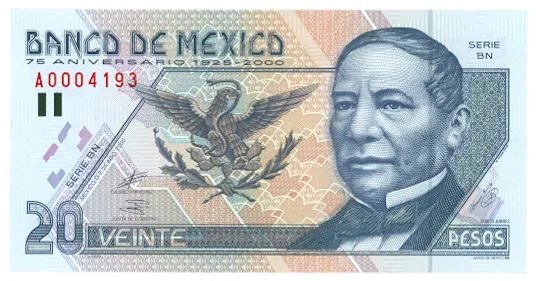
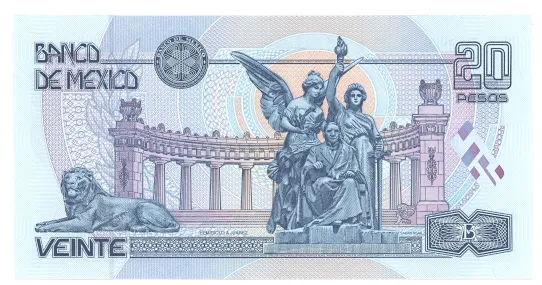
Design
Banxico
Obverse
Benito Juárez
Portrait of Benito Juárez (75th Anniversary of the Bank of Mexico)
Reverse
Monument and motifs of the Reform
About this banknote
If you inherited or found a Mexican 20 pesos note from 2000 with Benito Juárez on the front, here is the honest answer: a circulated example is worth roughly its face value, close to 1 US dollar at current exchange. The value jumps only when the note is uncirculated, carries a special serial number, or shows a genuine printing error. In 2026, most of these notes trade for a few dollars, not a fortune.
This is the Family D 20 pesos paper note from the Banco de México, issued around the bank's 75th anniversary. It is the paper predecessor to the well-known blue polymer 20 pesos note that came later. "Family" (familia in Spanish) is simply the term Banco de México uses for a generation of banknote designs. Before you value yours, confirm the year and series so you do not confuse it with the later Family F polymer version, which is plastic and has a clear transparent window.
What it looks like
The front (anverso) shows Benito Juárez, the 19th-century Mexican president. The back (reverso) carries imagery tied to La Reforma, the reform era he led. It is a printed paper note, not polymer. If your 20 pesos note is plastic with a see-through window, you have the newer version, not this one.
How much it's worth in 2026
Let's be direct. A worn, folded, everyday 2000 Family D 20 pesos note is worth its face value, about 1 US dollar. Age alone does not make it valuable. This note is recent by collecting standards and millions were printed.
Three things push the price above face:
- Uncirculated condition. Crisp, no folds, no stains, no soft corners. A true uncirculated example is worth several times face to a collector, though we are still talking a handful of dollars for a common serial.
- Special serial number. A very low serial (like 0000012), a radar or palindrome serial (reads the same both ways, such as 1234321), or a repeater serial. Collectors of fancy serial numbers pay a premium for these.
- A genuine printing error. Misaligned cuts, ink smears, a factory fold printed into the note, or a miscut. Real errors turn a common note into something worth many times face.
Damage from use is not an error. A tear, a stain, or wear from your wallet lowers value, it does not raise it. That distinction matters, and it is where most sellers get their hopes up for nothing.
| Note | Series / Family | Condition | Approx. value (USD) |
|---|---|---|---|
| 20 pesos, Benito Juárez | Family D (paper) | Circulated | ~1 (face value) |
| 20 pesos, Benito Juárez | Family D (paper) | Uncirculated, common serial | 3 to 10 |
| 20 pesos, Benito Juárez | Family D (paper) | Uncirculated, low or radar serial | 15 to 60+ |
| 20 pesos, Benito Juárez | Family D (paper) | Genuine printing error | Varies widely, often 30+ |
Values are collector-market estimates and depend on the exact serial, grade, and buyer demand. A professionally graded note in a certified holder can command more than the ranges above.
The notes people think are worth a fortune but aren't
Being out of circulation does not automatically mean valuable. Plenty of sellers online list a beat-up 20 pesos note for far more than any collector would pay, on the assumption that "old and retired" equals rare. It doesn't. Interest picks up when a denomination is being pulled from circulation, because people start saving crisp examples, but that only rewards the notes that are actually pristine or special.
How to check what yours is worth
Start with these three checks:
- Condition: Hold it flat under good light. Any fold, crease, or stain moves it out of uncirculated.
- Serial number: Look for a low number, a palindrome, or a repeating pattern.
- Errors: Compare the cut, alignment, and print against a clean example. Look for anything that clearly happened at the printer, not in a wallet.
For authenticity, examine the security features: the watermark held to the light, the security thread, microprinting, raised intaglio ink you can feel with a fingertip, and the paper texture. Reproductions and photocopies usually have smooth, flat paper and dull, uniform color. Compare your note against official Banco de México images of the design, paper, and signatures.
To sell safely, use a verified numismatic dealer or trade among collectors rather than dumping it to the first buyer on social media. Photograph both sides in strong, even light and note the serial number before you agree on any price.
Background reading that helps you value this note correctly:
Got one with an unusual serial or something that looks like a printing error? Post clear photos of both sides in the Pesoteca forum and the community will tell you what you're holding.
Historical context
This 20-peso note belongs to Family D, the series that circulated between 1996 and 2006 and that already displays the consolidated peso, without the N$ that had marked the era of the new pesos. On the obverse appears Benito Juárez, the Benemérito of the Americas, the president who led the Reform Laws and the resistance against the French intervention.
The 2000 issue coincides with the 75th Anniversary of the Banco de México, founded in 1925, an occasion the central institute wished to highlight on the piece. The reverse recovers a monument and motifs linked to the Reform, the great liberal movement of the nineteenth century that separated Church from State.
Placing Juárez on the lowest denomination of everyday circulation was a way of keeping his figure present in the pockets of millions of Mexicans, a nod to republican memory on the paper money in daily use.
Frequently asked questions
How much is the Mexican 20 pesos note (2000) worth?
A circulated Family D note with Benito Juárez is worth its face value, about 1 US dollar. An uncirculated example runs a few dollars, and a note with a low or palindrome serial number or a genuine printing error can reach 15 to 60 dollars or more. Condition and rarity drive the price.
Is the 2000 20 pesos note rare?
No, not by itself. Millions were printed and the note is recent. What makes a specific example collectible is pristine uncirculated condition, a special serial number (low, radar, or repeater), or a verified factory printing error. A worn everyday note is common and worth face value.
Where can I sell a Mexican 20 pesos note (2000)?
The safest options are a verified numismatic dealer who can appraise it in person, or a collector-to-collector marketplace. Photograph both sides in good light, record the serial number, and check for a low or palindrome serial or an error before agreeing on a price. Avoid selling to the first casual buyer on social media.
How do I tell if the 20 pesos note (2000) is genuine?
Check the security features: the watermark against the light, the security thread, microprinting, and raised intaglio ink you can feel with your finger. Genuine notes have textured paper and layered color, while reproductions feel smooth and look flat. Compare the design and signatures against official Banco de México images, and ask in the Pesoteca forum if unsure.
Características Banxico
Conmemorativo del 75 aniversario del Banco de México. 1925-2000.
Familia D
This banknote belongs to the BIL-D family within the Sistema PSM . Explore all the banknotes that share origin, era and design with this piece.
Ver todos los billetes de la familia D →