
Mexico 20 Pesos Benito Juárez Polymer Note (2006): Value Guide
Familia F · polímero
Period: México Contemporáneo
Design
Banxico
Obverse
Benito Juárez
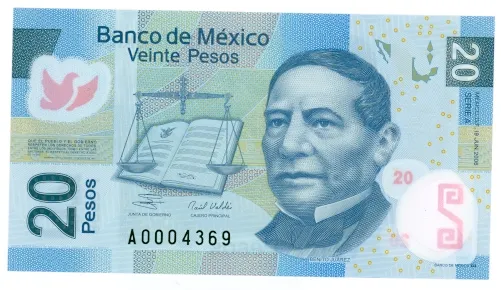
Portrait of Benito Juárez, a scale symbolizing justice, and a book representing the Reform Laws
Reverse
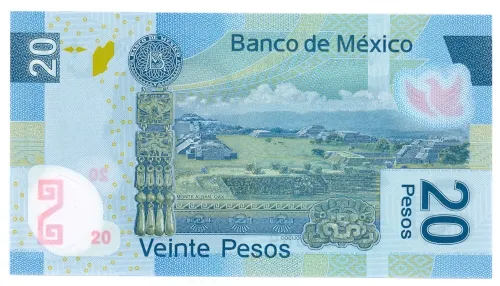
Monte Albán and a Zapotec vessel from Oaxaca
About this banknote
Most Mexican 20 peso Benito Juárez notes are worth exactly that: 20 pesos, roughly 1 US dollar at current exchange rates. But an uncirculated example, a low or radar serial number, or a printing error can push the value several times higher. Here is how to tell which one you have.
This blue note was the first Mexican banknote printed on polymer (plastic) instead of paper, which is why it survived so well in wallets. It belongs to the Banco de México Family F series. The front shows Benito Juárez (1806-1872), the reformist president, alongside a scale and a book that represent justice and the Reform Laws he enacted in 1859.
What it's actually worth in 2026
Let's be direct. If your note is worn, folded, and looks like it spent years in circulation, it is worth face value: about 20 pesos, close to 1 USD. No collector premium, no exceptions. Age alone does not make a modern note valuable, and 2006 is not old in notaphily (the study and collecting of paper money) terms.
Three things move this note above face value:
- Uncirculated condition. Crisp, no folds, no stains, no soft corners. A genuinely uncirculated Family F 20 peso note carries a modest premium among collectors, typically in the low single digits of US dollars, more if it's still sealed in original bank packaging.
- Special serial numbers. A very low serial (like A0000012), a solid number, or a radar serial (a palindrome that reads the same forward and backward) is actively hunted by collectors. These can sell for anywhere from a few dollars to a few dozen, depending on how dramatic the number is and the note's condition.
- Printing errors. Genuine factory errors (misaligned cuts, ink smears, missing print, folded-over paper, mismatched or repeated serials) turn a common note into a rarity worth many times face value. Real errors are scarce, and this is where the money is.
What does NOT add value: normal wear, handling damage, tears, tape, or writing. Those are damage, not errors, and they lower the price.
Value at a glance
| Type | Condition | Approx. value (USD) |
|---|---|---|
| Common circulated note | Worn, folded | Face value (~1 USD) |
| Uncirculated | Crisp, no folds | A few USD |
| Sealed original packaging | Mint | Several USD |
| Low or radar serial | Uncirculated | Several to a few dozen USD |
| Genuine printing error | Any | Many times face, case by case |
Banco de México has confirmed the gradual withdrawal of the 20 peso note in favor of a coin. That matters: when a denomination starts leaving circulation, collectors begin hunting clean, unused examples. If you have one in mint condition, hold it rather than spend it.
The reverse: Monte Albán
The back shows the archaeological site of Monte Albán in Oaxaca, featuring a pendant found in Tomb 7 and a fragment of the mask of Cocijo, the Zapotec god of rain and thunder. It's a design collectors like, but the imagery itself doesn't add value; condition and serial number do.
How to tell if yours is genuine
Counterfeits of this note exist. Check the security features built into the polymer:
- Transparent window. The polymer note has a clear window that cannot be faked on a printed copy.
- Raised print. Run your finger over the portrait and lettering; a genuine note has tactile relief. A fake usually feels flat and smooth.
- Microprinting. Tiny text that stays sharp under magnification.
- Watermark and thread equivalents integrated into the substrate, not printed on top.
A counterfeit tends to feel like ordinary paper or a slick photocopy, with the security elements simply printed rather than embedded. If you're unsure, post clear photos of both sides in the Pesoteca forum and the community will help you check.
Where to sell it
For a common note, honestly, it isn't worth the effort of a formal sale. For an uncirculated example, a special serial, or a suspected error, your best options are:
- A verified dealer from the Pesoteca shop directory, who can appraise it in person.
- The Pesoteca buy-and-sell forum, where you deal directly with collectors who know what a radar serial or a real error is worth.
Photograph both sides in good light, note the serial number, and check condition before agreeing on a price. Avoid dumping it on a general social media marketplace to the first buyer, where you'll either underprice a good note or get lowballed.
Want background before you sell? Read why the 20 peso note is being withdrawn from circulation and the most counterfeited banknotes in Mexico. Think you've got a rare serial or a real error? Post it in the forum and let's look at it together.
Fun fact
It was the first Mexican note printed on polymer (plastic), which made it far more durable. Banxico has already announced its withdrawal to replace it with a coin.
Historical context
The obverse of this 20-peso note honors Benito Juárez García, the Zapotec politician born in San Pablo Guelatao, Oaxaca, in 1806. Of humble origin and a Zapotec speaker in his childhood, he rose to become president of Mexico and led the Reform Laws, which separated Church from State. His resistance against the French intervention and the Second Empire made him a symbol of Mexican liberalism and of the phrase attributed to him about respect for the rights of others.
The reverse looks to Juárez's own roots: a view of the archaeological site of Monte Albán, capital of the Zapotec culture in the central valleys of Oaxaca and a World Heritage Site. Also appearing are pieces of his legacy, such as the goldwork found in the famous Tomb 7 and the effigy of Cocijo, Zapotec deity of rain and lightning.
Within Family F, issued starting in 2006, this note marked the last stage of cotton paper in the 20-peso denomination before giving way to polymer, closing a chapter in Mexican monetary design.
Frequently asked questions
How much is the Mexican 20 peso Benito Juárez note worth?
A circulated, worn note is worth face value: about 20 pesos, roughly 1 US dollar. An uncirculated example is worth a few dollars, and a note with a low or radar serial number or a genuine printing error can sell for several times more. Condition and rarity decide the price.
Is the 20 peso Benito Juárez note rare?
No. It's a common Banco de México Family F note from 2006, the first Mexican note printed on polymer. Millions were made. Only specific examples are rare: pristine uncirculated notes, special serial numbers (low or radar), and genuine factory printing errors.
Where can I sell my 20 peso Benito Juárez note?
For anything above face value, use a verified dealer from the [Pesoteca shop directory](/tiendas) for an in-person appraisal, or the [Pesoteca buy-and-sell forum](/foro/compra-venta) to deal directly with collectors. Photograph both sides, record the serial number, and confirm condition before agreeing on a price.
How do I tell if my 20 peso note is genuine?
Check the polymer security features: the clear transparent window, raised print you can feel on the portrait and lettering, sharp microprinting under magnification, and embedded security elements. A counterfeit usually feels flat and smooth with printed-on features. If unsure, post photos in the [Pesoteca forum](/foro).
Familia F
This banknote belongs to the BIL-F family within the Sistema PSM . Explore all the banknotes that share origin, era and design with this piece.
Ver todos los billetes de la familia F →