
Mexico 20 Pesos Banknote (1967): Value & Prices
Familia MOD · algodón
Period: México Contemporáneo
Design
Banxico
Obverse
Josefa Ortiz de Domínguez
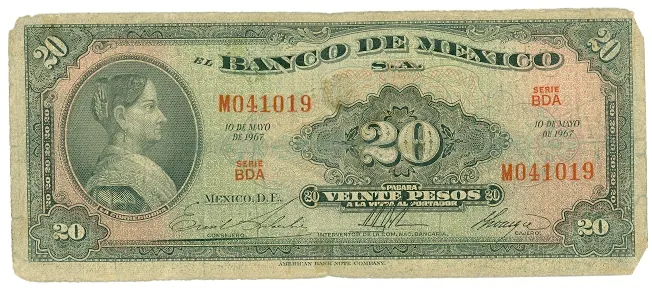
Bust of Josefa Ortiz de Domínguez, la Corregidora
Reverse
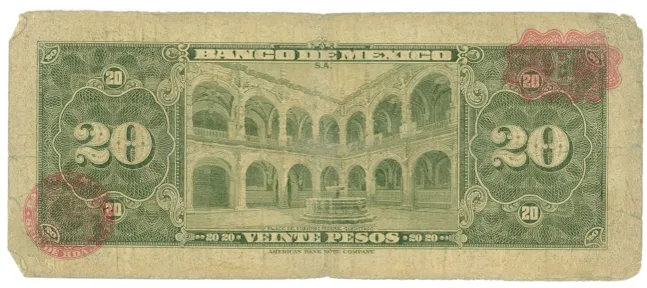
The inner courtyard of a colonial building with arches and a fountain
About this banknote
Most 1967 Mexican 20 pesos notes are worth a few dollars, not a fortune. A crisp uncirculated example typically trades between 15 and 50 USD to collectors, and only notes with special serial numbers or genuine printing errors climb higher. Here is what yours is actually worth and how to check.
This is the 20 pesos note from the Banco de México, featuring Josefa Ortiz de Domínguez, known as "la Corregidora de Querétaro." She warned the independence conspirators in 1810 that their plot had been discovered, forcing the movement to launch early. The back shows the interior courtyard of a colonial building with arches and a fountain. The 1967 emission is one of the classic postwar peso notes and appears in the older MOD family series.
How much is it worth in 2026
This note is demonetized, meaning it no longer has legal spending value in Mexico. Its worth is entirely collector value, driven by condition and rarity rather than the printed "20 pesos."
Here is the honest breakdown for 2026:
- Circulated (folds, soft corners, light stains): roughly 2 to 8 USD. Common in this grade.
- Uncirculated (crisp, no folds, sharp corners, full color): roughly 15 to 50 USD depending on eye appeal and series letter.
- Special serial numbers or printing errors: can bring several times more, sometimes into the low hundreds of USD for a standout piece.
Condition is the single biggest driver. A worn note and a pristine note of the same date can differ tenfold in price. Ignore the inflated "rare, worth thousands" listings you see on general marketplaces; for a standard 1967 20 pesos, those numbers do not reflect real sales.
Note details (Banco de México, 1967)
| Feature | Detail |
|---|---|
| Denomination | 20 pesos |
| Emission date | 1967 |
| Issuer | Banco de México |
| Series family | MOD |
| Front | Josefa Ortiz de Domínguez (la Corregidora) |
| Back | Colonial courtyard with arches and fountain |
| Status | Demonetized (collector value only) |
What actually raises the value
Three things turn a common note into one collectors chase:
- Grade. Uncirculated notes with no folds, no pinholes, and original crispness command the premium. Third-party grading (PMG) can add value and confidence for higher-end examples.
- Serial number. A low serial (starting with several zeros), a radar/palindrome number (reads the same both ways), or a solid/repeating number is worth more than a random serial.
- Printing errors. Genuine factory errors like misaligned cuts, ink smears, missing print, or misregistered serials are legitimate rarities. Everyday wear and handling damage is not an error and does not add value.
Is it rare?
Not in ordinary circulated grade. Millions of these were printed, and worn examples are easy to find. Rarity kicks in only at the top of the grade scale or with a genuine error or standout serial. If yours is a crisp, uncirculated note with a special folio, that is the version worth setting aside.
How to tell if yours is genuine
Compare your note against official Banco de México reference images for the 1967 20 pesos. Check the watermark (hold it to the light), the security thread, the feel of the paper, and the sharpness of the engraved portrait. Reproductions and reprints tend to show flat colors, smooth paper without the printed texture, and fuzzy fine lines. If anything looks off, post clear photos in the Pesoteca forum for a second opinion. For context on what fakes look like, see Mexico's most counterfeited banknotes.
Where to sell it
For US and international collectors, the deepest markets are dedicated world-paper-money channels: notaphily forums, specialist auction houses (Heritage and Stack's Bowers both handle Mexican paper), and eBay's world banknotes category, where completed sales show real prices. If you are in Mexico or want a local appraisal, the verified numismatic shops in the Pesoteca directory value notes on the spot, and the Pesoteca buy-and-sell forum connects you with collectors directly.
Before you sell, photograph both sides in good light, note the serial number, and be honest about condition. Do not dump it on the first social-media offer; a crisp note with a low or palindrome serial can be worth far more than a quick sale suggests.
Have a 1967 20 pesos with an odd serial, a factory error, or still in mint condition? Post it in the Pesoteca forum and let the community weigh in on what it's really worth.
Historical context
A 20-peso note of 1967 issued by the Banco de México, S.A., already in the full period of the consolidated central bank, far from the monetary disorder of the Revolution. It is money from an era of stability, when the Mexican peso had prestige and notes were also used to honor historical figures.
The obverse shows the bust of Josefa Ortiz de Domínguez, 'La Corregidora', one of the key figures of Mexico's Independence. As wife of the corregidor of Querétaro, she warned the conspirators when the plot was discovered, precipitating the start of the struggle in 1810. Bringing her to the note recognized the role of women in the country's founding. On the reverse, the inner courtyard of a colonial building, with arches and a fountain, evokes the viceregal architecture of Querétaro.
This note represents the Banco de México's custom of paying tribute to national heroes on its paper money, a tradition that continues to the present issues. For its Independence theme and elegant engraving, the 'Corregidora' is a piece much appreciated by collectors of modern Mexican notes.
Frequently asked questions
How much is a 1967 Mexican 20 pesos note worth?
It has no spending value since it is demonetized, so its worth is collector value. A circulated example runs about 2 to 8 USD, while a crisp uncirculated note typically brings 15 to 50 USD. Notes with a low or palindrome serial number or a genuine printing error can sell for several times more.
Is the 1967 20 pesos note rare?
Not in ordinary worn condition, since millions were printed and circulated examples are common. It becomes desirable only in uncirculated grade or when it has a special serial number (low, radar, or solid) or a legitimate factory printing error.
Where can I sell my 1967 20 pesos banknote?
For the best prices, use dedicated world-paper-money channels: specialist auction houses like Heritage or Stack's Bowers, notaphily forums, or eBay's world banknotes category where you can check completed sales. In Mexico, the [Pesoteca shop directory](/tiendas) and the [buy-and-sell forum](/foro/compra-venta) connect you with appraisers and collectors. Photograph both sides and note the serial before selling.
How can I tell if my 1967 20 pesos note is genuine?
Check the watermark against the light, inspect the security thread and paper texture, and compare the portrait and design with official Banco de México images. Reproductions usually have flat colors, smooth paper, and blurry fine lines. If in doubt, post clear photos of both sides in the [Pesoteca forum](/foro) for a review.
Familia MOD
This banknote belongs to the BIL-MOD family within the Sistema PSM . Explore all the banknotes that share origin, era and design with this piece.
Ver todos los billetes de la familia MOD →