
200 Pesos Banknote (1995): Sor Juana, Value & Prices
Familia AA · algodón
Period: México Contemporáneo
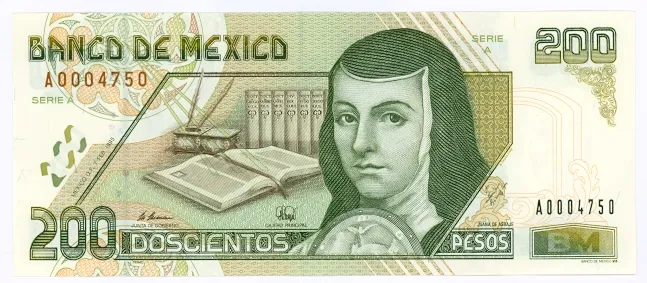
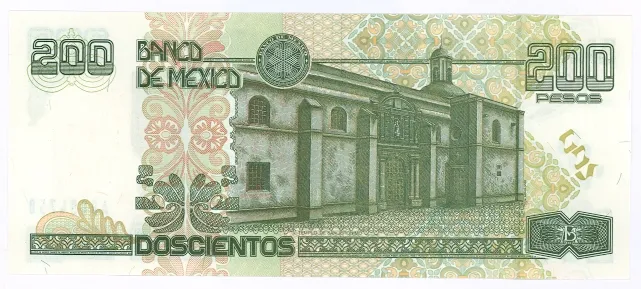
Design
Banxico
Obverse
Sor Juana Inés de la Cruz
Portrait of Sor Juana Inés de la Cruz with books and a quill pen
Reverse
The former convent of San Jerónimo
About this banknote
Most 1995 Mexican 200 pesos notes are worth a few US dollars, close to what you'd get for the paper as a collectible. The 200 pesos featuring Sor Juana Inés de la Cruz left circulation years ago, so it no longer trades at face value. What moves the price is condition, an unusual serial number, or a genuine printing error. In 2026, a crisp uncirculated example can sell for several times what a folded, handled one brings.
What it is
This is a Bank of México (Banco de México) 200 pesos note from the AA family, the series issued after the 1993 currency reform that dropped three zeros from the old peso. The front shows Sor Juana Inés de la Cruz, the Hieronymite nun and poet of the New Spanish Golden Age, one of the great voices in the Spanish language. She appears with books and a quill, the tools of her intellectual world.
The back shows the former Convent of San Jerónimo in Mexico City, where Sor Juana lived and wrote. This design is the direct predecessor of the green F family 200 pesos note that came later.
What it's worth in 2026
Because this note is no longer legal tender for everyday spending, its value is entirely collector-driven. Here is what actually sets the price:
- Condition (the biggest factor). A note that is folded, stained, or has soft corners is common and sells cheap. An uncirculated example, no folds, no stains, sharp corners, crisp paper, is worth several times more.
- Serial number. Low serial numbers, radar (palindrome) numbers, and notes from the first print runs draw extra interest from collectors.
- Printing errors. Misaligned cuts, ink smears, factory folds, or off-center serials turn a common note into something worth well above face.
For a typical circulated note, expect the low single-digit dollar range. A clean uncirculated piece moves into the tens of dollars, and a documented error or standout serial can go higher, depending entirely on what a specialist collector will pay.
| Note | Family | Condition | Approximate value (USD) |
|---|---|---|---|
| 200 pesos Sor Juana | AA | Circulated (folds, wear) | A few dollars |
| 200 pesos Sor Juana | AA | Uncirculated | Tens of dollars |
| 200 pesos Sor Juana | AA | Low serial / radar / error | Higher, buyer-dependent |
Be skeptical of the inflated "worth thousands" listings you'll see on social media and auction sites. Those are asking prices, not sale prices. A common circulated note is not a rarity no matter how old it looks.
Is it rare?
Not on its own. The AA family 200 pesos was printed in large quantities and circulated for years, so the standard note is easy to find. Rarity comes from a specific feature: uncirculated grade, an unusual serial, or a real factory error. Age alone does not make it valuable.
How to tell if yours is genuine
Compare your note against official Bank of México reference images and check the built-in security features:
- Watermark visible when held to light.
- Security thread embedded in the paper.
- Microprinting that stays sharp under magnification.
- Raised print you can feel with a fingertip.
Reproductions usually give themselves away with smooth, flat paper and dull, printed-on colors instead of the layered feel of a real note. If you're unsure, post clear photos of both sides in the Pesoteca forum and let the community weigh in. For background on which Mexican notes get faked most, see our report on the most counterfeited banknotes in Mexico.
Where to sell it
To sell the 1995 200 pesos note safely, use a verified numismatic shop from the Pesoteca directory, which can appraise it on the spot, or trade with fellow collectors in the Pesoteca buy-and-sell forum. Photograph both faces in good light and note whether it has a low serial, a radar number, or any error, since those raise the price. Don't dump it to the first buyer on Facebook.
Got one with an odd serial or still sealed in a blister pack? Post it in the forum and we'll take a look together.
Historical context
This 200-peso note of Family AA was born well into the era of the new pesos, with a 1995 issue, still under the scheme of the 1993 monetary reform that had removed three zeros from the currency and adopted the N$ symbol.
The obverse presents Sor Juana Inés de la Cruz, the great poet of viceregal Mexico, with books and a quill that underscore her condition as an exceptional woman of letters in her time.
The reverse shows the former convent of San Jerónimo, in Mexico City, the place where Sor Juana professed and wrote much of her work, today the seat of a university. The scene precisely unites the face of the Tenth Muse with the actual space where her conventual life unfolded, a fine touch of historical coherence on the paper money.
Frequently asked questions
How much is the 1995 Mexican 200 pesos note worth?
It no longer trades at face value since it's out of circulation, so its worth is collector-based. A circulated example brings a few US dollars. A crisp uncirculated note, a low or radar serial number, or a genuine printing error can push it into the tens of dollars or higher, depending on the buyer.
Is the 200 pesos Sor Juana note rare?
The standard note is not rare; it was printed in large numbers and circulated for years. Value comes from a specific feature, an uncirculated grade, an unusual serial number, or a real factory error. Age by itself does not make it valuable.
Where can I sell the 1995 200 pesos banknote?
The safest options are a [verified numismatic shop in the Pesoteca directory](/tiendas), which can appraise it in person, or the [Pesoteca buy-and-sell forum](/foro/compra-venta) among collectors. Photograph both sides in good light and flag any low or radar serial or error before agreeing on a price.
How do I know if my 200 pesos note is genuine?
Check the security features: a watermark visible against light, an embedded security thread, sharp microprinting, and raised print you can feel. Compare the design, paper, and signatures to official Bank of México images. Reproductions usually have smooth paper and flat colors. If in doubt, ask in the [Pesoteca forum](/foro).
Familia AA
This banknote belongs to the BIL-AA family within the Sistema PSM . Explore all the banknotes that share origin, era and design with this piece.
Ver todos los billetes de la familia AA →