
The 2,000-Peso Mexican Note: The Bank of Mexico Ghost
Octavio Paz y Rosario Castellanos en el anverso, Paisaje Agavero de Tequila en el reverso. Disenado por Banxico, sin fecha de circulación.
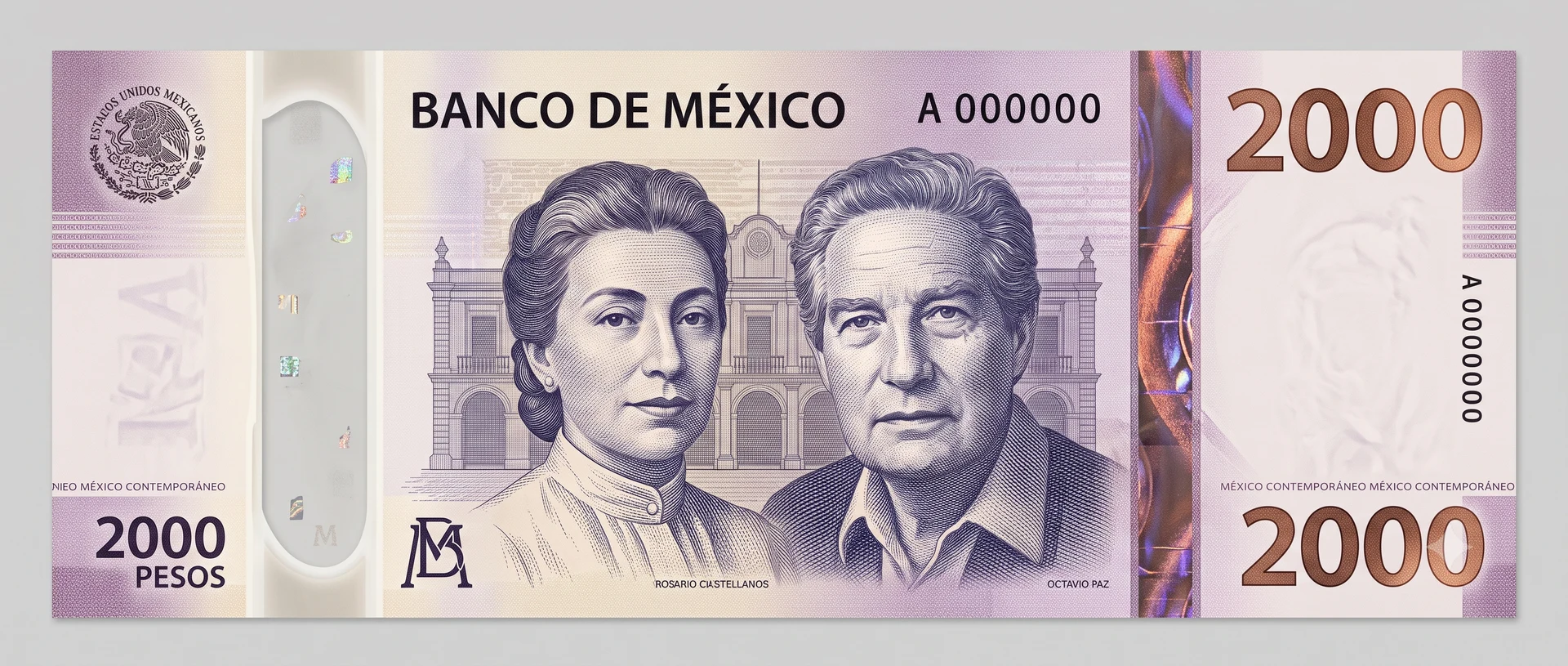
Rendering based on the features published by Banco de México for Family G. It is not an official image nor a real banknote: no specimen has been printed and its final design, printing and circulation are yet to be determined.
Design
Banxico
Obverse
Octavio Paz y Rosario Castellanos
Reverse
Agave Landscape of Tequila
Dry forests · Lesser long-nosed bat
About this banknote
If you think you have a 2,000-peso Mexican note, here is the honest answer up front: no genuine one exists. Banco de México (Mexico's central bank) designed it as part of the Familia G polymer series, published the artwork, then never printed it. Any physical 2,000-peso note you see is either a printout of the official design or an outright fake. It has no legal value and no collector value, because there is no issued specimen to collect.
That clears up the number one question we get from US and international collectors who spot images of this note online: it is not worth money, because it does not officially exist as currency.
The official design (fully documented)
Banco de México did the design work and slotted the 2,000-peso note into the Familia G, the same modern polymer family as the 50-peso axolotl note. According to the bank's published plan for the series, the note belongs to the "contemporary Mexico" theme:
- Front: the poets Octavio Paz and Rosario Castellanos, two towering figures of Mexican literature sharing one note.
- Back: the Agave Landscape of Tequila (Paisaje Agavero de Tequila), a UNESCO World Heritage site, featuring the agave plant and the endangered magueyero bat. The ecosystem represented is the tropical dry forest.
Octavio Paz is a repeat performer on Mexican money. He also appears on the year-2000 commemorative 20-peso coin. On paper he would have been paired with Rosario Castellanos.
Why it was never printed
Banco de México was direct about this: the 2,000-peso note would only be issued if the public actually needed a denomination higher than the 1,000-peso note. As of 2026, there is no such need. There is no print order, no issue date, and no authorization from the bank's Governing Board (Junta de Gobierno) to release it.
The design sits in a drawer. The note is not printed. It could stay that way for years, or it may never be issued at all. Until inflation pushes demand for a denomination above 1,000 pesos, there is no reason to release it.
Is the one you saw real or fake?
If you have a "physical" 2,000-peso note in hand, be suspicious. No genuine specimen exists in circulation anywhere. What travels around the internet is two things:
- Images of Banco de México's own official design plan.
- Counterfeits that copy that published artwork.
Neither is money. A note without an issue authorization has no legal tender value in Mexico, no matter how convincing the image looks. There is no series letter, serial range, dimension spec, or security-feature set for an issued 2,000-peso note, because it was never manufactured.
What it's worth
| Item | Status | Value |
|---|---|---|
| Issued 2,000-peso note | Does not exist | None (not printed) |
| "Collector" 2,000-peso note offered online | Fake or design printout | Zero, and likely a scam |
| Official design image from Banxico | Reference document | Free to view, not currency |
Today the answer is zero, because it does not circulate. Down the road, if it were ever issued and then withdrawn, an issued note could carry a collector premium. But that is speculation about a piece that has never been printed. If anyone offers to buy or sell a "collectible" 2,000-peso note, walk away: there is no genuine piece to trade.
To value Mexican notes that actually exist, use our what's my note worth tool or ask a verified numismatic dealer.
The ghost of the Familia G
The 2,000-peso note is the last line in the Familia G table, the same polymer family as the 50-peso axolotl note that won international banknote design awards. It shares the polymer substrate and the theme of Mexican ecosystems and historical figures. The difference is simple: every other denomination in the family was actually issued, and this one stayed on paper.
For the full story of how this design surfaced and why half the internet believes it already exists, we cover it in our investigation of the 2,000-peso ghost note.
Have you seen one of these floating around online, or been offered one for sale? Post the image in the Pesoteca forum and we'll tell you exactly what it is.
Frequently asked questions
How much is the 2,000-peso Mexican note worth?
Nothing, because it was never issued or printed. It has no legal tender value and no collector value. Any 'collectible' 2,000-peso note offered for sale is a fake or a scam. To value real Mexican notes, use our what's-my-note-worth tool or a verified dealer.
Does the 2,000-peso Mexican note actually exist?
The design exists and is documented by Banco de México within the Familia G series, but the note does not circulate and has never been printed. You will not find it in your change or at a bank.
I saw a 2,000-peso note for sale. Is it genuine?
No. No genuine specimen exists in circulation anywhere. What you see online is either an image of Banxico's official design plan or a counterfeit copying it. A note with no issue authorization has no legal or collector value, so any sale is fraudulent.
Who appears on the 2,000-peso note design?
The front shows the poets Octavio Paz and Rosario Castellanos (the contemporary Mexico theme). The back depicts the Agave Landscape of Tequila, a UNESCO World Heritage site, with the agave plant and the endangered magueyero bat.