
20 Pesos Octavio Paz (2000): Value & Prices
The 20 Pesos Octavio Paz : Value & Prices is worth between $200 and $680 MXN depending on its grade of preservation.
Prices updated: August 2026
Bimetallic commemorative · Turn of the millennium · Bust of Octavio Paz
Bimetallic commemorative · Turn of the millennium · Bust of Octavio Paz
The 20 Pesos Octavio Paz : Value & Prices is worth between $200 and $680 MXN depending on its grade of preservation.
Prices updated: August 2026
How much is the 20 Pesos Octavio Paz (2000): Value & Prices worth?
The estimated value of the 20 Pesos Octavio Paz (2000): Value & Prices ranges from $200 (circulated, XF) up to $680 (official blister pack), with $505 as a reference for an uncirculated (UNC) piece. The estimate is based on the official mintage and the historical behavior of the family.
The real price depends on four factors: the grade of preservation (a circulated piece is worth the low end of the range; an uncirculated one, or one still in its official blister pack, the high end), the finish (satin vs mirror/proof), the rarity within the series based on the mintage, and the metal spot price on the day of the deal when the piece is silver or gold. Check the value-by-grade table above and compare with equivalent pieces before buying or selling.
Where to buy or sell this coin?
Browse the national directory of numismatic shops or the community forum to trade directly with other collectors.
Description
If you inherited or found a Mexican 20 pesos coin with a poet's face on it, here is the straight answer: the 20 Pesos Octavio Paz (2000) is worth roughly 11 to 37 USD depending on condition. The half-million-dollar figures floating around social media are fantasy listings with no real buyer. This is a common commemorative, not a rarity.
What you have
The coin honors the year 2000 and the start of the third millennium, pairing that milestone with a tribute to Octavio Paz, the Mexican poet and essayist who won the Nobel Prize in Literature. The reverse shows Paz in a three-quarter profile facing right, three lines from his poem "Fuente," his signature, the value "20," and the mint mark "Mo" for the Mexican Mint (Casa de Moneda de México).
It is a bimetallic coin from the C1 family: an aluminum-bronze outer ring around a copper-nickel center. It weighs 15.945 grams and measures 32 millimeters across, with a segmented edge that alternates reeded and smooth sections. The Bank of Mexico (Banco de México) minted and issued it in 2026's reference market at a mintage of about 15,000,000 pieces for the year 2000.
What it's actually worth in 2026
This is a circulating commemorative, so its value is driven almost entirely by condition, not age. A coin from 2000 is not old enough or rare enough to command a premium on scarcity alone.
| Condition | Approx. value (USD) | Approx. value (pesos) |
|---|---|---|
| Circulated (worn) | 11 to 16 | 200 to 300 |
| Good condition | 16 to 25 | 300 to 450 |
| Uncirculated (UNC), full luster | up to 37 | up to 680 |
| Sealed blister (mint packaging) | above loose UNC | above 680 |
The UNC reference price of 680 pesos comes from a validated purchase in the Pesoteca catalog. A coin still sealed in its original mint blister trades above a loose uncirculated example, because the packaging protects the surfaces and confirms it never entered circulation.
The metal here is not silver or gold. It is aluminum-bronze and copper-nickel, so there is no bullion floor propping up the price. Everything comes down to grade and demand from collectors.
The million-peso myth
You will see posts claiming this coin sells for half a million or a million pesos. Ignore them. Those are wishful asking prices with no completed sale behind them, the online equivalent of listing your used car for 100 times its value. Nobody pays it. The realistic ceiling for a standard example in top condition is the range in the table above.
Is there more than one year?
Yes, and it matters slightly. The Octavio Paz design was struck in 2000 (about 15 million pieces) and again in 2001 (just over 2.5 million pieces). The 2001 is the scarcer of the two, but the value gap between them is only a few pesos. Check the year engraved on the reverse before you assume anything. If you are working through this whole commemorative series, the related Xiuhtecuhtli "Lord of Fire" 2000 issue and the Xiuhtecuhtli "Lord of Fire" 2001 issue use the same 20 pesos format.
How to tell if yours is genuine
Counterfeits of a low-value commemorative are uncommon, but easy to rule out with two tools:
- Weight: a genuine coin weighs 15.945 grams. Use a jewelry scale.
- Diameter: it should measure exactly 32 millimeters. Use calipers.
- Look: genuine pieces have crisp relief, a clean split between the two metal tones, and a segmented edge with alternating reeded and smooth sections. Flat detail, muddy color, or a wrong edge points to a fake or heavy damage.
Most "error coins" people get excited about online are post-mint damage (scratches, corrosion, machine dings), not factory errors. True mint errors (off-center strikes, die rotation, doubled dies) can multiply value if genuine and verifiable, but they are rare. If you think you have one, post clear photos in the Pesoteca forum so the community can check it.
Where to sell it
To sell without getting lowballed, use a verified numismatic shop from the Pesoteca directory, where you can get an in-person appraisal, or list it in the buy-and-sell forum among collectors who know what it is. Photograph the obverse, reverse, and edge, confirm the condition against the table above, and do not dump it to the first Facebook offer.
Have one sitting in a drawer, or a whole box of these commemoratives? Post photos in the Pesoteca forum and let collectors tell you which years and conditions in your batch are actually worth setting aside.
Historical context
This piece celebrates two things at once: the arrival of the year 2000 and Octavio Paz, the figure Mexico chose to represent the turn of the millennium. The decree was published on January 6, 2000, and the coin entered circulation on April 3 of that year.
Paz (Mexico City, 1914 - Coyoacan, 1998) was a poet and essayist, and remains the only Mexican to have won the Nobel Prize in Literature, in 1990. A child of the Revolution (his father was a lawyer for Emiliano Zapata) and shaped between Mixcoac, Paris, and diplomacy, he wrote works that became a mirror of the country: "El laberinto de la soledad" (1950) and "Piedra de sol," among many others.
That's why the coin bears no fireworks or clocks: it bears a face and a verse from his poem "Fuente," "Todo es presencia, todos los siglos son este Presente." Mexico saw off the 20th century by putting its greatest poet in people's pockets, and that decision makes it one of the most sought-after commemoratives of family C.
The two years: 2000 and 2001
Here's the detail many don't know: this coin exists in two dates. It was struck in the year 2000 and also in 2001. According to the records, the bulk of production was in 2000, with close to 15 million pieces, and a considerably smaller quantity in 2001, just over 2.5 million. That makes the 2001 the scarcer of the two. It's worth checking the year engraved on the reverse before keeping it or selling it: the difference in mintage doesn't turn it into a fortune, but for anyone building the series in detail, having both dates counts.
How to identify it
It's bimetallic, with a cupronickel center and a bronze ring, 32.0 mm in diameter, 15.945 g in weight, and 2.65 mm thick, with a segmented edge (alternating reeded and plain sections) and the Mo mint. The visual cue that never fails is on the reverse: the portrait of Octavio Paz in three-quarter profile looking to the right, the verse of the poem "Fuente" in three lines, the value 20, the poet's signature, the year, and the mint mark. The obverse is the standard National Coat of Arms. Only the engraved year changes between the 2000 and the 2001.
What it's worth
Around the internet there are posts claiming it's worth half a million or even a million pesos: that's hot air, Marketplace listings where someone sets an absurd price in case a naive buyer falls for it. The real value depends on scarcity and condition: circulated and worn, 200 to 300 pesos; in good condition or lightly circulated, 300 to 450; uncirculated (UNC), 450 to 680 pesos. The 2001, being scarcer, is usually asked a bit higher, but the difference is a few pesos, not thousands. Store it well from now on: a circulated one today doesn't become UNC tomorrow, and the original shine can't be recovered. To sell it or hunt for a UNC at a fair price, check the store directory instead of falling for someone inflating prices with internet posts.
This piece belongs to the era
Nuevos Pesos y actualidad →Explore all the Mexican coins of this era, their historical context and how they connect to the monetary system of the period.
Piezas por grado en circulación
Proyección de cuántas piezas sobreviven hoy y cómo se distribuyen entre grados de conservación, a partir de la acuñación oficial y la antigüedad de esta moneda.
| Grado | Piezas | % |
|---|---|---|
| MS-65 Gem | 491,531 | 5.0% |
| MS-60–64 | 1,769,510 | 18.0% |
| AU-50–58 | 1,966,122 | 20.0% |
| XF-40–45 | 2,162,734 | 22.0% |
| VF-20–35 | 1,769,510 | 18.0% |
| F-12–15 | 983,061 | 10.0% |
| VG / G | 491,531 | 5.0% |
| AG-3 | 196,612 | 2.0% |
| Totales | 9,830,610 de 15,000,000 (65.5%) | |
Estimaciones basadas en la acuñación oficial, la antigüedad y curvas estándar de desgaste numismático (curva conmemorativa moderna (post-1990)). Los valores reales pueden variar según preservación específica, eventos de fundido, y demanda del mercado.
Other denominations from 2000
Monedas de 20 pesos · Bimetálica
Same denomination, other years
20 pesos Bimetálica · Monedas de 20 pesos
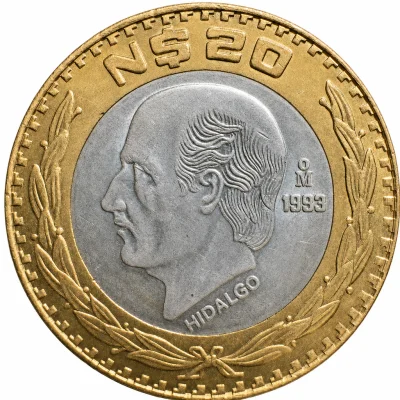
20 Nuevos Pesos Hidalgo
1993
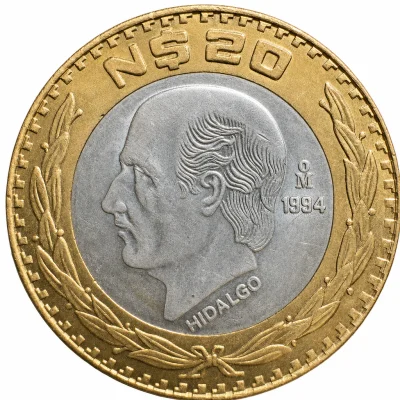
20 Nuevos Pesos Hidalgo
1994
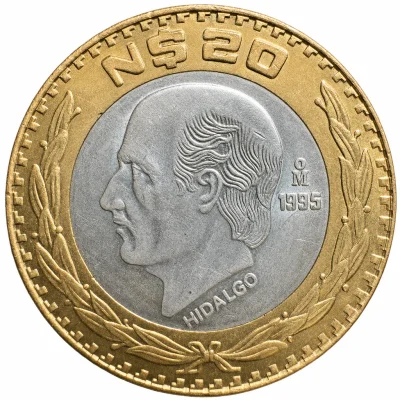
20 Nuevos Pesos Hidalgo
1995
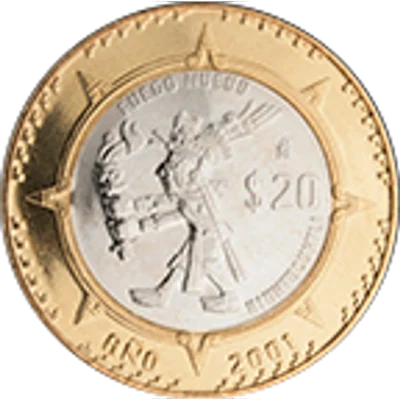
20 Pesos Año 2000, inicio del Tercer Milenio. Representación prehispánica de Xiuhtecuhtli "Señor del fuego, S
2001
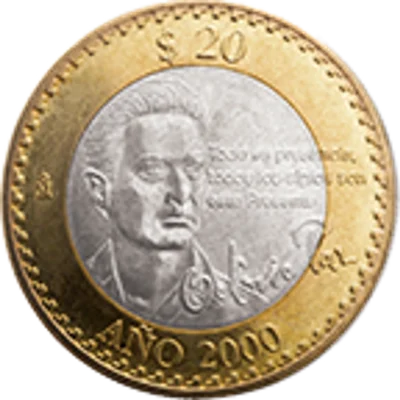
Llegada del Año 2001 y el Inicio del Tercer Milenio. Busto de tres cuartos de perfil a la derecha de Octavio Paz
2001
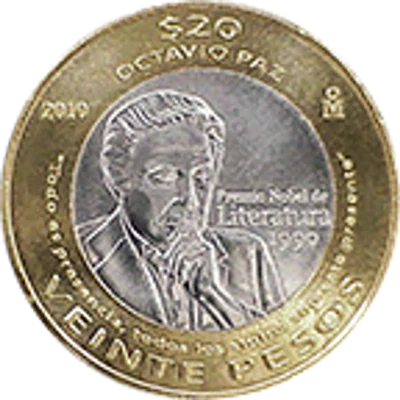
20 Pesos Conmemorativa del Vigésimo Aniversario de la entrega del Premio Nobel a Octavio Paz
2011
Official sources
Frequently asked questions
How much is the 20 Pesos Octavio Paz 2000 coin worth?
Realistically 11 to 37 USD (about 200 to 680 pesos) depending on condition. A circulated coin runs 11 to 16 USD, a nicer one 16 to 25 USD, and an uncirculated example with full luster and no spots reaches around 37 USD. The half-million or million-peso prices in viral posts are fantasy listings with no real buyer.
Is the Octavio Paz coin rare?
No. About 15 million pieces were struck in 2000 and just over 2.5 million in 2001. The 2001 is the scarcer of the two, but the value difference is only a few pesos. It is a common circulating commemorative, so condition matters far more than the year.
Where can I sell my Octavio Paz 20 pesos coin?
The safest options are a verified numismatic shop from the Pesoteca directory, which appraises it on the spot, or the Pesoteca buy-and-sell forum among collectors. Photograph the obverse, reverse, and edge, and check the condition-based price range before selling. Avoid taking the first random offer on Facebook.
How do I tell if my Octavio Paz coin is genuine?
Weigh it (it should be 15.945 grams) and measure the diameter (32 millimeters) with a jewelry scale and calipers, then compare to the specs. Genuine coins have sharp relief, a clean split between the two metal tones, and a segmented edge with alternating reeded and smooth sections. Wrong weight, flat detail, or muddy color signals a fake or heavy damage.
Conversation
0 comments
Sources
Images for informational and educational purposes, attributed to their original source. Reference values; the real price depends on the grade, the specific variant and demand.
Loading comments…