
Mexico 20 Pesos "Fuego Nuevo" (2000): Value & Prices
The Mexico 20 Pesos "Fuego Nuevo" : Value & Prices is worth between $200 and $600 MXN depending on its grade of preservation.
Prices updated: August 2026
Bimetallic commemorative · Turn of the millennium · Xiuhtecuhtli (Lord of Fire)
Bimetallic commemorative · Turn of the millennium · Xiuhtecuhtli (Lord of Fire)
Design
Banxico
Reverse
Pre-Hispanic representation of Xiuhtecuhtli "Lord of Fire, Lord of the Year," holding in his hands the torch with the new fire, inscription "FUEGO NUEVO", symbol of the Mexican Mint "M°", symbol "$", number "20", inscription "XIUHTECUHTLI", a stylization of the solar radiance ring from the Sun Stone, inscription "AÑO" and year of minting. Discontinuous border of stepped frets.
Obverse
The National Coat of Arms in sculptural relief, with the legend ESTADOS UNIDOS MEXICANOS in an upper semicircle.
The Mexico 20 Pesos "Fuego Nuevo" : Value & Prices is worth between $200 and $600 MXN depending on its grade of preservation.
Prices updated: August 2026
How much is the Mexico 20 Pesos "Fuego Nuevo" (2000): Value & Prices worth?
The estimated value of the Mexico 20 Pesos "Fuego Nuevo" (2000): Value & Prices ranges from $200 (circulated, XF) up to $600 (official blister pack), with $455 as a reference for an uncirculated (UNC) piece. The estimate is based on the official mintage and the historical behavior of the family.
The real price depends on four factors: the grade of preservation (a circulated piece is worth the low end of the range; an uncirculated one, or one still in its official blister pack, the high end), the finish (satin vs mirror/proof), the rarity within the series based on the mintage, and the metal spot price on the day of the deal when the piece is silver or gold. Check the value-by-grade table above and compare with equivalent pieces before buying or selling.
Where to buy or sell this coin?
Browse the national directory of numismatic shops or the community forum to trade directly with other collectors.
Description
If you found a Mexican 20 pesos coin dated 2000 with an ancient figure holding a torch, here is the honest answer: it is worth roughly 1 to 30 US dollars depending on condition, not the 500,000 pesos you may have seen in a viral listing. Uncirculated examples sit near the top of that range; a worn one is barely above face value. Nobody has ever sold a circulated one for a life-changing sum.
This is the 20 Pesos "Año 2000, Inicio del Tercer Milenio" featuring Xiuhtecuhtli, the Aztec "Lord of Fire" (pronounced shoo-teh-COO-tlee), issued by Banco de México (Banxico) to mark the year 2000 and the start of the third millennium. Collectors call it the Fuego Nuevo ("New Fire") coin. It is a legal-tender commemorative that actually circulated, so millions exist.
What it's actually worth in 2026
The value is driven almost entirely by condition and whether it is still sealed. This is a common coin, so grade is everything.
| Condition | Approx. value (USD) | Notes |
|---|---|---|
| Circulated (worn) | 1 to 3 | Barely above face value |
| Uncirculated (loose) | 15 to 30 | Full luster, no wear |
| Sealed Banxico blister | 30 to 50 | Trades above a loose UNC coin |
| Certified NGC/PCGS MS66+ | Higher, sold individually | Only worth grading in top condition |
At current exchange rates, 600 Mexican pesos (a common catalog reference for a near-uncirculated example) is roughly 30 US dollars. Do not expect more for a coin pulled from pocket change.
The "worth 500,000 pesos" myth
You have probably seen headlines claiming this coin sells for half a million pesos (around 25,000 USD). That figure comes from marketplace listings where anyone can type any price they want. A listing is not a sale. No Fuego Nuevo coin has ever changed hands for that amount. The real ceiling for a circulated piece is a few dollars; a pristine sealed one tops out in the low tens of dollars. Treat those viral posts as clickbait.
How to identify it (and tell it apart from lookalikes)
Mexico issued several bimetallic 20-peso commemoratives that look similar at a glance. Here is how to confirm you have this exact coin:
- Reverse: Xiuhtecuhtli holding a torch, with the legends "FUEGO NUEVO" and "XIUHTECUHTLI", framed by a stylized ring of rays from the Aztec Sun Stone. Those two legends separate it from the Templo Mayor and other pre-Hispanic 20-peso designs.
- Composition: Bimetallic (C1 family). Bronze-aluminum outer ring, cupronickel center.
- Weight: 15.945 grams.
- Diameter: 32 millimeters.
- Year: 2000 on the obverse.
The closely related 2001 Xiuhtecuhtli "Señor del Fuego" shares the design but carries a different date and a much smaller mintage. If you have the Octavio Paz portrait instead of the fire god, that is a different coin: see 20 Pesos Octavio Paz Milenio 2000.
Mintage: is it rare?
No, the 2000 issue is not rare. Banxico struck about 14 million pieces in 2000. The 2001 version is the scarcer of the two, with roughly 2.5 million minted. Combined, just over 17 million entered circulation across both years. Because so many were made and they circulated freely, the only versions that command any premium are truly uncirculated or sealed examples.
How to check if yours is genuine
With millions in circulation, outright fakes are uncommon, but it pays to verify:
- Weigh it on a jewelry scale. It should read 15.945 grams.
- Measure the diameter with calipers. It should be 32 millimeters.
- Check the strike. Genuine coins have sharp relief and correct color separation between the golden ring and the silvery center. Flat detail, muddy color, or off weight points to a problem.
Most "error coins" people post online are actually post-mint damage (dings, corrosion, cleaning), not factory errors. Genuine, verifiable mint errors (off-center strikes, die rotation, double strikes) can multiply value, but they are rare and need expert eyes.
Where to sell it in 2026
For a coin in this price range, keep it simple:
- A verified coin dealer will appraise it on the spot. Browse the Pesoteca shop directory to find one.
- Collector-to-collector on the Pesoteca buy-and-sell forum, where you reach people who actually want the coin.
- Photograph the obverse, reverse, and edge before you list anything, and compare against the specs above so you price it honestly.
Avoid dumping it to the first bidder on social media. For a coin worth a handful of dollars, cleaning it or overpaying to grade it will cost you more than the coin is worth unless it is a flawless example.
Think you have a genuine mint error or a sealed blister set worth grading? Post clear photos on the Pesoteca forum and let the community weigh in before you sell.
Historical context
This piece does not celebrate a pre-Hispanic figure at random: the decree (DOF, January 6, 2000) authorizes a coin for the arrival of the year 2000 and the start of the Third Millennium, and to mark that turn of the cycle Mexico chose Xiuhtecuhtli, the Lord of Fire, also called the Lord of the Year.
The choice is entirely deliberate. For the Mexica, Xiuhtecuhtli governed time and dwelled at the center of the cosmos, the home, and the hearth. Every 52 years, when a calendar cycle closed, all fires were extinguished, and in the New Fire Ceremony a single one was lit atop the Cerro de la Estrella, to renew the world and guarantee another period of life. That is why the reverse shows him holding the torch with the New Fire: the same gesture of renewal that the country wished to invoke as it crossed into a new millennium.
It is the first of the two 20-peso coins in the decree; the second honors Octavio Paz. To hunt it down is to hunt down the way Mexico looked toward its future through its most ancient roots.
The New Fire Ceremony, step by step
The ritual the coin invokes had its own name: the Xiuhmolpilli, "the binding of the years." The Mexica measured time in cycles of 52 years, when the 365-day solar calendar aligned with the 260-day sacred one. At the close of each cycle it was believed the universe reached a critical point: it could renew itself or come to an end. On the night of the closing, all fires in Tenochtitlan were extinguished and the city was left in darkness. The fire priests climbed the Cerro de la Estrella (the Huixachtlan) and waited for the Pleiades to cross the sky on their normal course; at midnight they lit a new fire, and from that flame they rekindled the entire city. The same thing the country did as it passed from 1999 into 2000, five hundred years later.
How to identify it and its two years
It is bimetallic, with the dimensions of the 20-peso family: 32 mm in diameter, 15.945 g in weight, an alpaca (silver-colored) core and an aluminum-bronze ring, discontinuous reeded edge. It entered circulation on April 3, 2000. On the reverse, Xiuhtecuhtli holds the torch with the fire in his hands; above is the legend "FUEGO NUEVO", the "Mo" mark of the Mexican Mint, the peso sign, and the "20"; below, the name "XIUHTECUHTLI", a stylization of the ring of solar rays from the Sun Stone, and the word "AÑO" with the year of minting. Do not confuse it with the 20-peso Templo Mayor coin or other pre-Hispanic pieces of the era: the words "XIUHTECUHTLI" and "FUEGO NUEVO" leave no room for doubt.
The variant that matters is the year, because this coin was struck in two: 2000 and 2001. This entry is the year 2000 one, with the larger mintage, around 14 million pieces; the 2001 version was much shorter, close to 2.5 million, and is therefore notably scarcer (in total, a little over 17 million between both years).
What it's worth (no tall tales of millions)
Online you'll see listings for "500 thousand," "400 thousand," or "239 thousand": these are absurd prices anyone can post on a marketplace, not real sales. No one has ever sold a Fuego Nuevo circulated coin for the price of a car. The real price, the one people actually pay, depends on condition: a circulated one, from pocket change, runs between 20 and 60 pesos (close to its face value); in good condition and lightly circulated, from 100 to 250 pesos; uncirculated (UNC) or in a Banxico blister, from 200 to 600 pesos. The range we use at Pesoteca runs from 200 to 600 pesos, and that ceiling is for brand-new specimens, spot-free, ideally in their blister. Condition is everything: a UNC with luster is worth several times what the same worn and spotted coin is. To buy or sell at a fair price, compare in the store directory with people who really move these pieces.
This piece belongs to the era
Nuevos Pesos y actualidad →Explore all the Mexican coins of this era, their historical context and how they connect to the monetary system of the period.
Piezas por grado en circulación
Proyección de cuántas piezas sobreviven hoy y cómo se distribuyen entre grados de conservación, a partir de la acuñación oficial y la antigüedad de esta moneda.
| Grado | Piezas | % |
|---|---|---|
| MS-65 Gem | 491,531 | 5.0% |
| MS-60–64 | 1,769,510 | 18.0% |
| AU-50–58 | 1,966,122 | 20.0% |
| XF-40–45 | 2,162,734 | 22.0% |
| VF-20–35 | 1,769,510 | 18.0% |
| F-12–15 | 983,061 | 10.0% |
| VG / G | 491,531 | 5.0% |
| AG-3 | 196,612 | 2.0% |
| Totales | 9,830,610 de 15,000,000 (65.5%) | |
Estimaciones basadas en la acuñación oficial, la antigüedad y curvas estándar de desgaste numismático (curva conmemorativa moderna (post-1990)). Los valores reales pueden variar según preservación específica, eventos de fundido, y demanda del mercado.
Other denominations from 2000
Monedas de 20 pesos · Bimetálica
Same denomination, other years
20 pesos Bimetálica · Monedas de 20 pesos
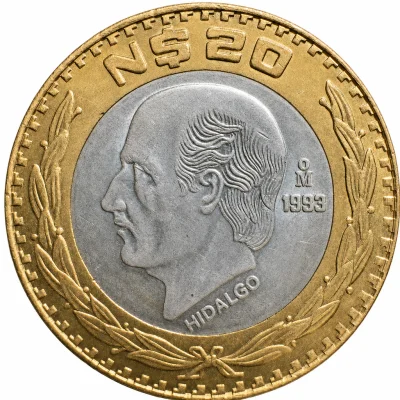
20 Nuevos Pesos Hidalgo
1993
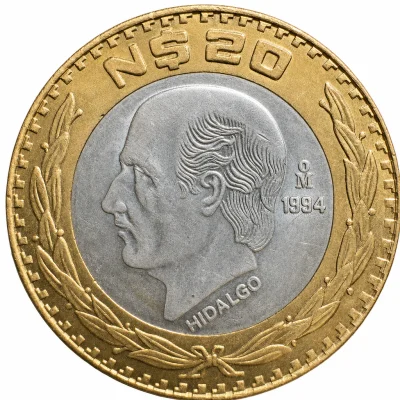
20 Nuevos Pesos Hidalgo
1994
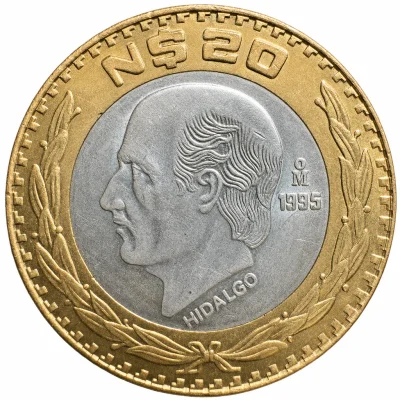
20 Nuevos Pesos Hidalgo
1995
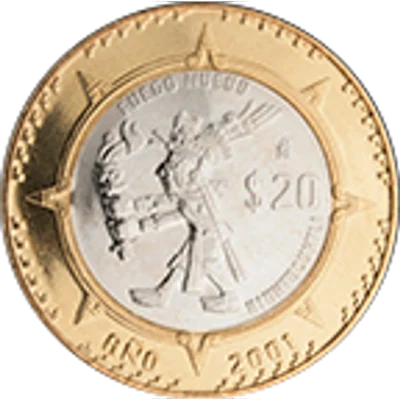
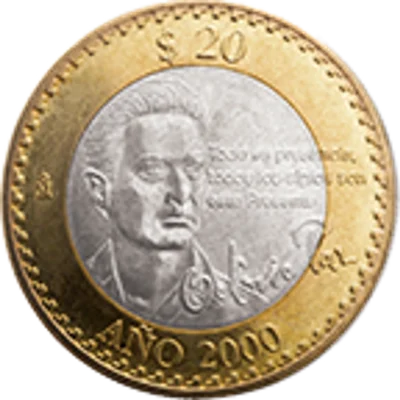
20 Pesos Año 2000, inicio del Tercer Milenio. Representación prehispánica de Xiuhtecuhtli "Señor del fuego, S
2001
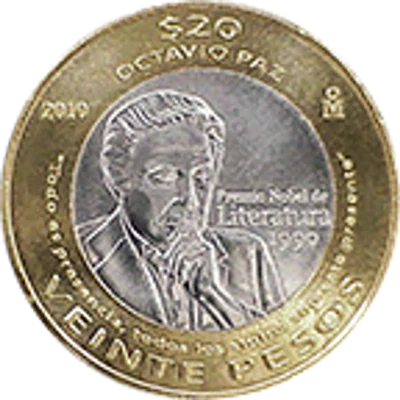
Llegada del Año 2001 y el Inicio del Tercer Milenio. Busto de tres cuartos de perfil a la derecha de Octavio Paz
2001
20 Pesos Conmemorativa del Vigésimo Aniversario de la entrega del Premio Nobel a Octavio Paz
2011
Official sources
Frequently asked questions
How much is the Mexican 20 pesos Fuego Nuevo (2000) worth?
In circulated condition it is worth about 1 to 3 US dollars, barely above face value. A loose uncirculated example runs 15 to 30 USD, and a sealed Banxico blister can reach the 30 to 50 USD range. Only pristine, certified pieces bring more.
Is the Fuego Nuevo 20 pesos coin rare?
No. Banxico struck about 14 million of the 2000 issue. The 2001 version is scarcer at roughly 2.5 million. With over 17 million made across both years, only true uncirculated or sealed examples carry any premium.
Is it true this coin sells for 500,000 pesos?
No. That figure comes from marketplace listings where anyone can post any price. No Fuego Nuevo coin has ever actually sold for that. Real market value runs from a couple of dollars for a worn coin up to the low tens of dollars for a sealed uncirculated one.
Where can I sell my Fuego Nuevo 20 pesos coin?
A verified dealer from the Pesoteca shop directory will value it on the spot, or you can list it on the Pesoteca buy-and-sell forum among collectors. Photograph the obverse, reverse, and edge and check the price range above before selling. Skip rushing to the first bidder on social media.
Conversation
0 comments
Sources
- Banxico
- Banco de México
Images for informational and educational purposes, attributed to their original source. Reference values; the real price depends on the grade, the specific variant and demand.
Loading comments…