
20 Pesos "Fuego Nuevo" Xiuhtecuhtli 2001: Value & How to Sell
The 20 Pesos "Fuego Nuevo" Xiuhtecuhtli 2001: Value & How to Sell is worth between $150 and $500 MXN depending on its grade of preservation.
Prices updated: August 2026
Bimetallic commemorative · Year 2001 · Xiuhtecuhtli · Mintage 2.5M
Bimetallic commemorative · Year 2001 · Xiuhtecuhtli · Mintage 2.5M
The 20 Pesos "Fuego Nuevo" Xiuhtecuhtli 2001: Value & How to Sell is worth between $150 and $500 MXN depending on its grade of preservation.
Prices updated: August 2026
How much is the 20 Pesos "Fuego Nuevo" Xiuhtecuhtli 2001: Value & How to Sell worth?
The estimated value of the 20 Pesos "Fuego Nuevo" Xiuhtecuhtli 2001: Value & How to Sell ranges from $150 (circulated, XF) up to $500 (official blister pack), with $373 as a reference for an uncirculated (UNC) piece. The estimate is based on the official mintage and the historical behavior of the family.
The real price depends on four factors: the grade of preservation (a circulated piece is worth the low end of the range; an uncirculated one, or one still in its official blister pack, the high end), the finish (satin vs mirror/proof), the rarity within the series based on the mintage, and the metal spot price on the day of the deal when the piece is silver or gold. Check the value-by-grade table above and compare with equivalent pieces before buying or selling.
Where to buy or sell this coin?
Browse the national directory of numismatic shops or the community forum to trade directly with other collectors.
Description
If you inherited a Mexican 20 peso coin with a fierce fanged figure on the back and "AÑO 2001" next to it, here's the honest answer: it's worth roughly 8 to 30 US dollars in collectible condition, not the half a million pesos some websites claim. It is genuinely scarce (about 2.5 million minted), which puts it above the common 2000 version, but the fantasy prices online are just unsold ads, not real sales.
That figure is the whole story most people are looking for. The rest of this page explains what the coin is, why the 2001 date matters, how to spot the scarce one, and where to sell it without getting lowballed.
What this coin actually is
This is the 20 peso commemorative Mexico issued to mark the start of the third millennium. The design is called "Fuego Nuevo" (New Fire) and the figure on the reverse is Xiuhtecuhtli, the Aztec Lord of Fire, rendered from pre-Hispanic art. The Banco de México (Mexico's central bank) released it in the year 2001.
It is a bimetallic coin: an outer ring of aluminum-bronze and an inner core of copper-nickel, the same two-tone construction used on modern circulating 10 and 20 peso coins. It contains no silver and no gold, so there is no melt value floor propping it up. Its worth is entirely collector-driven, which means date scarcity and condition are everything.
Specifications (keep these for authentication)
| Spec | Detail |
|---|---|
| Denomination | 20 Pesos |
| Design | "Fuego Nuevo" / Xiuhtecuhtli (Lord of Fire) |
| Year on this variety | 2001 |
| Composition | Bimetallic: aluminum-bronze ring, copper-nickel center |
| Weight | 15.945 grams |
| Diameter | 32 mm |
| Mintage (2001) | 2,500,000 |
| Issuer | Banco de México |
Why the 2001 is worth more than the 2000
There are two versions of this exact design, and they look identical except for one line of text. This is the single most important thing to check.
- AÑO 2000: roughly 15 million minted. Common. Worth a few dollars.
- AÑO 2001: about 2.5 million minted. Scarce. The one collectors want.
Look at the reverse, right next to the Xiuhtecuhtli figure. The date reads either "AÑO 2000" or "AÑO 2001." That's the only difference, there is no design change. If your coin is circulated and the date is worn, use good light and a loupe. If it says 2001, you have the better one, minted at about one-sixth the quantity of the 2000.
What it's really worth in 2026
In collectible condition, the Fuego Nuevo runs roughly 8 to 30 US dollars depending on year and grade. A worn, heavily circulated piece sits at the bottom. An uncirculated coin (UNC) with full luster and no spots reaches the top of that range, and a factory-sealed blister card can beat a loose UNC.
Grade drives the number more than anything else:
| Condition | What it means | Rough value (2001) |
|---|---|---|
| Circulated (worn) | Handled, dull, scratches | Low single digits USD |
| XF (Extra Fine) | Light wear, most detail sharp | Around 15 to 25 USD |
| UNC (Uncirculated) | No wear, full mint luster | Up to about 30 USD |
| Sealed blister | Original bank packaging | Above loose UNC |
The 2000 version in the same grade is worth noticeably less because it is far more common.
The "half a million pesos" myth
You have probably seen a headline claiming this coin sells for half a million pesos (tens of thousands of dollars). It doesn't. That number comes from listing prices, not completed sales. When Banco de México retires a coin, some sites post fantasy asking prices, and content farms report them as if they were auction results. A price someone typed into a listing is not proof anyone paid it.
The Fuego Nuevo is scarce, especially the 2001, but its real market value lives in the tens of dollars, not the tens of thousands. Anyone quoting you a five-figure price either doesn't know the market or is trying to sell you something.
How to tell if yours is genuine
Counterfeits of a coin worth 20 or 30 dollars are uncommon, but damaged coins get passed off as valuable "errors" all the time. Check the basics:
- Weigh it. It should be 15.945 grams on a jewelry scale. Off weight is a red flag.
- Measure it. Diameter should be 32 mm with a caliper.
- Inspect the relief. Genuine coins have crisp, dimensional detail. Fakes look flat, and the two metal colors are cleanly separated on a real one.
- Mind the "error" trap. Most "errors" circulating on social media are post-mint damage (dings, corrosion, cleaning), not factory mistakes. Genuine, verifiable mint errors (off-center strikes, die rotation, doubling) can raise value, but they are rare. If you think you have one, post clear photos in the Pesoteca forum for a second opinion before you assume it's worth more.
Where to sell it
To sell without getting lowballed:
- Photograph the obverse, reverse, and edge in good light.
- Confirm the date (2000 vs 2001) and estimate the grade using the table above.
- Take it to a verified dealer from the Pesoteca shop directory, who can value it on the spot, or list it in the Pesoteca buy-and-sell forum among collectors who know the coin.
Skip dumping it on general marketplaces to the first buyer who messages you. On a coin worth 30 dollars the difference is small, but the same habit costs you real money on better pieces.
If you're working through a millennium-series inheritance, two related coins are worth checking too: the 20 Pesos Octavio Paz "Arrival of 2001" and the more common 2000-dated Xiuhtecuhtli "Fuego Nuevo".
Got one and not sure whether it's the 2000 or the scarce 2001? Post a photo of the reverse in the Pesoteca forum and the community will confirm the date and rough grade for you.
Historical context
This piece came out as part of the commemorative issue for the turn of the millennium, which is why it carries the engraved legend "Fuego Nuevo" (New Fire): a direct link to the way the Mexica measured and renewed time.
Xiuhtecuhtli, the figure you see on the reverse, was the god of fire in the Mexica worldview. They called him the Turquoise Lord and the Lord of the Year, patron of the calendar and of the warmth of life. He presided over the New Fire ceremony (in Nahuatl, Toxiuhmolpilia, "the binding of the years"), a rite that took place only once every 52 years, when the 260-day ritual cycle (tonalpohualli) and the 365-day solar year (xiuhpohualli) coincided again.
That night all the fires of the Anáhuac were extinguished and the priests lit a new one on the Hill of the Star. It was believed that if the fire failed to catch, the world would end. That Mexico closed its own millennium with this image is no coincidence: it is the same gesture of renewing the cycle.
In 2001 about 2.5 million pieces were struck, considerably fewer than the nearly 15 million of 2000, which makes it the more sought-after of the two dates.
On this coin the year matters more than the design
There is a rule to this series almost no one tells you: here the year matters more than the design. The Fuego Nuevo has two dates, 2000 and 2001, with the same reverse, the same god and the same face. But nearly 15 million pieces came out of 2000 and barely about 2.5 million of 2001. And yet many people who inherit one don't even glance at the date: that is where the novice gives away a scarce piece thinking they have a common one. If you inherited several bimetallic 20-peso coins, sort them by year and set the 2001 aside before selling them as a block.
How to identify it
It shares the base format of the 20-peso family: dodecagonal (12 sides), bimetallic, 32 mm in diameter and 15.945 g in weight. On the reverse is the heart of the coin: the figure of Xiuhtecuhtli within a decorated circle, the legend "FUEGO NUEVO", the name "XIUHTECUHTLI", the peso sign, the number 20, and a stylized representation of solar radiance reminiscent of the Sun Stone. On the obverse, the National Coat of Arms with the eagle on the nopal, just like the whole series.
The only thing you really need to check is the year: on the reverse you will read "AÑO 2000" or "AÑO 2001". That is the difference between a common coin and a scarce one. There is no design variant between the two, no error, no hidden mark: only the date. Check that line under light and, if you can, with a loupe, because a circulated piece with a worn date is easy to confuse.
What it's worth (without the half-million tall tales)
The real market value in collectible condition runs between 150 and 500 pesos, and the range depends on two things: the year and the condition. The circulated 2000 is the common one of the pair; if someone offers it to you well above face value, that's scalper pricing. The circulated 2001 already has real scarcity: a used but legible piece is worth more than the 2000 in the same condition. The uncirculated (UNC) 2001, with luster and no spots or edge dings, is the top of the range and the one worth hunting.
You'll see posts shouting that this coin is worth half a million pesos. It's the same thing that happens with nearly every 20-peso coin that Banxico begins to withdraw: someone posts a listing with a fantasy price, a website picks it up as news, and that price never turns into a real sale. A listing is not a sale. The Fuego Nuevo is scarce, especially the 2001, but scarce doesn't mean half a million. For a real price reference and where to buy or sell, check the Pesoteca shop directory. If you're building the commemorative 20-peso series, go straight for the 2001 in good condition; you'll gather the 2000 without effort.
This piece belongs to the era
Nuevos Pesos y actualidad →Explore all the Mexican coins of this era, their historical context and how they connect to the monetary system of the period.
Piezas por grado en circulación
Proyección de cuántas piezas sobreviven hoy y cómo se distribuyen entre grados de conservación, a partir de la acuñación oficial y la antigüedad de esta moneda.
| Grado | Piezas | % |
|---|---|---|
| MS-65 Gem | 83,264 | 5.0% |
| MS-60–64 | 299,750 | 18.0% |
| AU-50–58 | 333,056 | 20.0% |
| XF-40–45 | 366,362 | 22.0% |
| VF-20–35 | 299,750 | 18.0% |
| F-12–15 | 166,528 | 10.0% |
| VG / G | 83,264 | 5.0% |
| AG-3 | 33,306 | 2.0% |
| Totales | 1,665,280 de 2,500,000 (66.6%) | |
Estimaciones basadas en la acuñación oficial, la antigüedad y curvas estándar de desgaste numismático (curva conmemorativa moderna (post-1990)). Los valores reales pueden variar según preservación específica, eventos de fundido, y demanda del mercado.
Other denominations from 2001
Monedas de 20 pesos · Bimetálica
Same denomination, other years
20 pesos Bimetálica · Monedas de 20 pesos
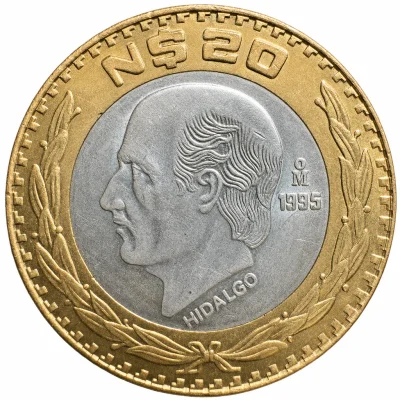
20 Nuevos Pesos Hidalgo
1995
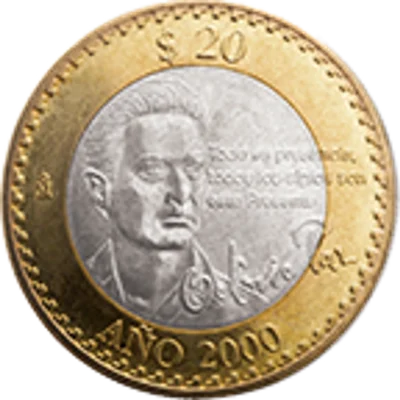
Llegada del Año 2000 y el Inicio del Tercer Milenio. Busto de tres cuartos de perfil a la derecha de Octavio Paz
2000
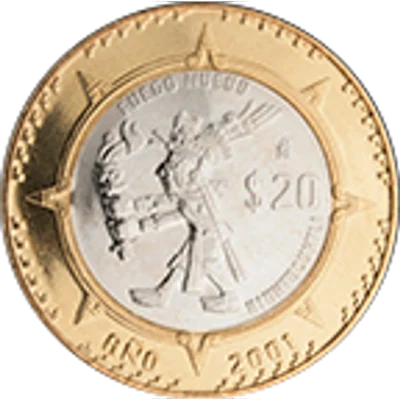
20 Pesos Año 2000, inicio del Tercer Milenio. Representación prehispánica de Xiuhtecuhtli "Señor del fuego, S
2000
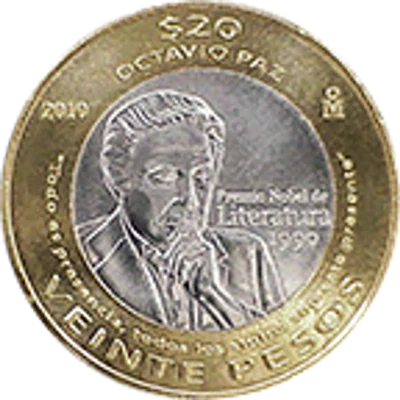
20 Pesos Conmemorativa del Vigésimo Aniversario de la entrega del Premio Nobel a Octavio Paz
2011
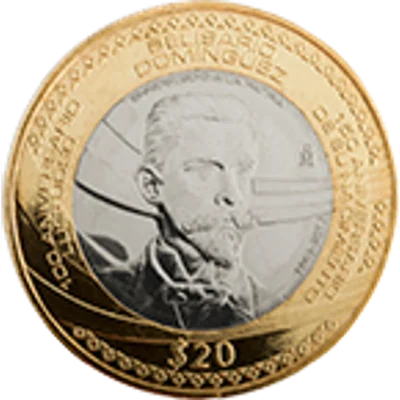
20 Pesos 150 Aniversario del Natalicio y el 100 Aniversario Luctuoso de Belisario Domínguez Palencia
2013
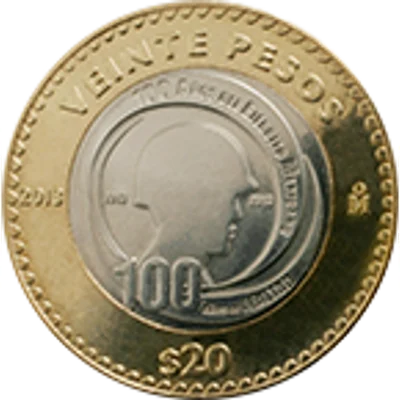
20 Pesos Centenario del Ejército Mexicano
2013
Official sources
Frequently asked questions
How much is the 2001 Fuego Nuevo 20 peso coin worth?
In collectible condition it runs about 8 to 30 US dollars depending on grade. A worn circulated piece sits at the low end; an uncirculated coin with full luster and no spots reaches the top, and a factory-sealed blister card beats a loose UNC. The 2001 is worth more than the 2000 in the same grade because it is far scarcer.
Is the 2001 version rare?
It's scarce, not rare. About 2,500,000 were minted for 2001, versus roughly 15 million for the 2000 date, so the 2001 is the one collectors seek. Check the reverse next to the Xiuhtecuhtli figure: it reads either 'AÑO 2000' or 'AÑO 2001.' That single line is the only difference between the two.
Is it true this coin sells for half a million pesos?
No. That figure comes from fantasy asking prices in listings, not completed sales, which content farms repeat as news when the coin is retired. A posted price is not proof of a sale. The Fuego Nuevo is scarce, especially the 2001, but its real market value is in the tens of dollars, not the tens of thousands.
Where can I sell it and how do I know it's genuine?
Sell through a verified dealer in the Pesoteca shop directory or the Pesoteca buy-and-sell forum, after photographing the obverse, reverse, and edge. To check authenticity, weigh it (should be 15.945 grams) and measure the diameter (32 mm) against the specs above. Fakes usually show wrong weight, flat relief, or poorly separated two-tone color.
Conversation
0 comments
Loading comments…