
20 Pesos Centenario del Ejército Mexicano 2013
The 20 Pesos Centenario del Ejército Mexicano 2013 is worth between $80 and $200 MXN depending on its grade of preservation.
Prices updated: August 2026
Bimetallic commemorative · 100 years of the Mexican Army
Bimetallic commemorative · 100 years of the Mexican Army
Design
Banxico
Reverse
The center of the reverse field is occupied by a composition formed by the profile silhouette of the bust of a soldier with a helmet, flanked by the years 1913 and 2013; with the legends "100 años del Ejército Mexicano", in an upper semicircle, and "100 años de lealtad", in a lower semicircle. In the upper margin the denomination VEINTE PESOS (in letters) can be seen; in the exergue the denomination $20 (in numerals); in the left margin the year of minting 2013 and, in the right, the mint mark of the Mexican Mint "M°"; border of elliptical frets.
Obverse
The National Coat of Arms in sculptural relief, with the legend ESTADOS UNIDOS MEXICANOS in an upper semicircle.
The 20 Pesos Centenario del Ejército Mexicano 2013 is worth between $80 and $200 MXN depending on its grade of preservation.
Prices updated: August 2026
How much is the 20 Pesos Centenario del Ejército Mexicano 2013 worth?
The estimated value of the 20 Pesos Centenario del Ejército Mexicano 2013 ranges from $80 (circulated, XF) up to $200 (official blister pack), with $156 as a reference for an uncirculated (UNC) piece. The estimate is based on the official mintage and the historical behavior of the family.
The real price depends on four factors: the grade of preservation (a circulated piece is worth the low end of the range; an uncirculated one, or one still in its official blister pack, the high end), the finish (satin vs mirror/proof), the rarity within the series based on the mintage, and the metal spot price on the day of the deal when the piece is silver or gold. Check the value-by-grade table above and compare with equivalent pieces before buying or selling.
Where to buy or sell this coin?
Browse the national directory of numismatic shops or the community forum to trade directly with other collectors.
Description
If you inherited or pulled a Mexican 20 Pesos Centenario del Ejército Mexicano 2013 out of a jar and hoped it was a small fortune, here is the honest answer: it is a common circulating coin worth close to face value. In 2026 an uncirculated example trades around 200 Mexican pesos (roughly 10 to 12 USD), and a worn one is worth barely a couple of dollars. Mexico struck 5 million of them.
What this coin actually is
"Centenario del Ejército Mexicano" translates to "Centennial of the Mexican Army." It is a commemorative 20-peso piece released by Banco de México (Banxico, Mexico's central bank) in 2013 to mark 100 years since the founding of the modern Mexican Army. The two dates you see on it, 1913 and 2013, refer to that century.
It is not silver and not gold. This is a bimetallic coin: an outer ring of aluminum-bronze and a center of cupronickel. There is no precious metal, so there is no melt value to fall back on. That single fact rules out the "it must be worth a lot" assumption most people start with.
The specs (verify yours against these)
| Feature | Specification |
|---|---|
| Denomination | 20 Pesos |
| Year | 2013 |
| Composition | Aluminum-bronze ring, cupronickel center (bimetallic) |
| Weight | 15.945 grams |
| Diameter | 32 mm |
| Shape | Dodecagonal (12-sided) |
| Mintage | 5,000,000 |
| Issued | August 15, 2013 |
How much is it worth?
Value tracks condition, and for a coin this common the spread is narrow.
| Condition | Approximate value |
|---|---|
| Circulated (worn, from pocket change) | Face value, about 1 to 2 USD |
| Uncirculated (no wear) | Around 200 Mexican pesos, roughly 10 to 12 USD |
| Sealed in original Banxico blister pack | A slight premium over a loose uncirculated coin |
The 200-peso reference is a validated buy price from the Pesoteca catalog. Do not expect an auction house to take interest in a normal example. With 5 million struck, supply comfortably meets demand.
Is it rare?
No. A mintage of 5 million makes this a widely circulated coin. You can still find them in change in Mexico, at coin shows, and in collector groups. If someone tells you this specific piece is scarce, they are wrong.
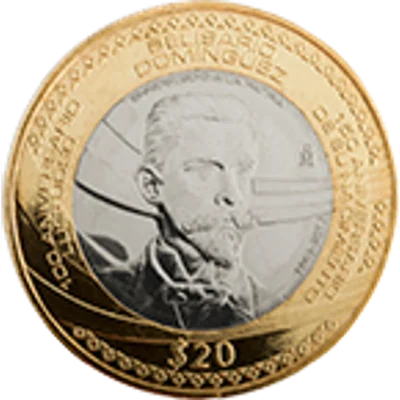
What is worth knowing: the 2013-2014 commemorative 20-peso program includes genuinely scarcer siblings. Pieces like the Belisario Domínguez 2013 and the Toma de Zacatecas 2014 had lower distribution and can command more. The Army centennial is the common one in the family.
How to tell yours apart from other 20-peso commemoratives
Banxico issued several bimetallic 20-peso coins that look alike at a glance. The Army piece is identified by its reverse: the profile silhouette of a soldier in a helmet, flanked by the years 1913 and 2013, with the legends "100 años del Ejército Mexicano" and "100 años de lealtad." It is 12-sided and bimetallic. Do not confuse it with the Navy (Plan de Marina) coin, which shows a sailor and is a separate issue.
How to check if it is genuine
Fakes of a low-value circulating coin are uncommon, but you can confirm authenticity in two minutes:
- Weigh it on a jewelry scale. It should read 15.945 grams.
- Measure the diameter with calipers. It should be 32 mm.
- Inspect the relief. Genuine strikes have crisp, dimensional detail and clean separation between the two metals. Flat relief or smeared colors are red flags.
Counterfeits usually miss on weight or diameter, or show flat, muddy detail.
What about "error" coins?
Genuine mint errors (off-center strikes, die rotations, double strikes) can multiply a coin's value when they are real and verifiable. Be skeptical: most "errors" people post online are post-mint damage, dings, scratches, and corrosion from handling, not factory mistakes. If you think you have a true error, post clear photos of the front, back, and edge in the Pesoteca forum so the community can weigh in.
Where to sell it
Because it is close to face value, keep it simple and skip the shady middlemen:
- A verified coin shop from the Pesoteca shop directory will appraise and buy it on the spot.
- The Pesoteca buy-and-sell forum connects you directly with collectors.
- Photograph the obverse, reverse, and edge, and check the price range on this page before you sell so you are not talked down.
Selling to the first bidder on social media is the fastest way to leave money on the table, though for a coin worth a few dollars, the risk is small either way.
Have one sitting in a drawer and not sure if it is worn or truly uncirculated? Post a photo in the Pesoteca forum and let collectors grade it before you decide what to do with it.
Historical context
The modern Mexican Army was born in the midst of the Revolution. After Victoriano Huerta's coup against Francisco I. Madero in February 1913, the Congress of Coahuila issued decree 1421 (February 19, 1913) disavowing Huerta and empowering Governor Venustiano Carranza to raise a force to restore constitutional order. Shortly after, on March 26, 1913, Carranza proclaimed the Plan of Guadalupe at the hacienda of the same name, in Coahuila, and from there arose the Constitutionalist Army, the seed of the armed institution we know today. That is why February 19 is celebrated as the Day of the Mexican Army.
This piece closes precisely that hundred-year circle: Banxico put it into circulation on August 15, 2013, to mark the centennial 1913-2013, with the legend "100 años de lealtad". It is one of the most hunted bimetallics of the C1 family, so if you come across it in your change, keep it.
From the Plan of Guadalupe to the entry into the capital
The origin the coin commemorates has a clear sequence. In February 1913 the Ten Tragic Days occurred: Victoriano Huerta betrayed and overthrew President Francisco I. Madero, who was later assassinated along with Vice President Pino Suarez. On February 19, 1913, the XXII Congress of Coahuila issued Decree 1421, which disavowed Huerta and gave Venustiano Carranza extraordinary powers to raise forces to restore order; that is why that day is the Day of the Mexican Army. The next step was the Plan of Guadalupe, signed on March 26, 1913, at the Hacienda de Guadalupe (Ramos Arizpe) after Carranza gathered some seventy military leaders: seven pragmatic articles that disavowed Huerta and named Carranza First Chief of the Constitutionalist Army, the direct origin of today's Armed Forces. The plan worked as designed: it united the scattered forces, ensured that the United States would not recognize Huerta, and he resigned in July 1914. The Federal Army was dissolved with the Treaties of Teoloyucan, and Carranza entered Mexico City on August 20, 1914.
How to identify it and how rare it is
It belongs to the C1 family of the 20 pesos: dodecagonal (12 sides) and bimetallic (cupronickel core, aluminum-bronze ring), 32 mm in diameter, about 15.94 g in weight, discontinuous reeded edge. The visual sign that distinguishes it from the whole series is on the reverse: the profile silhouette of the bust of a soldier with a helmet, flanked by the years 1913 and 2013, with the legends "100 AÑOS DEL EJÉRCITO MEXICANO" and "100 AÑOS DE LEALTAD". Don't confuse it with the sailor of the Plan de Marina, which is another piece. It has no design or year variants: it is 2013 and that's it, so be wary of any "rare variant".
On value, without tales of millions: Banxico reported an issue of 5 million pieces, of wide circulation, far from the scarce ones in the series (Toma de Zacatecas, Belisario Dominguez, Fuego Nuevo). At Pesoteca we place it between 80 and 200 pesos, and the range depends on condition: circulated, it is worth little above its 20-peso face value; uncirculated (UNC), with luster and no stains, or in the original Banxico blister, it approaches the high end. A key detail of these bimetallics: they tend to stain over time if not stored well, and a stained UNC loses much of its value. Check the ring and the helmet area against the light before paying a UNC price. It is one of the accessible pieces of the commemorative 20 pesos series, one of those you close early.
This piece belongs to the era
Nuevos Pesos y actualidad →Explore all the Mexican coins of this era, their historical context and how they connect to the monetary system of the period.
Piezas por grado en circulación
Proyección de cuántas piezas sobreviven hoy y cómo se distribuyen entre grados de conservación, a partir de la acuñación oficial y la antigüedad de esta moneda.
| Grado | Piezas | % |
|---|---|---|
| MS-65 Gem | 202,388 | 5.0% |
| MS-60–64 | 728,597 | 18.0% |
| AU-50–58 | 809,552 | 20.0% |
| XF-40–45 | 890,507 | 22.0% |
| VF-20–35 | 728,597 | 18.0% |
| F-12–15 | 404,776 | 10.0% |
| VG / G | 202,388 | 5.0% |
| AG-3 | 80,955 | 2.0% |
| Totales | 4,047,759 de 5,000,000 (81.0%) | |
Estimaciones basadas en la acuñación oficial, la antigüedad y curvas estándar de desgaste numismático (curva conmemorativa moderna (post-1990)). Los valores reales pueden variar según preservación específica, eventos de fundido, y demanda del mercado.
Other denominations from 2013
Monedas de 20 pesos · Bimetálica
Same denomination, other years
20 pesos Bimetálica · Monedas de 20 pesos
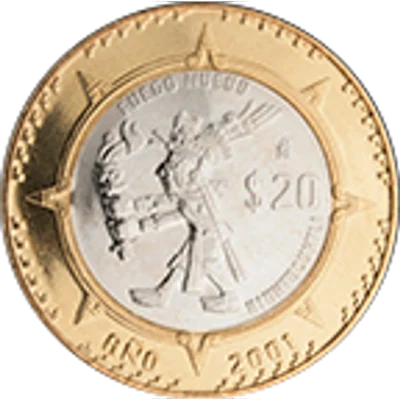
20 Pesos Año 2000, inicio del Tercer Milenio. Representación prehispánica de Xiuhtecuhtli "Señor del fuego, S
2001
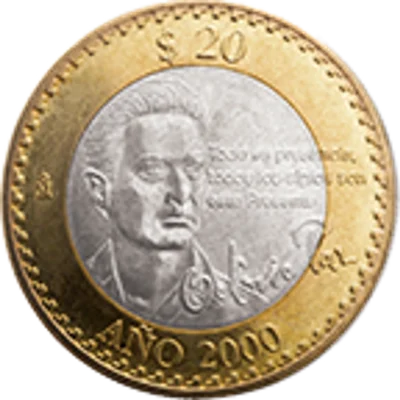
Llegada del Año 2001 y el Inicio del Tercer Milenio. Busto de tres cuartos de perfil a la derecha de Octavio Paz
2001
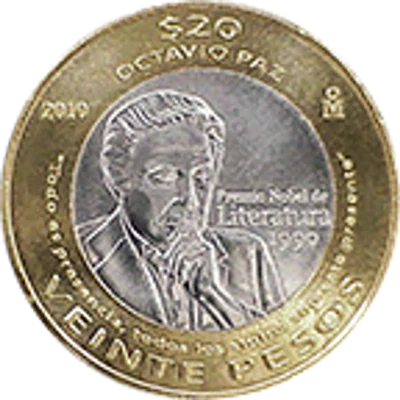
20 Pesos Conmemorativa del Vigésimo Aniversario de la entrega del Premio Nobel a Octavio Paz
2011
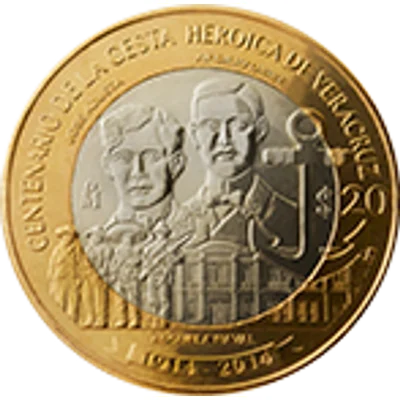
20 Pesos Centenario de la Gesta Heroica del Puerto de Veracruz
2014
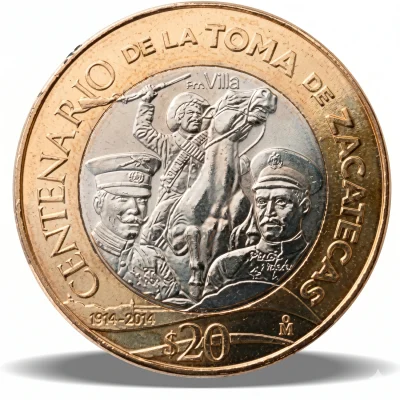
20 Pesos Centenario de la Toma de Zacatecas
2014
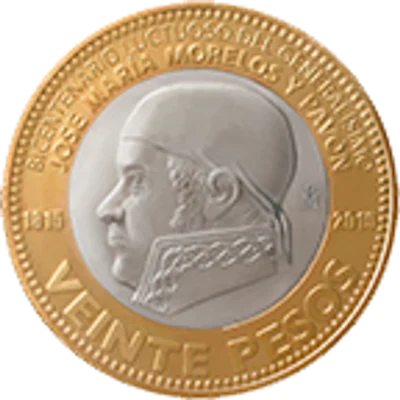
20 Pesos Bicentenario Luctuoso del Generalísimo José María Morelos y Pavón
2015
Official sources
Frequently asked questions
How much is the Mexican 20 Pesos Army Centennial 2013 worth in USD?
In circulated condition it is worth about face value, roughly 1 to 2 USD. An uncirculated example trades around 200 Mexican pesos, about 10 to 12 USD, and a coin sealed in its original Banxico blister pack carries a small premium over that.
Is the 20 Pesos Centenario del Ejército Mexicano 2013 rare?
No. Banco de México struck 5 million of them, so it is a common, widely circulated coin. Other pieces in the 2013-2014 commemorative series, such as Belisario Domínguez and Toma de Zacatecas, are much scarcer, but this one is not.
Where can I sell this coin?
The safest options are a verified coin shop from the Pesoteca directory, which appraises and buys on the spot, or the Pesoteca buy-and-sell forum with collectors. Photograph the front, back, and edge, and check this page's price range first. Avoid selling to the first bidder on social media.
How do I know if my coin is genuine?
Weigh it (it should be 15.945 grams) and measure the diameter (32 mm) against the specs above. Genuine coins have crisp, dimensional relief and clean separation between the two metals. Counterfeits usually have wrong weight or diameter, flat relief, or poorly distributed colors.
Conversation
0 comments
Sources
- Banxico
- Banco de México
Images for informational and educational purposes, attributed to their original source. Reference values; the real price depends on the grade, the specific variant and demand.
Loading comments…