
Mexico 5 Pesos Banknote (1969): Value & Prices
Familia A · algodón
Period: México Contemporáneo
Design
Banxico
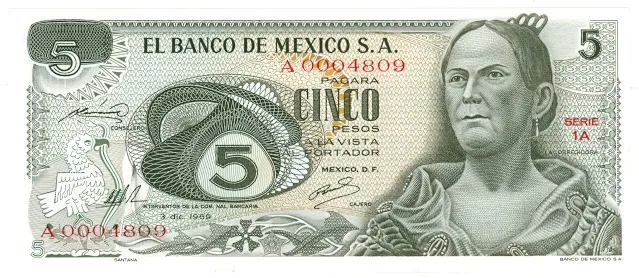
Obverse
Josefa Ortiz de Domínguez
Portrait of Josefa Ortiz de Domínguez, la Corregidora
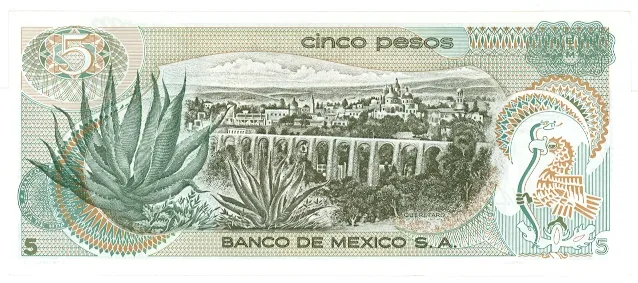
Reverse
The aqueduct and a view of the city of Querétaro among maguey plants
About this banknote
Most 1969 Mexican 5 pesos notes are worth a few US dollars. This was a common circulation note, and old does not mean valuable here. A crisp uncirculated example, a low or radar serial number, or a genuine printing error is what pushes the price into double digits or higher. Here is how to tell which one you have.
This is a Banco de México note from Familia A (Family A), the letter code the bank uses for a design series. It features Josefa Ortiz de Domínguez, known as la Corregidora de Querétaro, one of the few women on Mexican paper money of that era. She was the figure who warned the Querétaro conspirators that the independence movement had been discovered, helping trigger the 1810 uprising. The back shows the aqueduct of Querétaro, the arched stone waterwork that remains the city's emblem, set among maguey plants. The note is a sober greenish-brown, typical of late-1960s Mexican currency.
What it's worth in 2026
The 5 pesos note is long out of circulation, so its value is collector value, not face value. Condition drives the price more than anything.
- Circulated (folds, creases, soft corners): roughly 2 to 5 US dollars. These are common.
- Uncirculated (crisp, no folds, sharp corners, clean paper): typically 10 to 30 US dollars, more for a certified high grade.
- Low serial numbers, radar/palindrome serials, or early-series notes: a premium on top of the above.
- Genuine printing errors (misaligned cuts, ink smears, factory folds): the real money, sometimes several times the normal price.
Be skeptical of inflated online listings. The overwhelming majority of Family A notes are common and trade for a handful of dollars. "Old" and "scarce" are not the same thing.
| Note | Series | Condition | Approx. value (USD) |
|---|---|---|---|
| 5 pesos, Josefa Ortiz de Domínguez | Familia A (1969) | Circulated | 2 to 5 |
| 5 pesos, Josefa Ortiz de Domínguez | Familia A (1969) | Uncirculated | 10 to 30 |
| 5 pesos, Josefa Ortiz de Domínguez | Familia A (1969) | Low serial / radar | premium over above |
| 5 pesos, Josefa Ortiz de Domínguez | Familia A (1969) | Genuine print error | several times normal |
What actually adds value
Three things turn a common note into a note collectors chase: grade (uncirculated beats used every time), a special serial number (low numbers like 0000012, or radar serials that read the same forwards and backwards), and a genuine factory error. Normal wear and handling damage is not an error and does not add value. If you think your note has a real error, photograph both sides and post it to the Pesoteca forum so the community can confirm it before you assume anything.
How to tell if yours is genuine
Compare your note against official Banco de México images. Check the watermark when held to light, the security thread, the raised feel of the printing (intaglio texture), and the crispness of the design and signatures. Reproductions usually have smooth paper and flat, printed-looking colors instead of the sharp lines and texture of the original. When in doubt, ask on the forum.
Where to sell it
To sell the 1969 5 pesos note, your safest options are a verified dealer from the Pesoteca shop directory, who can appraise it on the spot, or the collector buy-and-sell forum where you deal directly with other collectors. Shoot clear photos of both sides in good light, and note any low or radar serial or possible error, since those raise the price. Don't dump it to the first Facebook offer. For context on what fakes to watch for in the market, see the most counterfeited banknotes in Mexico.
Got a 5 pesos note with an unusual serial or a factory error? Post it on the forum and let the community weigh in before you sell.
Historical context
The 1969 5-peso note features Josefa Ortiz de Domínguez, la Corregidora of Querétaro, one of the few women honored on Mexican paper money of the era. Wife of the corregidor Miguel Domínguez, she was a key figure in the conspiracy of 1810: when the plot was about to be discovered, she managed to warn the insurgents and precipitated the outbreak of the struggle for Independence. Her act cost her imprisonment and made her a national heroine.
The reverse nods to her homeland: the aqueduct of Querétaro among magueyes, with its characteristic colonial arches that still cross the city. It is a double tribute, to the woman and to the place that witnessed her deeds.
This piece belongs to family A of the "old pesos," the ones that circulated before the 1993 monetary reform removed three zeros from the peso. In 1969 the runaway inflation of the 1980s was still unthinkable, and a five-peso note served for daily spending.
Frequently asked questions
How much is the 1969 Mexico 5 pesos note worth?
A circulated example is worth roughly 2 to 5 US dollars, since it's a common note. An uncirculated copy (no folds, sharp corners, clean paper) typically runs 10 to 30 US dollars. Low or radar serial numbers and genuine printing errors bring much more. Condition and rarity drive the price, not age.
Is the 1969 5 pesos banknote rare?
No, not in general. It belongs to Banco de México's Familia A (Family A) and was printed in large numbers, so most examples are common. What's scarce is a top-grade uncirculated note, an early-series or low serial number, a radar serial, or a genuine factory error, and those command a premium.
Where can I sell my 1969 Mexico 5 pesos note?
Your safest options are a verified dealer from the Pesoteca shop directory, who can appraise it in person, or the Pesoteca collector buy-and-sell forum where you deal with other collectors. Photograph both sides in good light and flag any low serial, radar serial, or error before agreeing to a price.
How can I tell if the 1969 5 pesos note is genuine?
Check the security features: the watermark held to light, the security thread, and the raised feel of the printing. Compare the design, paper, and signatures against official Banco de México images. Reproductions usually have smooth paper and flat colors. If you're unsure, post photos on the Pesoteca forum for a second opinion.
Familia A
This banknote belongs to the BIL-A family within the Sistema PSM . Explore all the banknotes that share origin, era and design with this piece.
Ver todos los billetes de la familia A →