
Mexican 50 Nuevos Pesos Banknote (1992): Value & Prices
Familia A · algodón
Period: México Contemporáneo
Design
Banxico
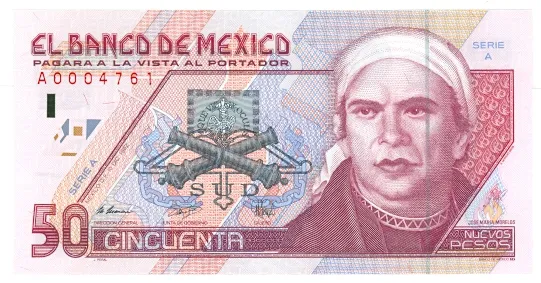
Obverse
José María Morelos
Portrait of José María Morelos and crossed swords
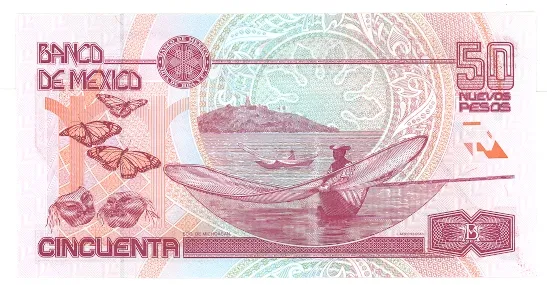
Reverse
A fisherman with a net and monarch butterflies
About this banknote
Most 1992 Mexican 50 nuevos pesos notes are worth a few dollars, not a fortune. This is a common banknote from a country that revalued its currency, so the internet listings promising hundreds are almost always wishful thinking. The real money is in condition and rarity: uncirculated notes, low serial numbers, and genuine print errors are the ones that actually command a premium in 2026.
What this note is
The front carries José María Morelos y Pavón, one of the leaders of Mexico's War of Independence, shown with crossed swords that nod to his role as a military commander. Collectors call this the Series A family ("familia A"), the design group Banco de México issued after the 1993 currency reform, when "nuevos pesos" (new pesos) replaced the old peso at 1,000 to 1.
The back shows a fisherman with a net and monarch butterflies. That same monarch motif was later reused on the pink Series F 50-peso note. The monarch butterfly is a pre-Hispanic symbol of Michoacán, the region Morelos came from.
Because the country revalued its currency, this note is no longer legal tender and can only be redeemed or collected, not spent. Its worth is a collector's value, not a face value.
What it's worth in 2026
Condition drives almost everything here. Notaphily (paper-money collecting) grades notes from heavily circulated up to Uncirculated (UNC), meaning no folds, no stains, sharp corners, and original crispness.
| Condition / feature | Typical collector value (USD) |
|---|---|
| Circulated, worn, folds | Under 5 dollars |
| Uncirculated, common serial | Roughly 10 to 30 dollars |
| Low serial number or radar/palindrome serial | Several times more, case by case |
| Genuine print error (misalignment, ink run, mis-cut) | A significant premium, sold individually |
These are collector ranges, not guaranteed offers. A note with an ordinary serial in worn shape is worth little more than novelty value. The features that lift the price are specific:
- Low serial numbers (like A0000123) and radar serials (palindromes that read the same forward and backward).
- Early series or notes still sealed in original bank packaging.
- Genuine print errors: cutting misalignment, ink smears from the factory, or off-center printing. Normal wear and handling damage is not an error and does not add value.
Most Series A notes are common. Be skeptical of online listings quoting large sums; the majority trade for a modest amount unless they carry one of the traits above.
How to tell if yours is genuine
This is an older paper note, so check the printed security elements against official Banco de México references:
- Watermark visible when you hold the note to the light.
- Security thread embedded in the paper.
- Microprinting that stays crisp under magnification.
- Raised intaglio print you can feel with a fingertip on the portrait and lettering.
Reproductions usually give themselves away with smooth, flat paper and printed colors that look uniform instead of layered. Compare the design, signatures, and paper texture to genuine images. If something looks off, post clear photos on the Pesoteca forum and let the community weigh in.
Where to sell it
World paper money has an active English-language market, so you have real options:
- eBay and specialty banknote dealers reach international collectors of Mexican and world notes.
- Graded banknote auctions (Heritage and Stack's Bowers both run currency sales) make sense only for genuine rarities, not common notes.
- The Pesoteca buy-and-sell forum connects you directly with collectors who know the series.
Before you list or sell, photograph both sides in good light, note the full serial number, and describe the condition honestly. If you suspect a low serial, radar, or a factory error, flag it, because those are what push the price well above face.
If you're trying to figure out what you actually have, check our guide to Mexico's most counterfeited banknotes and browse the wider Mexican banknotes reference.
Got one with an unusual serial or still in bank packaging? Post it on the forum and we'll help you pin down what it's worth.
Historical context
The 50 pesos of 1992 gives the stage to José María Morelos y Pavón, the priest and soldier who took command of the Independence movement after the deaths of Hidalgo and Allende. Author of the Sentimientos de la Nación (1813), he was the great political and military organizer of the insurgency until his execution in 1815. The crossed swords that accompany his portrait allude to his role as a strategist in the field.
The reverse breaks with expectations and shows a naturalist scene: a fisherman with a net and monarch butterflies, an evocation of Mexican landscapes and biodiversity, a stylistic turn of the last issues of the A family.
This piece belongs to the final "old pesos." Issued in 1992, it barely circulated before the reform of January 1993 removed three zeros from the peso and the country began counting in new pesos.
Frequently asked questions
How much is a 1992 Mexican 50 nuevos pesos note worth?
A worn, circulated example is worth only a few dollars. An uncirculated note with a common serial runs roughly 10 to 30 USD to collectors, and notes with low serial numbers, radar (palindrome) serials, or genuine print errors sell for several times more. Condition and rarity decide the price.
Is the 1992 50 nuevos pesos note rare?
No, most Series A notes are common. The note itself is easy to find. What is scarce, and what actually adds value, is an uncirculated grade, a low or radar serial number, an early series, or a genuine factory print error.
Where can I sell a 1992 Mexican 50 nuevos pesos note?
World paper money sells well on eBay and through specialty banknote dealers, and you can also list it on the Pesoteca buy-and-sell forum among collectors. Reserve graded auctions like Heritage or Stack's Bowers for genuine rarities. Photograph both sides, record the full serial number, and describe the condition honestly before selling.
How can I tell if my 1992 50 nuevos pesos note is genuine?
Check the watermark against the light, the embedded security thread, the microprinting under magnification, and the raised intaglio print you can feel on the portrait. Reproductions usually have smooth paper and flat, uniform colors. Compare it to official Banco de México images, and post photos on the Pesoteca forum if you have doubts.
Familia A
This banknote belongs to the BIL-A family within the Sistema PSM . Explore all the banknotes that share origin, era and design with this piece.
Ver todos los billetes de la familia A →