
Mexico 50 Pesos Banknote (2000, Series D)
Familia D · algodón
Period: México Contemporáneo
Design
Banxico
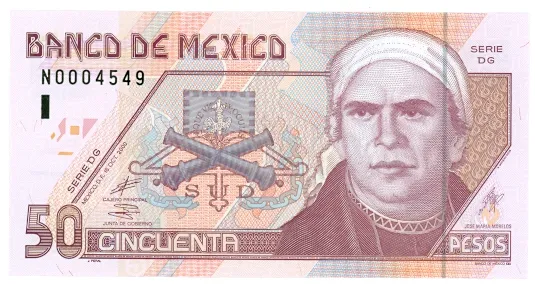
Obverse
José María Morelos y Pavón
Portrait of José María Morelos
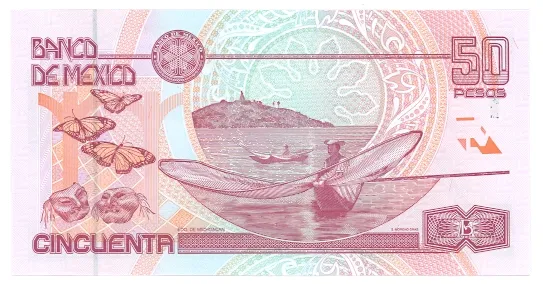
Reverse
Mojarra fishing and the aqueduct of Morelia
About this banknote
Most Mexico 50 pesos notes from around 2000 are worth face value, roughly 2.50 to 3 USD as pesos. The version collectors actually pay a premium for is uncirculated, has a low or radar serial number, carries a printing error, or is the special 75th-anniversary variant. Here's how to tell what you have.
This is the Series D (familia D) 50 pesos featuring José María Morelos y Pavón, the paper predecessor to the pink polymer note in circulation today. The back shows the mojarra fishery and the aqueduct of Morelia, in the state of Michoacán. The note has been withdrawn from circulation, which is exactly when collectors start assembling complete series in crisp condition.
What it's worth in 2026
If you found one in a drawer and it's worn, folded or stained, treat it as pocket money: it's worth face value, about 2.50 to 3 USD depending on the exchange rate. There is no old-note magic here. A used Series D 50 pesos is common paper.
The value jumps only under three specific conditions:
- Uncirculated (UNC). No folds, no soft corners, no handling marks, original crispness. A clean UNC example typically trades in the 5 to 15 USD range among collectors, more if graded.
- Special serial number. A very low serial (like 0000123), a radar/palindrome serial (reads the same both ways, e.g. 1234321), or a repeater can push a common note well above face, sometimes 20 to 60 USD or more depending on how striking the number is.
- Genuine printing error. Misaligned cuts, ink smears, foldovers, or off-center serials turn an ordinary note into a rarity worth several times face. Normal wear and handling damage is not an error.
| Attribute | Typical value (USD) |
|---|---|
| Circulated, worn | Face value (~2.50 to 3) |
| Uncirculated, common serial | 5 to 15 |
| Low / radar / repeater serial | 20 to 60+ |
| Genuine printing error | Several times face, case by case |
| 75th-anniversary variant (UNC) | Premium over the common note |
The 75th-anniversary variant to look for
This note has a commemorative variant marking the 75th anniversary of the Banco de México (1925-2000). It is not a different design. It is the same Series D 50 pesos with an added commemorative inscription, printed on cotton paper. Banxico did the same across several denominations from that era.
For collectors, the 75th-anniversary variant is more sought after than the plain note of the same year. Check the note carefully for the anniversary inscription. That single detail can be the difference between face value and a real premium. If you're not sure whether yours carries it, post clear photos on the Pesoteca forum and the community will confirm.
How to tell if yours is genuine
Series D notes on paper are old enough that reproductions exist. Check the standard security features: the watermark visible when held to light, the security thread, microprinting, and the raised feel of the intaglio ink on the portrait. Compare the design, paper texture and signatures against official Banco de México reference images. Reproductions usually have smooth paper and flat, lifeless colors. When in doubt, ask on the forum before you buy or sell.
Where to sell it
World paper money (notaphily) is an active English-language market, so a Mexican note is easy to place if it has a premium feature. For a common circulated note, don't expect more than face. For an uncirculated example, a special serial, or the anniversary variant, the safest route is a verified numismatic dealer from the Pesoteca directory, who can value it on the spot, or the Pesoteca buy-and-sell forum among collectors. Photograph both faces in good light, note the serial number, and flag any error before you agree to a price. Avoid dumping it on general marketplaces to the first bidder.
Worth reading next: why the 20 peso note is leaving circulation and the most counterfeited banknotes in Mexico.
Have a Series D 50 pesos with an odd serial, the anniversary inscription, or a possible error? Post it on the Pesoteca forum and let's see what you've got.
Fun fact
There is a commemorative variant of this note for the 75th anniversary of the Banco de México (1925-2000): the same design with a special legend added. Collectors seek it more than the common note.
Historical context
This 50-peso note of family D bears on its obverse José María Morelos y Pavón, priest of Carácuaro and one of the great leaders of Independence, author of the Sentiments of the Nation and organizer of the Congress of Anáhuac.
The reverse leaves the heroic realm to show a Michoacán scene: the fishing of the mojarra and the aqueduct of Morelia, an eighteenth-century hydraulic work that supplied the state capital. The choice is no accident, since Morelia (formerly Valladolid) was Morelos's homeland, so obverse and reverse converse around the same geography.
This series circulated between 1996 and 2006, with the peso now consolidated and without the N$, and sought to combine the faces of the homeland with regional landscapes and trades, a formula that gave the whole family D its identity.
Frequently asked questions
How much is the Mexico 50 pesos (2000) note worth?
A worn, circulated example is worth face value, roughly 2.50 to 3 USD as pesos. An uncirculated note runs about 5 to 15 USD among collectors. A special serial number (low, radar, or repeater) or a genuine printing error can push it to 20 to 60 USD or more. Condition and rarity drive the price.
Is the 2000 Mexico 50 pesos note rare?
The common circulated note is not rare, it's ordinary paper. Rarity comes from specific traits: uncirculated condition, a low or palindrome serial number, a real printing error, or the 75th-anniversary variant of the Banco de México (1925-2000), which carries an added commemorative inscription and is more sought after than the plain note.
Where can I sell a Mexico 50 pesos (2000) note?
For a note with a premium feature, use a verified dealer from the [Pesoteca directory](/tiendas), who values it in person, or the [buy-and-sell forum](/foro/compra-venta) among collectors. World paper money is an active market internationally. Photograph both faces, record the serial number, and note any error before agreeing on a price. Avoid selling to the first bidder on general marketplaces.
How do I tell if my 50 pesos (2000) note is genuine?
Check the security features: watermark held to light, security thread, microprinting, and the raised feel of the ink on the portrait. Compare the design, paper and signatures with official Banco de México reference images. Reproductions typically have smooth paper and flat colors. If unsure, post photos on the [Pesoteca forum](/foro).
Familia D
This banknote belongs to the BIL-D family within the Sistema PSM . Explore all the banknotes that share origin, era and design with this piece.
Ver todos los billetes de la familia D →