
Mexican 50 Pesos Banknote (2004): Value & Rarity
Familia D · polímero
Period: México Contemporáneo
Design
Banxico
Obverse
José María Morelos y Pavón
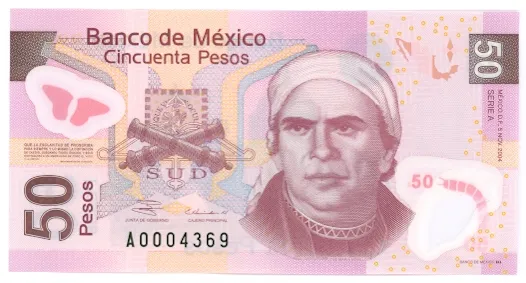
Portrait of José María Morelos
Reverse
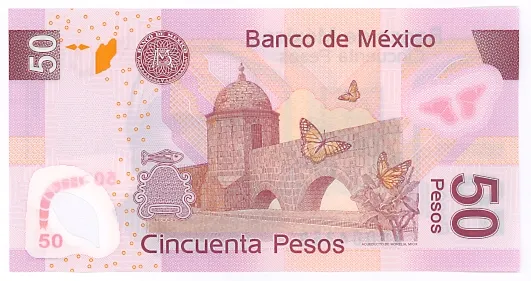
Mojarra fishing and the aqueduct of Morelia
About this banknote
Most Mexican 50 pesos notes from 2004 are worth exactly their face value, roughly a few US dollars at the exchange rate. The ones collectors actually pay a premium for are uncirculated examples, notes with special serial numbers, and genuine printing errors. Here is how to tell which one you have.
This is the Series D 50 pesos note featuring José María Morelos y Pavón, a hero of Mexico's War of Independence. It is the paper version that came before the pink polymer note now in circulation. If you inherited a box of Mexican currency, this is one of the notes you are most likely to find.
What it looks like
The front carries the portrait of Morelos. The back shows the fishing of the mojarra (a traditional net-fishing scene) and the aqueduct of Morelia, in the state of Michoacán. It is a standard Banco de México note, part of what the bank calls the Series D (familia D) family, the lettering system Mexico uses to mark each generation of note design.
Because this design has been withdrawn from circulation, it has become one of the notes collectors seek out to complete a full family set. That withdrawal is exactly what starts to create collector demand: once a denomination stops circulating, uncirculated examples get harder to find.
What it's actually worth
A circulated, worn 2004 50 pesos note is worth its face value and nothing more. There is no hidden fortune in a used one. Three things, and only three, push the price above face:
- Uncirculated condition. Crisp, no folds, no stains, no soft corners. A note fresh from a pack is worth several times a worn one to a collector.
- Special serial numbers. A very low serial (like 0000023), a solid or radar/palindrome serial (reads the same forwards and backwards), or repeated digits. These sell for a multiple of face.
- Genuine printing errors. Misaligned cuts, ink smears, factory folds, missing print, or off-center serials. A real error turns a common note into something collectors chase.
| Note | Series | Condition | Approx. collector value |
|---|---|---|---|
| 50 pesos, 2004 | D | Worn / circulated | Face value only |
| 50 pesos, 2004 | D | Uncirculated (crisp) | A few times face |
| 50 pesos, 2004 | D | Low serial or palindrome | Several times face |
| 50 pesos, 2004 | D | Genuine printing error | Highest, varies by error |
One warning: ordinary wear and use damage is not a printing error. A crease from someone's wallet does not add value. Only a fault made at the print works counts.
Is it rare?
By itself, no. Millions of Series D 50 pesos notes were printed and circulated for years. What makes an individual note scarce is the combination of top condition plus an interesting serial or a factory error. A common used note is common; a pack-fresh note with serial 0000001 is not.
How to tell if yours is genuine
Check the standard Banco de México security features against official reference images:
- Watermark visible when held to the light.
- Security thread running through the paper.
- Microprinting in the design.
- Raised ink (intaglio) you can feel with a fingertip.
Reproductions and photocopies usually give themselves away with smooth, flat paper and flat colors, with no raised texture and no real watermark. Compare the paper, the portrait detail, and the signatures with official images. If anything looks off, post clear photos of both sides in the Pesoteca forum and let the community weigh in.
Where to sell it
The safest route is a verified dealer from the Pesoteca shop directory, who can appraise it on the spot, or the collector buy/sell forum, where you deal directly with other collectors. Before you sell, photograph both faces in good light and check for a low serial, a palindrome, or an error, since those raise the price. Avoid dumping it to the first bidder on social media.
To put this note in context, see why Mexico's 20 pesos note is being phased out and Mexico's most counterfeited banknotes by the numbers.
Think your 50 pesos has an odd serial or a factory error? Post it in the forum and we'll look at it together.
Historical context
A 2004 date variant of this 50-peso note of Family D, the series that carried the peso, now without the N$ of the new pesos, throughout the country between 1996 and 2006. The obverse keeps José María Morelos y Pavón, the generalísimo who sustained the insurgency after the death of Hidalgo and gave political form to the movement at the Congress of Chilpancingo.
The reverse repeats the Michoacán scene of the mojarra fishing beside the aqueduct of Morelia, a tribute to the landscape and trades of the state that saw Morelos born.
The late issues of Family D, like this one, tend to incorporate gradual improvements in security features compared to the first printings, a detail that collectors follow closely when comparing dates within a single denomination.
Frequently asked questions
How much is the 2004 Mexican 50 pesos note worth?
A worn, circulated note is worth its face value, roughly a couple of US dollars at the exchange rate. As a collectible, an uncirculated example, one with a special serial number, or one with a genuine printing error can sell for several times face. Condition and rarity drive the price.
Is the 2004 50 pesos note rare?
Not on its own. Millions were printed and it circulated for years, so a common used note is easy to find. What makes a single note scarce is top uncirculated condition combined with a low or palindrome serial, or a real factory error.
Where can I sell my 2004 50 pesos note?
The safest options are a verified dealer from the [Pesoteca shop directory](/tiendas), who values it in person, or the [buy/sell forum](/foro/compra-venta) among collectors. Photograph both sides in good light and note any low or palindrome serial or error, since those raise the value. Avoid selling to the first bidder on social media.
How do I know if my 2004 50 pesos note is genuine?
Check the security features: a watermark visible against the light, the security thread in the paper, microprinting, and raised ink you can feel. Compare the paper, portrait, and signatures with official Banco de México images. Reproductions usually have smooth paper and flat colors. If unsure, ask in the [forum](/foro).
Familia D
This banknote belongs to the BIL-D family within the Sistema PSM . Explore all the banknotes that share origin, era and design with this piece.
Ver todos los billetes de la familia D →