
Mexico 500 Peso Benito Juárez Banknote (Family G): Value Guide
Familia G · algodón
Period: México Contemporáneo
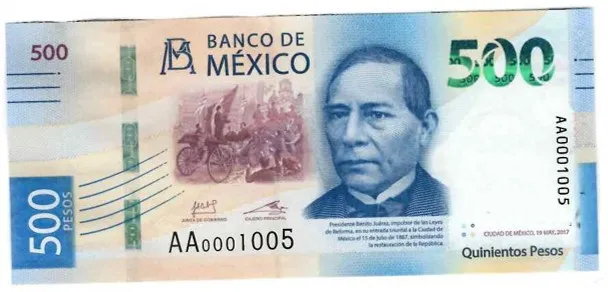
Design
Banxico
Obverse
Benito Juárez
Portrait of Benito Juárez with the process of the Reform
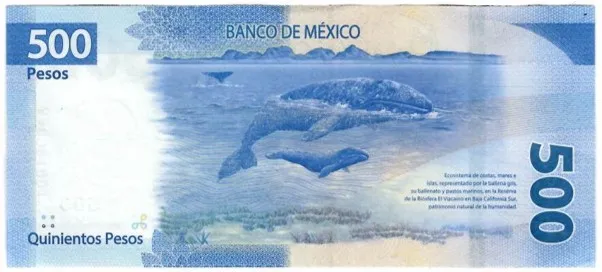
Reverse
A gray whale and its calf
Pacific coasts and seas ecosystem · Gray whale (Eschrichtius robustus)
About this banknote
If you're holding a Mexican 500 peso note with Benito Juárez on the front and gray whales on the back, here's the honest answer: most examples are worth exactly their face value, about 25 to 30 US dollars depending on the exchange rate. The premium copies (uncirculated notes, low or radar serial numbers, and genuine printing errors) are the ones collectors actually chase. This page tells you which is which.
This is the 500 peso note of Family G (familia G), the current generation of Mexican banknotes issued by the Banco de México. It was the first note of the new family to enter circulation, on August 27, 2018. The front features Benito Juárez, the 19th-century president tied to the Reform era and the restoration of the Republic. Because it is a current, circulating note, an everyday used example is worth its face and nothing more.
What it's actually worth
Let's separate the two realities.
A circulated note is worth face value. If your 500 peso Benito Juárez note has folds, soft corners, or handling wear, it is worth 500 pesos, which converts to roughly 25 to 30 US dollars. That is not a collectible; that is spending money. No age, no myth, no premium.
Three things push it above face:
- Uncirculated condition. A crisp note with no folds, no stains, no soft corners, ideally straight from a bank pack. Graded examples in a holder from PMG (Paper Money Guaranty) command a modest premium over face, especially in top grades like 66 or 67 EPQ.
- Special serial numbers. A low serial (like A0000123), a radar/palindrome serial (reads the same forwards and backwards, e.g. 1234321), a solid serial (all same digit), or a repeater. These are the numbers world paper money collectors pay real premiums for.
- Genuine printing errors. Miscut notes, ink smears, misaligned printing, factory folds, or duplicated serials. A true production error can be worth several times face. Ordinary wear and damage from use is not an error and adds nothing.
The pattern in notaphily is simple: current-issue notes stay at face until the denomination starts being pulled from circulation. That is when uncirculated and packaged examples start climbing.
The note in detail
| Feature | Detail |
|---|---|
| Denomination | 500 pesos |
| Series / family | Family G (current generation) |
| Front (obverse) | Benito Juárez, Reform and restoration of the Republic |
| Back (reverse) | Gray whale and calf, El Vizcaíno Biosphere Reserve (Baja California Sur), a UNESCO World Heritage Site |
| Theme | Historical identity, natural heritage |
| First circulated | August 27, 2018 |
| Issuer | Banco de México |
The reverse showcases Mexico's natural heritage: a gray whale with her calf in the El Vizcaíno Biosphere Reserve in Baja California Sur. The whole Family G design theme is "historical identity, natural heritage."
How to tell if yours is genuine
World paper money is faked, so check the built-in security features before you pay for or accept one:
- Watermark: hold it to light. The watermark portrait should be part of the paper itself, subtle and shaded. A printed-on fake watermark looks flat and sits on the surface.
- Security thread: a woven thread visible against light.
- Raised printing: run your finger over the main design. Genuine intaglio printing has texture you can feel. A counterfeit usually feels smooth and flat.
- Microprinting: tiny text that stays sharp under magnification.
- Color-shifting ink on key elements that changes hue as you tilt the note.
A note that feels slick, shows no raised texture, and has a watermark that only appears printed on the surface is a red flag.
Where to sell it
Because a plain circulated example is only worth face, don't overthink it if yours is worn. If you have an uncirculated note, a special serial, or a suspected error, photograph both sides in good light and get it in front of collectors. Your options:
- A verified dealer from the Pesoteca shop directory, who can value it on the spot.
- The Pesoteca buy-and-sell forum, where collectors trade directly.
For context on how the current banknote family works and what to watch for, see why the 20 peso note is leaving circulation and Mexico's most counterfeited banknotes.
Have one with an odd serial number or what looks like a factory error? Post clear photos of both sides in the forum and the community will help you confirm whether it's the real thing.
Fun fact
It was the first note of family G to be announced, and its reverse featuring the gray whale of El Vizcaíno made it very popular. It replaced the controversial Diego Rivera and Frida Kahlo note.
Historical context
This 500-peso note belongs to family G, the current series of Mexican paper money and the most modern in circulation. Its obverse is dedicated to Benito Juárez, presented alongside the process of the Reform, the nineteenth-century liberal movement that separated Church from State and laid the foundations of a secular Mexico.
The reverse breaks with the tradition of historical scenes and celebrates nature: a gray whale and its calf, an emblematic species that every winter comes to the lagoons of Baja California Sur to breed, within family G's marine ecosystem.
Thus this piece combines civic memory on the obverse with the natural wealth of northwestern Mexico on the reverse. It is a distant heir of those first new pesos of 1993, but now with a fully contemporary design and security language.
A note honored worldwide
The 500-peso note, the Benito Juárez one, opened family G's winning streak: it took the Best New Banknote of Latin America 2019 award from Reconnaissance International. It was the first in the series to be honored.
Frequently asked questions
How much is the Mexican 500 peso Benito Juárez note worth?
A circulated example is worth face value, about 25 to 30 US dollars depending on the exchange rate. As a collectible it climbs only when the note is uncirculated, carries a special serial number (low, radar, or solid), or has a genuine printing error. Condition and rarity drive the price.
Is the 500 peso Benito Juárez note rare?
No, it is a current circulating note from Family G, first issued in 2018, so ordinary examples are common and worth face. Rarity comes from specific traits: crisp uncirculated condition, a low or palindrome serial number, or a factory printing error. Those are the copies collectors seek.
Where can I sell my 500 peso Benito Juárez note?
Use a verified dealer from the [Pesoteca shop directory](/tiendas) for an on-the-spot valuation, or the [Pesoteca buy-and-sell forum](/foro/compra-venta) to trade with collectors directly. Photograph both sides in good light and note any low serial, radar serial, or error, since those raise the value. Don't dump it to the first buyer on social media.
How can I tell if the 500 peso Benito Juárez note is genuine?
Check the security features: hold it to light for the watermark and security thread, feel for raised intaglio printing, and look for microprinting and color-shifting ink. A fake usually feels smooth and flat, with a watermark that appears printed on the surface instead of built into the paper. When in doubt, ask in the [forum](/foro).
Características Banxico
Tipo G
Familia G
This banknote belongs to the BIL-G family within the Sistema PSM . Explore all the banknotes that share origin, era and design with this piece.
Ver todos los billetes de la familia G →