
The numismatic history of Mexico is the economic history of an empire, a colony, two empires, several republics and a modern country. Five centuries of continuous minting make Mexico one of the deepest numismatic niches in the world, and the Mint of Mexico the oldest minting institution in all of the Americas.
This guide documents the complete history, decade by decade, with real pieces from the Pesoteca catalog, official sources (Banxico, the Mint, INAH, DOF) and verifiable data. If you arrived looking only for a specific era, use the table of contents above. If you want the full picture, read on.
The origin: Mint of Mexico (1535)
Key facts
- Founding: May 11, 1535, by Royal Decree.
- Signing monarchs: Charles I of Spain and Queen Joanna.
- Historical status: the first minting institution in all of the Americas.
- First issue: 1536, "Charles and Joanna" coins in quartillos, half reales and silver reales.
- Initial emblem design: Pillars of Hercules with a furled banner (likely origin of the "$" symbol).
The Mint of Mexico was founded by Royal Decree of May 11, 1535, issued by King Charles I of Spain and Queen Joanna. It is the oldest minting institution in the Americas and remained the main producer of silver coins for the Spanish Empire for nearly three centuries.
The founding answered a practical need: New Spain produced massive quantities of silver mined from Zacatecas, Taxco, Guanajuato and Pachuca, but until then all that silver traveled to Spain as ingots. Minting it locally in Mexico allowed the production to be monetized and boosted internal trade and trade with the Philippines.
The first issue came out in 1536: "Charles and Joanna" pieces in quartillos, half reales and silver reales. The design included the Pillars of Hercules (symbol of the Spanish Empire) and the monarchs' monogram. Today the Charles and Joanna pieces are extremely rare and worth hundreds of thousands of pesos.
Colonial Era / Viceroyalty (1536-1821)
Key facts
- Duration: 285 years (1536-1821), the longest era.
- Three sub-periods: Cobs (1572-1732), Pillar dollars (1732-1772), Busts (1772-1821).
- Dominant piece: the Mexican 8 reales peso, the world's trade coin for 250 years.
- Spanish kings depicted: from Charles I to Ferdinand VII.
- Silver production: New Spain was the world's leading silver producer for 3 centuries.
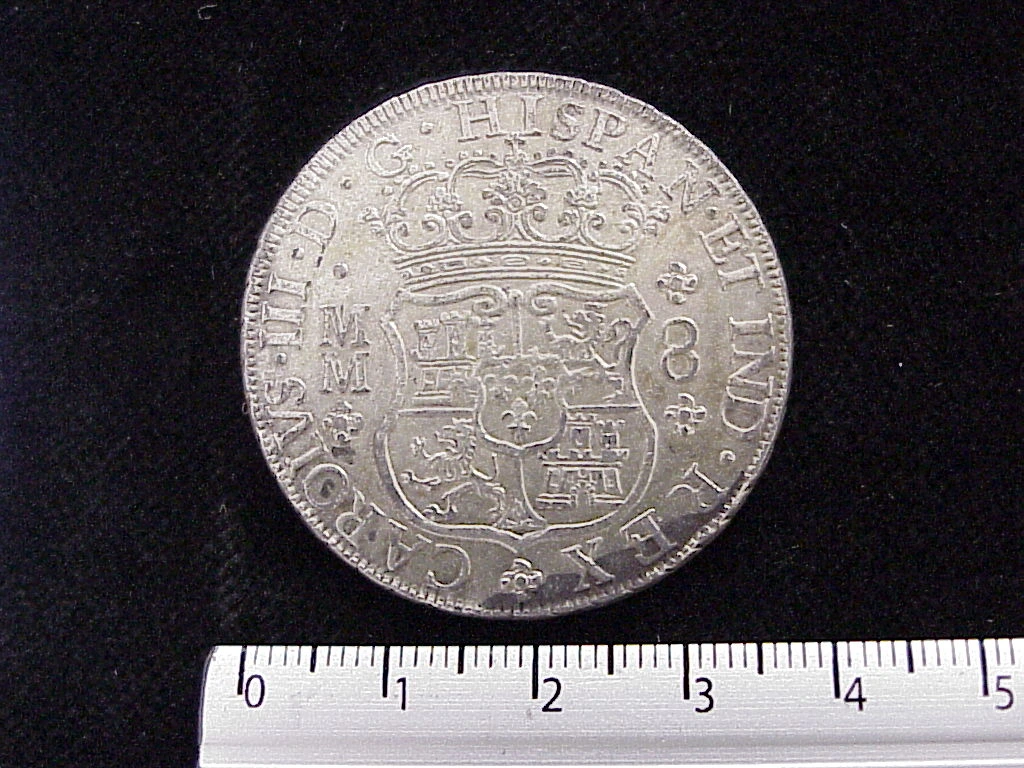
The era of the cobs (1572-1732)
For 160 years, Mexican coins were struck "by hammer": silver planchets crudely cut and struck with dies. The result is irregularly shaped pieces called "cobs" (from the Spanish "macuquina"). The weight was standard (the "real" weighed exactly the same across all pieces), but the shape varied.
Cobs are today rare and prized collector pieces. The PSM-MAC family in the Pesoteca catalog documents specific varieties. See the colonial 8 reales catalog.
The pillar dollars (1732-1772)
Philip V's reform of 1732 introduced the screw press: technology that allowed uniform round edges and improved dies. The first pieces produced with this technology were the "pillar dollars" (columnarias), so named for the two Pillars of Hercules dominating the reverse. They are the colonial pieces with the most internationally recognized design.
The busts (1772-1821)
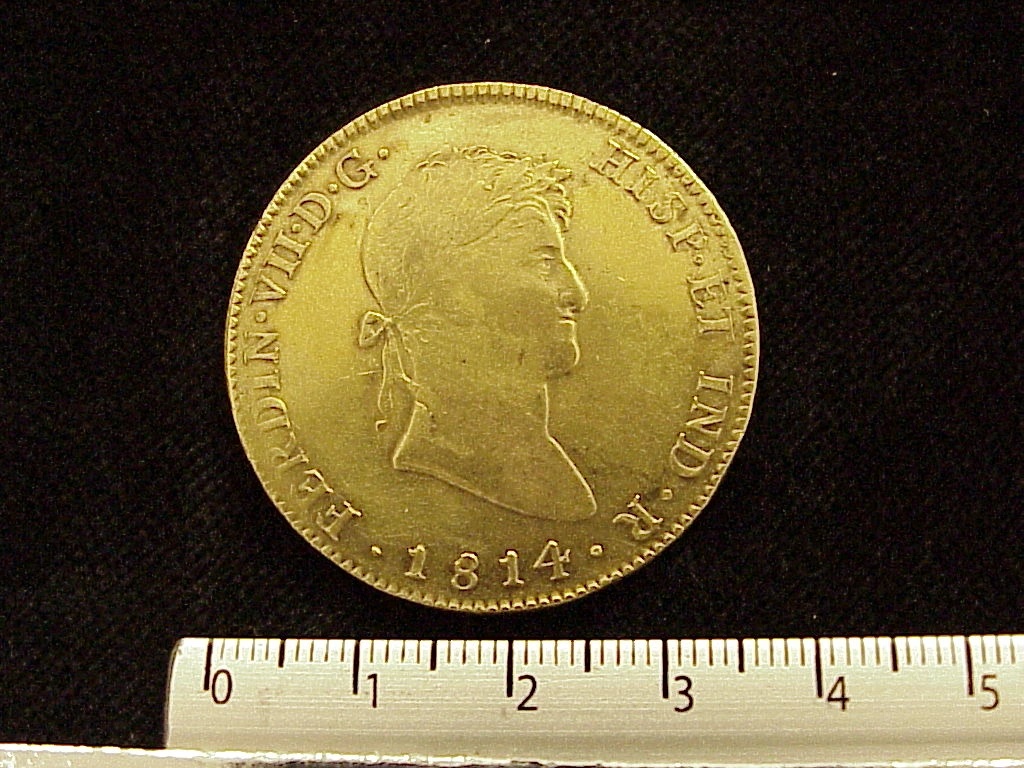
Charles III's reform of 1772 changed the design: the pillars were replaced by the king's bust on the obverse, keeping the royal shield on the reverse. Kings depicted during this era:
- Charles III (1759-1788)
- Charles IV (1788-1808)
- Ferdinand VII (1808-1821)
The bust pieces of Ferdinand VII are particularly interesting because they coincide with the War of Independence. Ferdinand VII was Napoleon's prisoner for part of his reign, yet Mexico kept minting coins bearing his face until Independence was consummated in 1821.
The Mexican 8 reales peso became a global trade coin. It circulated from the Philippines (via the Manila Galleon) to Boston. It was the basis of the U.S. dollar; the word "dollar" derives from the "Spanish milled dollar," which was essentially the Mexican 8 reales. The "$" symbol probably comes from the Pillars of Hercules with their furled band that appear on the pillar dollars.
Independence and the Iturbide Empire (1810-1823)
Insurgent minting (1811-1814)
When the War of Independence began in 1810, the insurgent forces needed money to finance their troops. José María Morelos set up his own minting in Oaxaca, producing coins with the SUD (South) monogram and others with the seal of the Supreme National American Junta (JNA). These are historical pieces with double value: numismatic and political.
At the same time, the royalist mints in Crown-controlled areas (Chihuahua, Durango) ramped up production. The royalist coins of Chihuahua from 1810-1821 are scarce and highly sought after.
First Mexican Empire: Agustín de Iturbide (1821-1823)
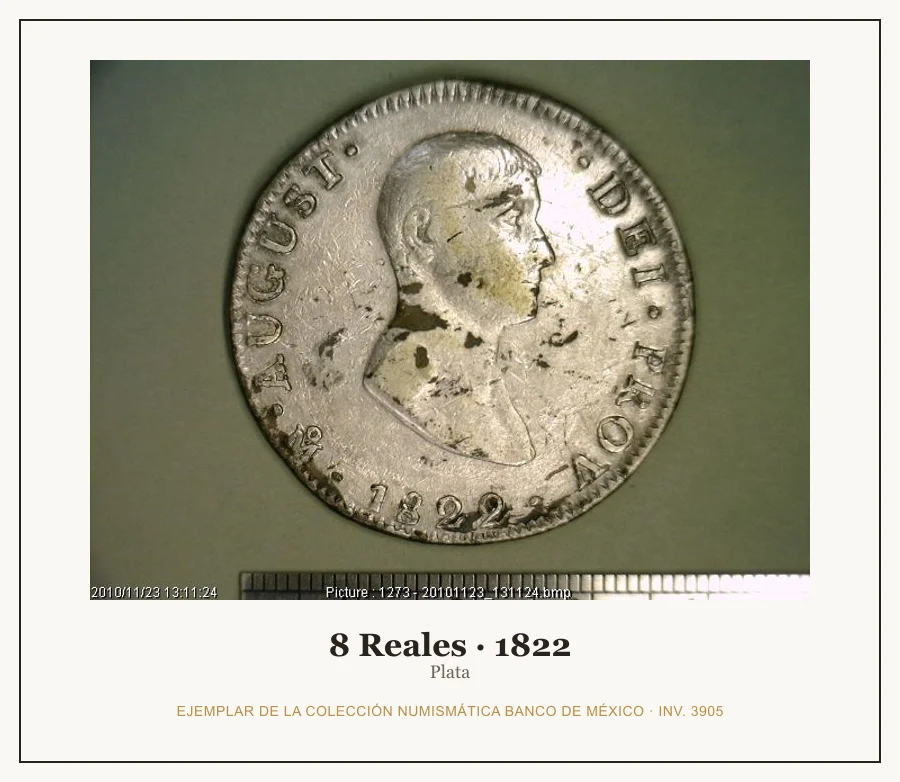
With Independence consummated in September 1821, Agustín de Iturbide proclaimed himself Emperor. The First Empire's coins were struck for barely two years (1822-1823) and are exceedingly scarce. They bore Iturbide's bust and the Mexican imperial eagle (crowned, distinct from the later republican one).
Federal Republic of Mexico (1823-1864)

Once Iturbide's Empire fell in 1823, the Federal Republic of Mexico was established. The coins adopted the die that would become the Mexican classic: the republican eagle on a nopal with a serpent on the obverse (the original version without a crown, distinct from the imperial one) and different denominations of republican silver.
This period is politically complex: there were civil wars, the war with the United States (1846-1848), the War of the Reform (1857-1860), the French intervention. The regional mints (Zacatecas, Guanajuato, Chihuahua, Durango, Guadalajara, Culiacán) ramped up production to meet local demand amid the chaos.
Second Empire: Maximilian (1864-1867)

In 1864, Napoleon III of France installed Archduke Maximilian of Habsburg as Emperor of Mexico (Second Empire). For three years, coins bearing his face were struck: half reales, reales, pesos. They are scarce pieces (the period was short) and historically fascinating.
Benito Juárez overthrew the Empire in 1867. Maximilian was executed at the Cerro de las Campanas, Querétaro. His coins were quickly withdrawn from circulation, which makes them rare today.
Restored Republic and the Porfiriato (1867-1905)
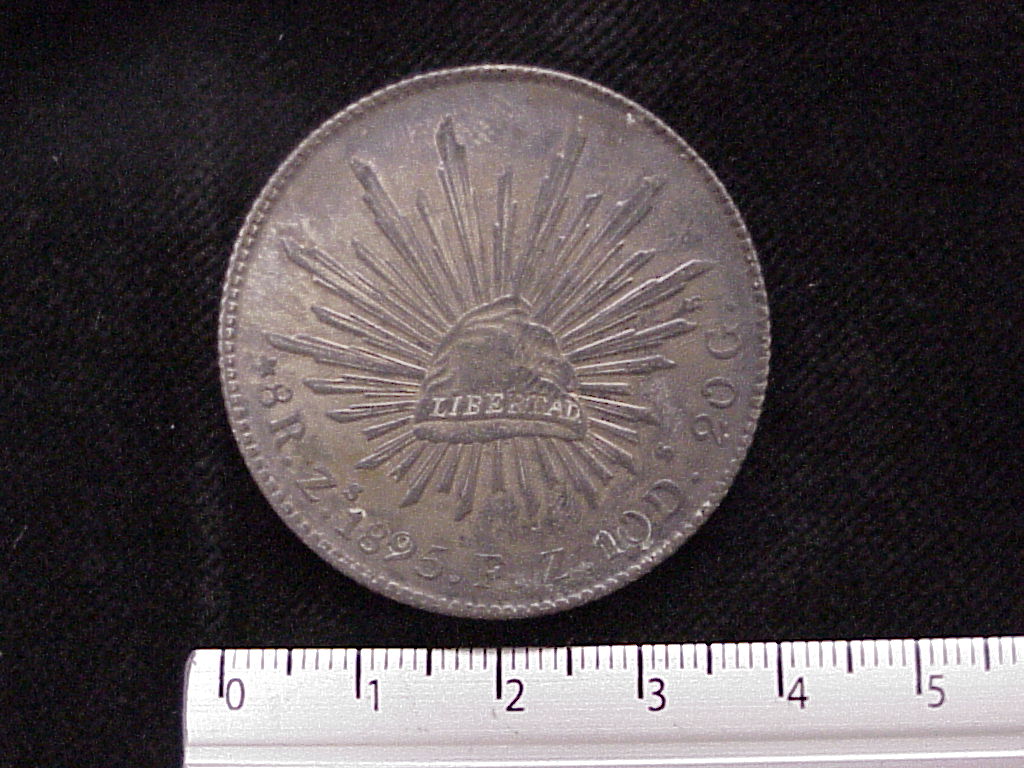
The Restored Republic (1867-1876) and the Porfiriato (1876-1911) represented Mexican monetary consolidation. Political stability allowed regular production across the 13 mints. The emblematic piece of the era is the "8 reales Resplandor", struck in silver with the radiant republican eagle on the obverse.
The Resplandor catalog is one of the most extensive in Mexican numismatics: each year combined with each mint yields a distinct collectible piece. See the catalog of 8 reales and colonial silver coins.
Monetary Reform of 1905
Key facts
- Year of the Reform: 1905, driven by José Yves Limantour.
- Main change: from a bimetallic standard (silver + gold) to the gold standard.
- Centralization: the 12 regional mints close; only the Mint of Mexico operates.
- Modern decimal system: the peso divided into 100 centavos.
- Emblematic piece of the period: Caballito Peso 1910, designed by Charles Pillet.
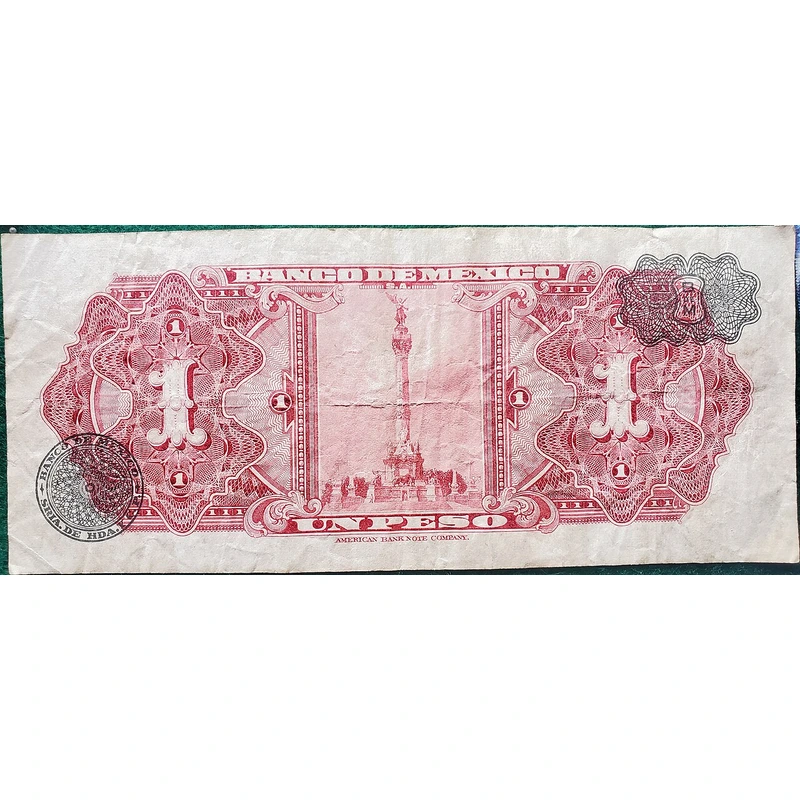
Finance Secretary José Yves Limantour drove a monetary reform in 1905 that changed everything: Mexico moved from the bimetallic system (silver + gold) to the gold standard, adopted the modern decimal system (the peso divided into 100 centavos) and centralized minting at the Mint of Mexico (closing the regional mints).
As part of the Centennial of Independence commemorations, the Caballito Peso was struck in 1910, designed by the French engraver Charles Pillet. It shows a Winged Victory riding a horse and carrying a torch. It is probably the most iconic modern piece in Mexican numismatics. See the Caballito Peso 1910 page and the complete series.
Mexican Revolution (1910-1920)
Key facts
- Duration: 10 years of absolute monetary chaos.
- Factions that minted their own money: Villa (Chihuahua), Zapata (Morelos), Carranza, several state governments.
- "Bilimbiques": the colloquial name for the local paper money issued by states.
- Centenario 50 pesos gold: originally minted 1921-1925 to celebrate 100 years of Independence.
- Institutional consequence: the creation of the Bank of Mexico in 1925 as a centralized monetary authority.

Between 1910 and 1920 the Mexican monetary system collapsed. Each revolutionary faction issued its own coins and paper money to finance troops: Villa minted coins in Chihuahua, Zapata in Morelos, Carranza in various areas, and the state governments issued "bilimbiques" (local paper money).
The result was brutal devaluation and widespread distrust. Much of the revolutionary money is collectible today precisely because of its extreme historical context.
The Centenario 50 pesos gold (1921-1925)
In 1921, with the country already stabilized under Álvaro Obregón, the Centenario 50 pesos gold was struck to commemorate the centennial of the consummation of Independence (1821-1921). It is the most globally recognized Mexican gold coin: 37.5 g of 0.900 alloy, 33.75 g of pure gold.
The originals were struck only between 1921 and 1925. The versions dated "1947" (the most common today) are modern restrikes produced between 1943 and 1972 as official bullion. See how to tell the original Centenario from the restrike.
Founding of Banxico (1925)
To end the revolutionary monetary chaos, President Plutarco Elías Calles founded the Bank of Mexico (Banxico) on September 1, 1925 as a centralized monetary authority. Banxico has monopolized the issuance of banknotes and coins ever since. Today it publishes the official catalog of Mexican currency on its banknotes and coins portal.
Modern Mexico (1920-1992)
Post-revolutionary 20th-century Mexico is a period of monetary consolidation. Banxico issues circulating series with historical figures (Hidalgo, Morelos, Madero, Juárez), copper centavos, and silver coins gradually reduced in purity by inflation.
The most important modern milestone is the launch of the Onza Libertad:
Onza Libertad 1949 (the historic one)
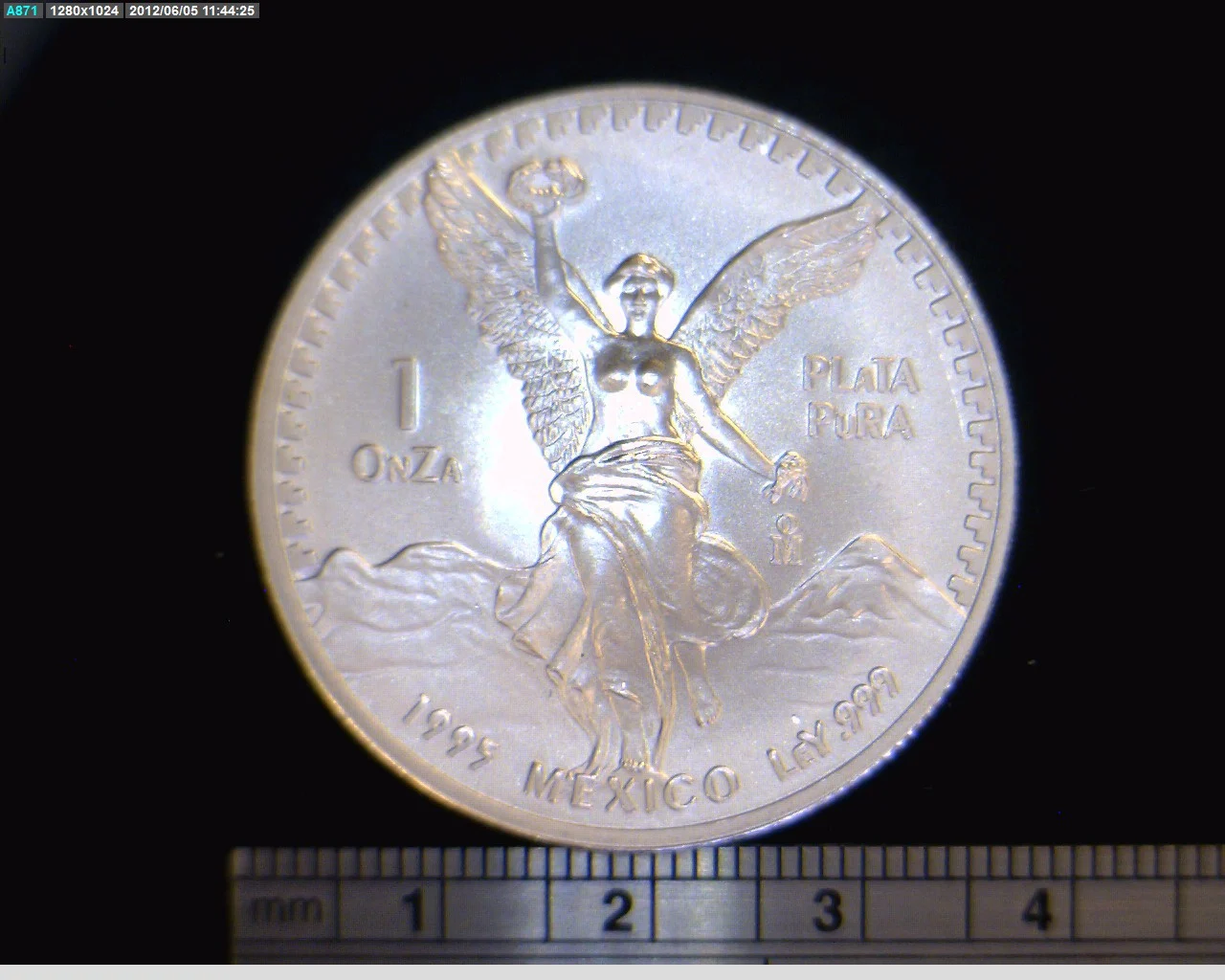
In 1949 the Mint struck the first Onza Libertad in silver: 1 troy ounce (31.103 g) of pure silver, with the figure of the Winged Victory and the National Coat of Arms. Only a few thousand were struck. Today they are rare pieces that exceed 80,000-200,000 MXN in high certified grades.
Modern Onza Libertad (1982-present)
In 1982, the Mint relaunched the Libertad line as modern bullion. Since then, it issues .999 silver ounces every year (and .999 gold ounces as well). It is the most exported Mexican collector piece in the world. See the complete Onza Libertad catalog and the current Onza Libertad price.
The inflationary crisis (1976-1992)
The economic crisis of the 1980s produced brutal devaluation: the peso went from 12 per dollar (1976) to more than 3,000 per dollar (1992). Coins lost their meaning; a peso was worth cents on the dollar. Banxico issued denominations up to 50,000 pesos to compensate.
Nuevos Pesos and today (1993-present)
Key facts
- Date of the Reform: January 1, 1993.
- Change: three zeros were dropped from the previous peso (1,000 old pesos = 1 nuevo peso).
- Visual identifier: the "N$" prefix before the value during 1993-1995.
- Bimetallic family: Nuevos 1, 2, 5, 10 and 20 Pesos.
- Key collector piece: Nuevos 20 Pesos Hidalgo 1995 (160,000 minted vs 5 million in 1993).
- Active modern series: commemorative 20 pesos (C1 family), Onza Libertad, 2026 World Cup.
The Nuevos Pesos reform (1993)
On January 1, 1993 the Nuevos Pesos (N$) monetary reform took effect: three zeros were dropped from the previous peso. What cost 1,000 old pesos now cost 1 nuevo peso. Banxico issued a complete family of new coins and banknotes, identified by the "N$" before the value.
The family included bimetallic coins (a technological innovation): Nuevos 1, 2, 5, 10 and 20 Pesos. The Nuevos 20 Pesos Hidalgo 1995 is the most expensive collector piece of this era because of its low mintage (160,000 vs 5 million in 1993).
100 Pesos States of the Federation (2003-2007)
A beautiful, underrated series: 32 bimetallic 100-peso coins with a silver core, one for each state of the Republic. Each coin shows a symbol representative of the state. It is a complex series to complete and undervalued in today's market.
Bicentennial of Independence + Centennial of the Revolution (2008-2010)
For the round anniversaries (200 years of Independence, 100 years of Revolution), Banxico issued enormous series: 37 silver 5-peso coins for the Bicentennial and Centennial dedicated to historical heroes, plus commemorative circulating 20- and 100-peso coins.
Modern commemorative 20 pesos (C1 family)
Since 2021 Banxico has issued the C1 family of bimetallic 20-peso coins with institutional themes: Bicentennial of Independence (2021), Navy (2022), Heroic Military College (2023). Each with a mintage of 5 million to 23 million pieces.
2026 World Cup (the current series)
For the 2026 FIFA World Cup (Mexico-USA-Canada), Banxico launched 12 commemorative coins: 4 Mexican host cities (Mexico City, Guadalajara, Monterrey, the pan-American "Triple Host") × 3 metals (bimetallic, pure silver, pure gold). It is the most ambitious commemorative series of recent history. See the complete 2026 World Cup catalog.
What's coming
Banxico has pieces planned that have not yet been issued: the 2,000-peso banknote designed but not printed (see Banxico's ghost banknote), the circulating 20-peso Kukulkán coin that replaces the banknote of the same value, and the 20-peso "El Mar" Consolidation of Independence (2026).
For the complete universe of Mexican paper money (Bank of Mexico, private issuing banks 1864–1925, the Revolution, old pesos through the current G family), go to the Mexican banknotes hub: 1,500 pieces cataloged with official Banxico data, grouped by PSM family.
Complete timeline
A visual summary of the most important milestones of Mexican numismatics, from 1535 to 2026: