
En resumen
Most Mexican coin errors are post-mint damage, not real errors. How to spot genuine mint errors and what they are worth, from a few dollars to hundreds.
Found a Mexican coin with a weird mark and pictured early retirement? Slow down. Real mint errors do sell for a premium, but most trade for a few dollars, not a fortune. And most "errors" people bring us are not errors at all: they are post-mint damage, scratches and machine dings that add nothing and often kill the value the coin had. Here is how to tell the difference and what the genuine errors actually fetch.
The one distinction that decides everything
A mint error happens at the mint, before the coin ever leaves Casa de Moneda (Mexico's national mint). Damage happens afterward, out in your pocket, a coin jar, or a cleaning bottle. Only the first type carries a premium.
| Type | Where it happened | Adds value? | Examples |
|---|---|---|---|
| Mint error | At the mint, in the die or on the blank, before release | Yes, depends on the type | Off-center strike, doubled die, wrong planchet, double strike |
| Post-mint damage | After the coin left the mint | No, usually destroys value | Deep scratches, corrosion, gouges, harsh cleaning |
Ask one question about any mark on your coin: could this have happened after the coin left the mint? If yes, it is damage, not an error. Damage never pays.
The Mexican error types that actually sell
Ranked by the kind of money they bring at real marketplaces and auctions.
1. Mule (mismatched dies)
The rarest and most coveted error. The coin is struck by two dies that do not belong to the same design, for example a 5 pesos obverse paired with a 1 peso reverse. Mules escape the mint by accident and almost never surface. When one does, it commands a large multiple of the coin's normal value. If you genuinely have a mule, get it to NGC or PCGS before you do anything else.
2. Wrong planchet / clipped planchet
The blank disc of metal (the planchet) was defective or wrong before it was struck. A coin struck on the wrong metal blank, or on a planchet with a piece missing (a clipped planchet), is a dramatic and desirable error. These stand out clearly and are hard to fake convincingly, which is exactly why collectors pay for them. Value depends on how obvious and how severe the defect is.
3. Off-center strike
The blank sat off-center when the die struck it, so part of the design is cut off and part of the blank shows blank metal. Severity is everything here: a mild 5 to 10 percent off-center coin is worth a small premium, while a dramatic 50 percent or more off-center piece brings serious money, especially if the date is still readable. A 75 percent off-center 5 pesos is the kind of dramatic example that commands a strong premium.
4. Double strike
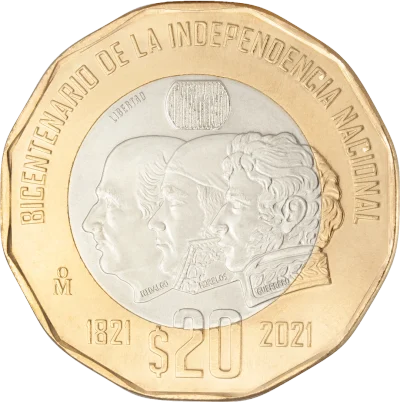
The die struck the coin twice and left the image overlapping, slightly shifted. It reads clearly as a mint event, which collectors like. The premium is real but modest for common coins. A 2021 20 pesos double struck listed around 10 USD, while a more dramatic 1982 off-center double struck peso sold for 60 USD. The more shift and the more eye appeal, the higher it climbs.
5. Doubled die
Different from a double strike. Here the die itself was made with doubling, so every coin from that die shows the doubling in the same place. Some doubled die varieties have mintages of only a few hundred coins, and that scarcity drives high collector demand when the variety is documented and confirmed.
6. Die chips and die cracks
The die had a crack or a broken chip when it struck the coin, leaving a raised line or blob on the surface. This is the subtle end of the error world and the least valuable. A 1982 50 pesos Coyolxauhqui die chip error listed at 35 USD. Useful, collectible, but not the error that changes your life.
Real Mexican error prices at a glance
| Error type | Example coin | Recent price (USD) |
|---|---|---|
| Double struck | 2021 20 pesos | ~10 |
| Off-center double struck | 1982 peso | 60 |
| Die chip | 1982 50 pesos Coyolxauhqui | 35 |
| Dramatic off-center | 5 pesos, 75% off-center | Strong premium (varies) |
| Doubled die | Low-mintage varieties | High demand, varies |
Figures reflect real marketplace and auction listings. Errors are priced case by case, so treat these as anchors, not fixed values.
The "errors" that are worth nothing extra
Most coins people flag as errors are damaged, not misstruck. Watch for these false alarms:
- Scratches and gouges. A raised, sharp cut is almost always something that hit the coin after it left the mint. Not an error.
- Corrosion and spots. Rust-colored blotches, green crust, or pitting come from storage and moisture. They lower value.
- Machine dings. Marks from vending machines, coin counters, or years in a register drawer are damage.
- Harsh cleaning. Someone scrubbed the coin, maybe with bleach or metal polish. This is one of the fastest ways to destroy a coin's value. A cleaned common coin is worth less than an untouched common coin.
None of these are mint errors. If your coin's flaw could have happened during circulation, assume it did.
How to check what yours is actually worth
- Rule out damage first. Look at the flaw and ask whether it could have happened after the mint. Raised, symmetrical, part-of-the-strike features point to a real error. Sharp cuts, corrosion, and worn-in marks point to damage.
- Match it to a known type. Off-center, double strike, doubled die, wrong planchet, mule, die crack. If it doesn't fit one of these, it is probably not an error.
- Get it authenticated. For anything you think might be a genuine error worth real money, submit it to NGC or PCGS. Their grade and error attribution are what buyers trust, and an authenticated error sells for far more than an unverified one. Common minor errors run a few dollars; dramatic authenticated errors reach the hundreds.
- Don't clean it. Ever. If you think you have an error, cleaning it will only cost you money.
Real, dramatic, authenticated Mexican errors do exist and they do pay. But the honest picture is this: most error finds are minor and worth a few dollars, and a large share of suspected errors are just damage. Know which one you have before you get your hopes up.
Have a Mexican coin with a mark you can't explain? Post clear photos of both sides, plus a close-up of the flaw, in the Pesoteca forum and we'll tell you whether it's a real mint error or just circulation damage. While you're at it, see how these stack up against the most valuable Mexican coins.
Loading comments…