
1000 Pesos Sor Juana (1989): Real Value in USD
Prices updated: August 2026
Old peso era · Sor Juana Inés de la Cruz · Aluminum bronze
Old peso era · Sor Juana Inés de la Cruz · Aluminum bronze
Design
Banxico
Reverse
Profile portrait of Sor Juana Ines de la Cruz (facing left) with the legend JUANA DE ASBAJE. The value 1000 appears vertically beside the effigy, plus the year of minting (1989) and the Mo mint mark of the Mexican Mint. The denomination is shown as 1000.
Obverse
Mexican National Coat of Arms with the inscription "ESTADOS UNIDOS MEXICANOS".
How much is the 1000 Pesos Sor Juana (1989): Real Value in USD worth?
The market value of the 1000 Pesos Sor Juana (1989): Real Value in USD is not yet documented with enough data to give a firm range. Weigh and measure your piece, compare it against the specifications, and check the forum for a second opinion.
The real price depends on four factors: the grade of preservation (a circulated piece is worth the low end of the range; an uncirculated one, or one still in its official blister pack, the high end), the finish (satin vs mirror/proof), the rarity within the series based on the mintage, and the metal spot price on the day of the deal when the piece is silver or gold. Check the value-by-grade table above and compare with equivalent pieces before buying or selling.
Where to buy or sell this coin?
Browse the national directory of numismatic shops or the community forum to trade directly with other collectors.
Description
If you inherited or found a large gold-colored 1000 Pesos coin with a woman's portrait, here is the honest answer: in 2026, a circulated 1989 1000 Pesos Sor Juana Inés de la Cruz is worth a few dollars at most. Over 215 million were struck in 1989 alone, and roughly 613 million between 1988 and 1992. That is not a rare coin. The listings you have seen asking 15,000 to 80,000 pesos are inflated asking prices, not real sales.
That gold color throws people off. It is not gold. The coin is aluminum-bronze, an alloy of about 92% copper, 6% aluminum, and 2% nickel. It has no silver or gold, so it has no melt value to fall back on. What you have is a common circulation coin from the last years of the old Mexican peso.
What the 1989 1000 Pesos Sor Juana actually is
This is a Mexican 1000 pesos coin issued from 1988 to 1992, honoring Sor Juana Inés de la Cruz, a 17th-century poet and nun (the reverse actually reads "JUANA DE ASBAJE," her name before entering the convent). It belongs to the old peso, the currency Mexico used before the 1993 reform that introduced the Nuevo Peso and cut three zeros off every price. Back then, high inflation meant 1000 pesos was an everyday coin, not a big amount.
Key specs (keep these exact if you are comparing to yours):
- Metal: aluminum-bronze (approx. 92% copper, 6% aluminum, 2% nickel)
- Weight: about 15 g (14.95 g recorded)
- Diameter: 30.94 mm
- Edge: reeded
- Minted by: Casa de Moneda de México
- Years struck: 1988 to 1992
- Mintage: over 215 million in 1989, roughly 613 million total
What it's really worth in USD
Because hundreds of millions were made, the market value is driven almost entirely by condition, not rarity. Here is the realistic picture.
| Condition | What it looks like | Realistic value (USD) |
|---|---|---|
| Heavily circulated | Worn, dull, marked | Under 1 dollar |
| Circulated, decent | Some wear, still clear detail | 1 to 3 dollars |
| Uncirculated (BU) | Full original luster, sharp face and relief | A few dollars to around 10 dollars |
| Certified high grade (MS65+) | Slabbed, top condition | Tens of dollars for the best examples |
The only versions that bring real premiums are patterns (test strikes) made in other metals like silver, brass, or chrome-plated steel. Those are museum and specialized-auction pieces, not something you would find in a coin jar. The coin in your pocket is the common aluminum-bronze issue.
The 80,000-peso myth
You will find people online asking 15,000, 40,000, even 80,000 pesos for this coin. Asking is not selling. A price tag on a listing means nothing until money changes hands. With more than 600 million pieces struck, there is no scarcity that could support those numbers. Before you believe any listing, check how many actually sell, and in what condition. The gap between fantasy asking prices and real completed sales is enormous on this coin.
This is the single most common trap for people who inherit old Mexican coins: a big, heavy, gold-colored coin feels valuable, and viral posts feed that feeling. The reality is that size and age do not equal worth. Mintage, survivors, demand, and grade do.
Does it still have legal value?
No. Banco de México (Banxico) demonetized the old peso on November 15, 1995. As an exchange reference, 1000 old pesos equaled 1 new peso (a few US cents). Today its only real value is to collectors, and only in high grade.
How to check what yours is worth
- Grade it honestly. Look at the highest points, the face of Sor Juana and the raised relief. If those are worn flat and the surface is dull, it is a common circulated coin. Full original shine with no rubbing is where any value lives.
- Check the date and mint marks against the 1988 to 1992 range. None of the standard circulation dates carries a premium on its own.
- Be skeptical of "error" claims. Most alleged errors circulating on social media are just damage or normal wear. A genuine mint error needs verification by an appraiser or a grading service like NGC or PCGS.
- Compare completed sales, not listings. Filter for sold items, not active asking prices.
Where to buy or sell without getting scammed
Skip the viral listings and go to established dealers who quote realistic prices based on grade. Look through the Pesoteca shop directory at /tiendas to find reputable numismatists and buy-sell houses. They will give you a fair number based on your coin's actual condition, not the fantasy figures floating around online.
If you have a whole box to sort through, our guides on Mexican silver coins and how coin grading works will help you tell the common pieces from the ones actually worth setting aside.
Got a 1989 Sor Juana with unusual shine, an odd color, or a strike you cannot explain? Post clear photos of both sides in the Pesoteca forum and let the community weigh in before you trust any online price.
Historical context
Mexican circulating peso coins from the second half of the 20th century were struck in alloys that changed with the cost of metals and inflationary processes: .720 silver in the $1, $5, $10 and $25 denominations during the 1940s-50s; cupronickel from the 1970s; aluminum-bronze and stainless steel in the 1980s; pieces with historical figures (Hidalgo, Cuauhtemoc, Juarez, Madero, Carranza, Sor Juana) in the late 1980s, just before the transition to Nuevos Pesos in 1992. 1989 corresponds to the period when this variant was in circulation. Sor Juana Ines de la Cruz, a poet of New Spain, appears on the circulating $1000 denomination of the 1980s, the first Mexican woman to appear on current coinage.
This piece belongs to the era
México Moderno (pre-1992) →Explore all the Mexican coins of this era, their historical context and how they connect to the monetary system of the period.
Value range of this piece
Value range without enough data for this piece.
See the full breakdown by grade (VG, F, VF, EF, AU, MS-60, MS-63, MS-65) for the whole series →
Other denominations from 1989
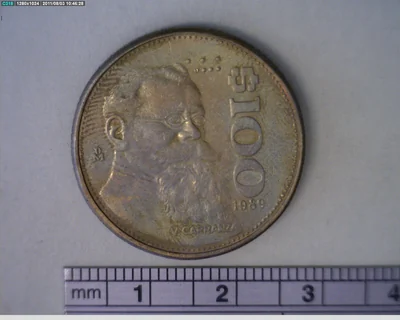
100 Pesos Bronce Aluminio · Aluminio-bronce
Same denomination, other years
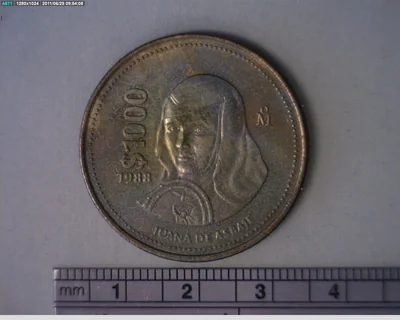
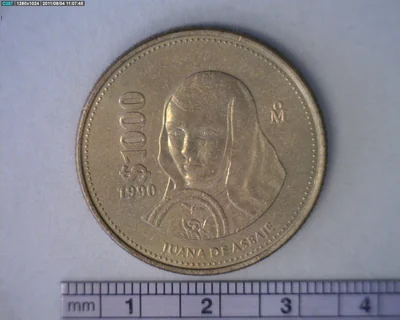
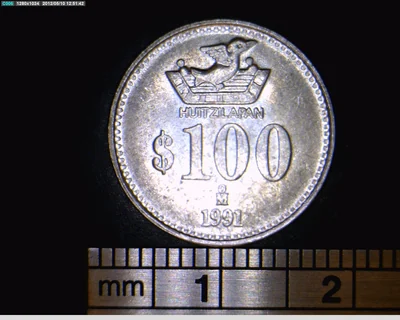
1000 pesos Aluminio-bronce · 100 Pesos Bronce Aluminio
Official sources
Frequently asked questions
How much is the 1989 1000 Pesos Sor Juana coin worth in USD?
A circulated example is worth a few dollars at most, and often under 1 dollar. Over 215 million were struck in 1989 and roughly 613 million from 1988 to 1992, so it is extremely common. Only uncirculated pieces with full original luster reach around 10 dollars, and top certified examples reach tens of dollars. The 15,000 to 80,000 peso listings are inflated asking prices, not real sales.
Is it true these sell for 80,000 pesos?
No. That number comes from listings where a seller asks that amount, and asking is not selling. With more than 600 million pieces made, there is no scarcity to justify that price. Always compare completed sales, not active listings, and check the coin's condition before believing any figure.
Is this coin made of gold or silver?
Neither. It is aluminum-bronze, an alloy of about 92% copper, 6% aluminum, and 2% nickel. The gold color comes from the alloy, not from a precious metal, so it has no melt value. Its only worth is as a collectible, and only in high grade.
Where can I sell a Mexican 1000 pesos coin safely?
Use established dealers rather than viral online listings. Check the Pesoteca shop directory at /tiendas to find reputable numismatists and buy-sell houses who will quote a realistic price based on your coin's actual grade, not the fantasy prices circulating on social media.
Conversation
0 comments
Sources
Images for informational and educational purposes, attributed to their original source. Reference values; the real price depends on the grade, the specific variant and demand.
Loading comments…