
1951 Mexico 20 Centavos Copper (Teotihuacán Pyramid)
Prices updated: August 2026
Old peso era · Copper
Old peso era · Copper
Design
Banxico
Reverse
Face value "20" or "20 CENTAVOS" in large size. Year of minting "1951" and mint mark "Mo" of the Mexican Mint.
Obverse
Mexican National Coat of Arms with the inscription "ESTADOS UNIDOS MEXICANOS".
How much is the 1951 Mexico 20 Centavos Copper (Teotihuacán Pyramid) worth?
The market value of the 1951 Mexico 20 Centavos Copper (Teotihuacán Pyramid) is not yet documented with enough data to give a firm range. Weigh and measure your piece, compare it against the specifications, and check the forum for a second opinion.
The real price depends on four factors: the grade of preservation (a circulated piece is worth the low end of the range; an uncirculated one, or one still in its official blister pack, the high end), the finish (satin vs mirror/proof), the rarity within the series based on the mintage, and the metal spot price on the day of the deal when the piece is silver or gold. Check the value-by-grade table above and compare with equivalent pieces before buying or selling.
Where to buy or sell this coin?
Browse the national directory of numismatic shops or the community forum to trade directly with other collectors.
Description
If you inherited or found a 1951 Mexican 20 centavos copper coin, here's the honest answer: in circulated condition it's worth well under a dollar, and even a clean example rarely brings more than a few US dollars. This is a common circulation coin, not a rarity. Value depends almost entirely on condition, and true uncirculated pieces are the only ones that command a small premium.
That doesn't mean it's worthless. It's a solid, attractive copper coin with one of the most recognizable designs in Mexican numismatics, and it's a comfortable, low-cost entry point if you want to start a collection. Below is what it actually is, what drives the price, and how to check whether yours is one of the better ones.
What the 1951 20 Centavos actually is
The 1951 20 centavos is a copper coin struck at the Casa de Moneda de México (the Mexican Mint). The specifications are:
- Metal: copper
- Weight: 10.02 grams
- Diameter: 28.5 mm
- Edge: plain (smooth)
The obverse carries the Mexican national eagle. The reverse shows the design that made this series famous: the Pyramid of the Sun at Teotihuacán, with the volcanoes Popocatépetl and Iztaccíhuatl in the background. It's a large, heavy coin for its denomination, and it feels solid in the hand.
This piece belongs to the family of 20 centavos coins with the Teotihuacán motif, a design that circulated for much of the 20th century and that most Mexican collectors recognize on sight. The pyramid-and-volcanoes scene became one of the best-known images in Mexican copper coinage. The 1951 date sits within that long production run, when copper was still the standard metal for the smaller circulating denominations.
How much is a 1951 20 Centavos worth?
Be realistic about this one. Millions were struck, and huge numbers survive, so scarcity is not on your side. What you have determines the value entirely by grade:
| Condition | What it looks like | Approximate value (USD) |
|---|---|---|
| Well circulated | Worn, dark, flat detail | Under 1 dollar |
| Lightly circulated | Full design, some wear | 1 to 3 dollars |
| Uncirculated (original luster) | Sharp pyramid, no rub, no spots | A few dollars, more for top grade |
The factor that rules the price here is condition, not age. Copper darkens, spots, and wears easily, so coins that keep their original luster with a fully struck pyramid and crisp eagle feathers are the ones worth setting aside. A brown, corroded, or pitted example is a dollar coin at best.
If you want to see how this fits with other small denominations, our guide to Mexican centavos and copper coins puts the whole family in context.
Watch out for errors and varieties
Genuine mint errors (off-center strikes, die rotation, doubled dies, and recognized varieties) can multiply the value of a common coin. That's the exception, not the rule. Most of the "errors" people post online are post-mint damage: dings, corrosion, and scratches that happened after the coin left the mint. Those add nothing.
If you think you have a real error, don't guess. Post clear photos of the obverse, reverse, and edge in the Pesoteca forum and let the community weigh in before you assume it's valuable.
How to tell if yours is genuine
Fakes of a common copper coin are uncommon because there's little profit in it, but it's worth a quick check:
- Weigh it. A genuine coin is 10.02 grams. Use a small jewelry scale.
- Measure it. The diameter is 28.5 mm. Use calipers.
- Check the strike. Real coins have crisp, three-dimensional relief. Counterfeits often look flat or soft, with uneven color across the surface.
If the weight or diameter is off, or the design looks mushy, be suspicious. Compare against the specifications above.
Where to sell a 1951 20 Centavos
Don't dump it on the first Facebook bidder. Your safest options:
- A verified coin shop from the Pesoteca directory, which can appraise it on the spot without the markup of a middleman.
- The Pesoteca buy-and-sell forum, where you deal directly with collectors.
Before you sell, photograph the coin (front, back, and edge) and compare it to the price ranges above so you know what to expect. For a common date like 1951, a single circulated coin isn't worth a trip; these are usually sold as part of a set or a group lot. If you inherited a whole box of Mexican coins, keep them together and get the group looked at once.
Have a 1951 20 centavos with full mint luster, or think you spotted a real striking error? Post your photos in the Pesoteca forum and get a straight answer from collectors who handle these coins.
Historical context
Centavo coins circulating in Mexico during the second half of the 20th century were struck in alloys that changed according to the cost of metals: copper, bronze and brass in the low denominations (1¢, 5¢, 20¢); cupronickel for the intermediate denominations (25¢, 50¢, late 10¢); and .720 silver for some 25¢ and 50¢ pieces in the 1950s. Each change of alloy generated a distinct variant of the same face value. 1951 corresponds to the period when this variant was in circulation, before the transition to Nuevos Pesos in 1992. The Mexican Mint kept the basic design of the National Coat of Arms on the obverse and the numeric value on the reverse throughout this era.
This piece belongs to the era
México Moderno (pre-1992) →Explore all the Mexican coins of this era, their historical context and how they connect to the monetary system of the period.
Value range of this piece
Value range without enough data for this piece.
See the full breakdown by grade (VG, F, VF, EF, AU, MS-60, MS-63, MS-65) for the whole series →
Other denominations from 1951
Centavos Mexicanos · Cobre
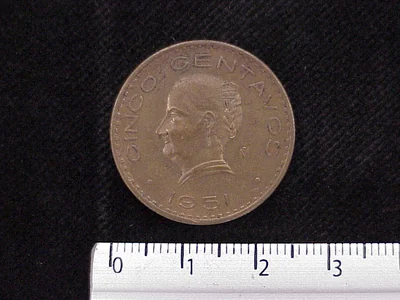
Same denomination, other years
20 centavos Cobre · Centavos Mexicanos
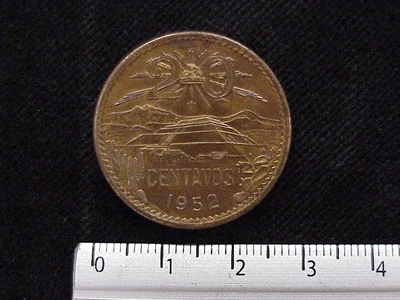
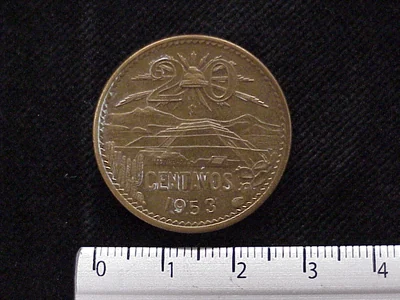
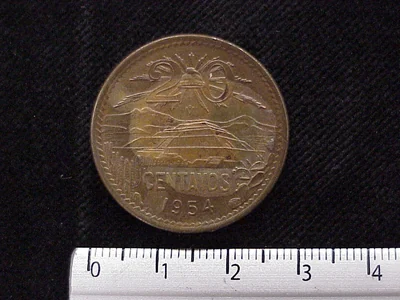
Frequently asked questions
How much is a 1951 Mexican 20 centavos worth?
In circulated condition it's worth under a dollar to a few dollars. Only uncirculated examples with original copper luster, a sharp pyramid, and no spots or corrosion bring a small premium above that. Age isn't the driver here; condition is everything, because millions were struck and many survive.
Is the 1951 20 centavos rare or valuable?
No, it's a common circulation coin. Large numbers were minted and plenty survive, so it isn't rare. The exceptions are pristine uncirculated pieces and genuine, verifiable mint errors, which can be worth more. Most so-called errors online are post-mint damage, not real value.
Where can I sell a 1951 20 centavos?
Your safest options are a verified coin shop from the [Pesoteca directory](/tiendas), which appraises it in person, or the [Pesoteca buy-and-sell forum](/foro/compra-venta) among collectors. Photograph the front, back, and edge first. For a common date, expect to sell it as part of a set or lot rather than on its own.
How can I tell if my 1951 20 centavos is genuine?
Weigh it (10.02 grams) and measure the diameter (28.5 mm) against the specs, using a jewelry scale and calipers. Fakes usually have the wrong weight or diameter, flat relief, or uneven color. If anything is off, post photos in the [Pesoteca forum](/foro) for a second opinion.
Conversation
0 comments
Sources
Images for informational and educational purposes, attributed to their original source. Reference values; the real price depends on the grade, the specific variant and demand.
Loading comments…