
1954 Mexico 20 Centavos (Copper) Value
Prices updated: August 2026
Old peso era · Copper
Old peso era · Copper
Design
Banxico
Reverse
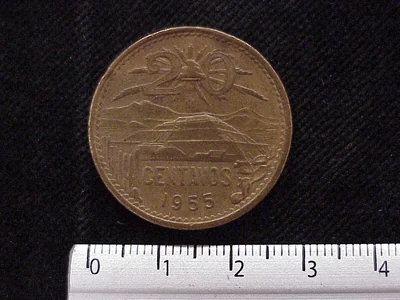
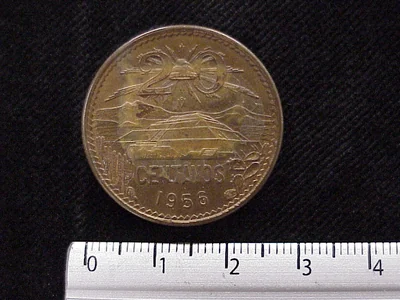
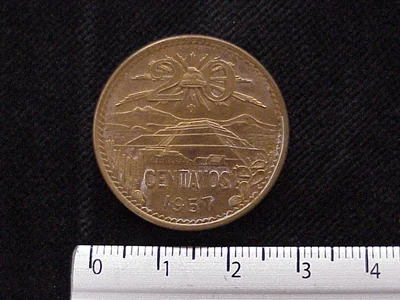
Reverse: Pyramid of the Sun of Teotihuacan at center, with the Popocatepetl and Iztaccihuatl volcanoes in the background and vegetation. Above, the value "20 CENTAVOS" with a radiant Phrygian cap (liberty cap) in the middle; below, the mint mark "Mo", the word "TEOTIHUACAN" and the year. Corresponds to KM#439 (not KM#440, which is the 1955 to 1971 variant).
Obverse
Mexican National Coat of Arms with the inscription "ESTADOS UNIDOS MEXICANOS".
How much is the 1954 Mexico 20 Centavos (Copper) Value worth?
The market value of the 1954 Mexico 20 Centavos (Copper) Value is not yet documented with enough data to give a firm range. Weigh and measure your piece, compare it against the specifications, and check the forum for a second opinion.
The real price depends on four factors: the grade of preservation (a circulated piece is worth the low end of the range; an uncirculated one, or one still in its official blister pack, the high end), the finish (satin vs mirror/proof), the rarity within the series based on the mintage, and the metal spot price on the day of the deal when the piece is silver or gold. Check the value-by-grade table above and compare with equivalent pieces before buying or selling.
Where to buy or sell this coin?
Browse the national directory of numismatic shops or the community forum to trade directly with other collectors.
Description
If you inherited or found a 1954 Mexican 20 centavos, here's the honest answer: in worn condition it's worth cents, not dollars. Over 40 million were minted, so it isn't rare. The only ones that carry real value are uncirculated examples with original shine, which sell for roughly 3 to 13 USD. This coin is a common, well-loved design, not a jackpot.
What you actually have
This is a bronze coin from Mexico's Teotihuacán series, the design most people recognize as "the pyramid one." It is made of bronze: 95% copper, 5% zinc. There is no silver or gold in it, so it has no precious-metal (melt) value. Any worth it has is purely numismatic and depends entirely on condition.
Quick specs to identify yours:
- Metal: bronze (95% copper, 5% zinc)
- Weight: about 10 g (some catalogs list 10.05 g)
- Diameter: 28.5 mm
- Edge: plain (smooth)
- Catalog number: KM#439 (the 1954 issue specifically)
The reverse shows the Pyramid of the Sun at Teotihuacán with the Popocatépetl and Iztaccíhuatl volcanoes behind it, the denomination topped by a radiant Phrygian cap, the "Mo" mint mark (Mexico City Mint, the Casa de Moneda de México), and the word TEOTIHUACAN. The obverse carries the Mexican national coat of arms with the legend ESTADOS UNIDOS MEXICANOS.
Is it rare? No
The 1954 mintage was 40,108,000 coins according to Numista, and the design circulated for decades. There are enormous numbers of these still around. In circulated grades this is one of the most common Mexican coins of its era, which is exactly why worn examples bring almost nothing.
How much is a 1954 20 centavos worth?
Grade drives the price, full stop.
| Condition | What it means | Approximate value (USD) |
|---|---|---|
| Circulated (worn) | Everyday wear, dull surfaces | A few cents to about 0.50 |
| Uncirculated / lustrous | Sharp detail, original shine | 3 to 13 |
Worn coins list around 0.05 to 0.50 EUR in catalogs, which is cents in dollars. An uncirculated piece with full luster is where the interest sits, typically in the 3 to 13 USD range on collector markets. If yours has been in a pocket or a coin jar, assume it's on the low end.
KM#439 vs KM#440: don't mix them up
The 1954 coin is KM#439. The KM#440 is the later variant struck from 1955 to 1971 with a redesigned eagle on the obverse. Both share the same pyramid reverse, which is why they get confused constantly. Confirm the date reads 1954 before you compare it to any price listing.
About "rare errors"
We have no confirmed record of a notable, valuable mint error specific to the 1954 date. With more than 40 million struck, value comes from high grade, not from imagined varieties. If someone tries to sell you a 1954 20 centavos as a "rare error" without third-party certification (NGC or PCGS), be skeptical.
How to tell if yours is genuine
- Check the weight and size: close to 10 g and 28.5 mm across, with a plain edge.
- Check the color: bronze has a distinctive coppery tone.
- Check the reverse: it must show the pyramid with the volcanoes, the word TEOTIHUACAN, the "Mo" mint mark, and the date 1954.
If anything looks off on weight or detail, a numismatic shop can confirm it in person.
Where to buy or sell one
Browse the Pesoteca shop directory to find numismatic dealers. Because worn examples are common, don't expect much for a used one; the real demand is for uncirculated, lustrous pieces. This coin is part of the Mexican centavos series from the modern pre-1992 era.
Got a 1954 20 centavos with strong luster and no wear? Post clear photos of both sides on the Pesoteca forum and we'll help you gauge the grade.
Historical context
The circulating centavo coins in Mexico during the second half of the 20th century were struck in alloys that changed with the cost of metals: copper, bronze and brass for low denominations (1¢, 5¢, 20¢); cupronickel for intermediate denominations (25¢, 50¢, later 10¢); and .720 silver for some 25¢ and 50¢ pieces in the 1950s. Each change of alloy produced a distinct variant of the same face value. 1954 corresponds to the period when this variant was in circulation, before the transition to Nuevos Pesos in 1992. The Mexican Mint kept the basic design of the National Coat of Arms on the obverse and the numeric value on the reverse throughout this era.
This piece belongs to the era
México Moderno (pre-1992) →Explore all the Mexican coins of this era, their historical context and how they connect to the monetary system of the period.
Value range of this piece
Value range without enough data for this piece.
See the full breakdown by grade (VG, F, VF, EF, AU, MS-60, MS-63, MS-65) for the whole series →
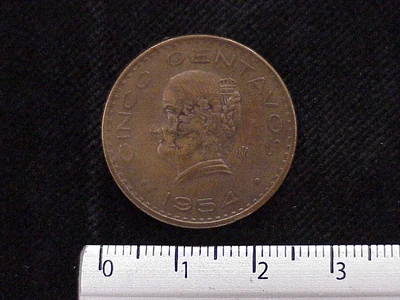
Other denominations from 1954
Centavos Mexicanos · Cobre
Same denomination, other years
20 centavos Cobre · Centavos Mexicanos
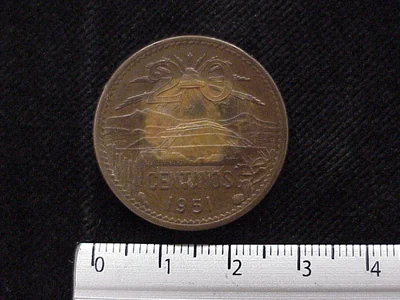
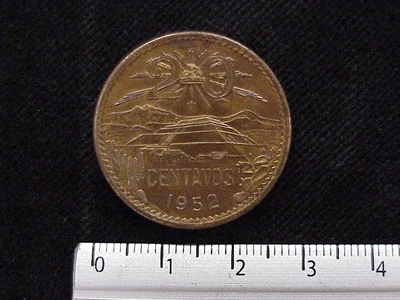
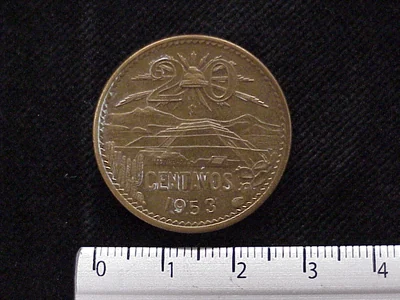
Frequently asked questions
How much is a 1954 Mexican 20 centavos worth?
It depends on grade. Circulated (worn) examples are worth cents, roughly 0.05 to 0.50 EUR in catalogs. An uncirculated coin with good luster can list between 3 and 13 USD on collector markets. It is not rare: the 1954 mintage was over 40 million.
Is the 1954 20 centavos rare or valuable?
No. With 40,108,000 struck in 1954 and decades of circulation, huge numbers survive. Only uncirculated, lustrous examples carry real interest. Worn ones are among the most common Mexican coins of the era.
What metal is the 1954 20 centavos made of?
Bronze: 95% copper and 5% zinc. There is no silver or gold, so it has no melt value. Its worth is purely numismatic and hinges on condition.
How can I tell if my 1954 20 centavos is genuine?
Check the specs: it should weigh close to 10 g, measure 28.5 mm, and have a plain edge, with a coppery bronze tone. The reverse must show the Teotihuacán pyramid with volcanoes, the word TEOTIHUACAN, the Mo mint mark, and the date 1954. A numismatic shop can confirm it if you have doubts.
Conversation
0 comments
Sources
Images for informational and educational purposes, attributed to their original source. Reference values; the real price depends on the grade, the specific variant and demand.
Loading comments…