
20 Centavos 1971 (Mexico): Value and What to Check
Prices updated: August 2026
Old peso era · Brass
Old peso era · Brass
Design
Banxico
Reverse
Pyramid of the Sun series reverse: Phrygian cap (liberty cap) with solar rays at the top, the Pyramid of the Sun of Teotihuacan at center flanked by the Iztaccihuatl and Popocatepetl volcanoes, prickly pear cacti bordering the word CENTAVOS, with the denomination 20 and the year at the bottom.
Obverse
Mexican National Coat of Arms with the inscription "ESTADOS UNIDOS MEXICANOS".
How much is the 20 Centavos 1971 (Mexico): Value and What to Check worth?
The market value of the 20 Centavos 1971 (Mexico): Value and What to Check is not yet documented with enough data to give a firm range. Weigh and measure your piece, compare it against the specifications, and check the forum for a second opinion.
The real price depends on four factors: the grade of preservation (a circulated piece is worth the low end of the range; an uncirculated one, or one still in its official blister pack, the high end), the finish (satin vs mirror/proof), the rarity within the series based on the mintage, and the metal spot price on the day of the deal when the piece is silver or gold. Check the value-by-grade table above and compare with equivalent pieces before buying or selling.
Where to buy or sell this coin?
Browse the national directory of numismatic shops or the community forum to trade directly with other collectors.
Description
Let's answer the question you came with: a 1971 Mexican 20 centavos coin is common. Circulated and with no minting error, it is worth roughly less than a dollar to a couple of dollars in USD. The headlines about these selling for hundreds of thousands of pesos refer to specific error coins, not the ordinary piece in your hand.
If you inherited a jar of Mexican coins and this large bronze piece is in it, that is completely normal. Millions were struck and it circulated for years. Below is exactly what you have, what drives value, and how to tell if yours is one of the rare exceptions.
What this coin is
The 20 centavos of 1971 is a bronze coin struck at the Casa de Moneda de México (the Mexican Mint). "Centavos" are cents: 100 centavos made one peso. It is large for such a low denomination, which is why it feels heavy in the hand.
- Metal: bronze, a high-copper alloy. Some catalogs list it as brass depending on the source. No silver, no gold, so there is no precious-metal floor to its value.
- Weight: 10.02 grams
- Diameter: 28.6 mm
- Edge: plain (smooth)
The reverse shows the confronted heads of the eagle and the sun, a design used across several years of Mexican small change. The obverse carries the National Coat of Arms, the eagle in profile.
How much is a 1971 20 centavos worth?
Value comes down to condition and whether it has a genuine mint error. For the ordinary coin, condition is the only lever, because the coin itself is not scarce.
| Condition | Approx. value (USD) | Notes |
|---|---|---|
| Circulated, worn | Under 1 dollar | The vast majority of surviving coins |
| Circulated, clean detail | 1 to 3 dollars | Sharp eagle feathers, minor wear |
| Uncirculated, original luster | 5 to 15 dollars | Genuinely hard to find in this state |
| Confirmed mint error | Varies widely | See the error section below |
For a collector, the appeal of these 20 centavos is not rarity. It is condition. Because the coin is bronze and circulated heavily, pieces that keep their original shine and crisp detail in the eagle's plumage are the ones worth chasing. A high-grade example without the usual nicks and wear stands out against the many worn ones you will find.
The two types of 1971 (KM#440 vs KM#441)
1971 was a transition year. Two types were struck side by side, and knowing which one you have is worth a minute. The difference is on the obverse (the coat-of-arms side), not on the pyramid or eagle reverse.
- Type 2, KM#440: larger National Coat of Arms, with the legend ESTADOS UNIDOS MEXICANOS more widely spaced.
- Type 3, KM#441: a stylized coat of arms built from outlines, with finer, thinner lettering.
Both were minted in quantity. Neither is scarce, so the 1971 date alone does not make your coin rare. Cataloging yours correctly just helps if you are building a set by year and type.
The myth: "worth hundreds of thousands"
You have probably seen viral posts claiming this coin is worth a fortune. Here is the honest version. Those figures apply only to specific error coins, and even then the eye-watering asking prices online are usually just that, asking prices, not confirmed sales. The common 1971 coin, no matter how old it looks, is worth a few dollars at most.
What a valuable error actually looks like
Errors that genuinely raise value are concrete and visible:
- Doubled die: doubling in the numerals or letters
- Off-center strike: the design shifted so part of the blank is missing
- Repeated marks or flashing (die cracks, flans) in digits and lettering
The only reliable way to confirm one is to compare your coin against reference photos and, if it looks promising, show it to a specialist. Most 1971 coins have no error at all. Cleaning the coin, scratches, or general wear are not errors and do not add value. In fact, cleaning a coin usually lowers what a collector will pay.
How to check what yours is worth
- Identify the type. Look at the coat of arms side and match it to KM#440 or KM#441 above.
- Grade the condition honestly. Original shine and sharp feather detail are what move the price. Worn is worn.
- Check for a real error. Compare against reference images before you get excited.
- Compare current listings. See what similar-condition coins actually sell for, not just asking prices.
Where to buy or sell it
This is a common, affordable coin. You will find it with sellers of Mexican coins and on general marketplaces. Because it is so available, compare price and grade before you buy or sell. You can find Mexican coin dealers in the Pesoteca shop directory. If you think yours carries a genuine error, verify it first, because that is the one case where the value changes.
Got a 1971 20 centavos and not sure which type it is, or you think you spotted doubling? Post clear photos of both sides in the Pesoteca forum and let the community help you confirm it before you list it.
Historical context
The centavo coins circulating in Mexico during the second half of the 20th century were struck in alloys that changed according to metal costs: copper, bronze, and brass for the low denominations (1¢, 5¢, 20¢); cupronickel for the intermediate denominations (25¢, 50¢, late 10¢); and .720 silver for some 25¢ and 50¢ pieces in the 1950s. Each alloy change produced a distinct variant of the same face value. 1971 corresponds to the period when this variant was in circulation, before the transition to Nuevos Pesos in 1992. The Mexico City Mint kept the basic design of the National Coat of Arms on the obverse and the numeric value on the reverse throughout this era.
This piece belongs to the era
México Moderno (pre-1992) →Explore all the Mexican coins of this era, their historical context and how they connect to the monetary system of the period.
Value range of this piece
Value range without enough data for this piece.
See the full breakdown by grade (VG, F, VF, EF, AU, MS-60, MS-63, MS-65) for the whole series →
Other denominations from 1971
Centavos Mexicanos · Bronce
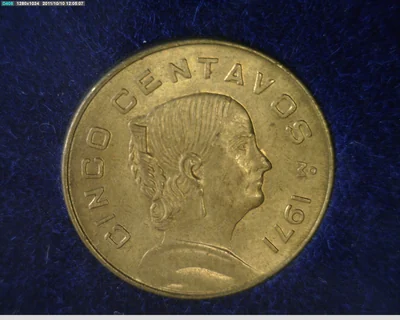
Same denomination, other years
20 centavos Bronce · Centavos Mexicanos
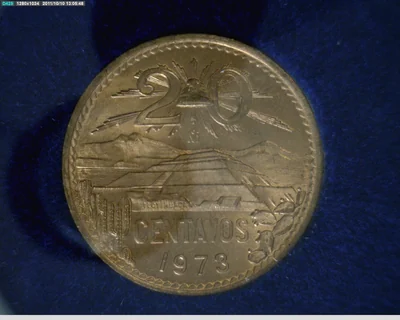
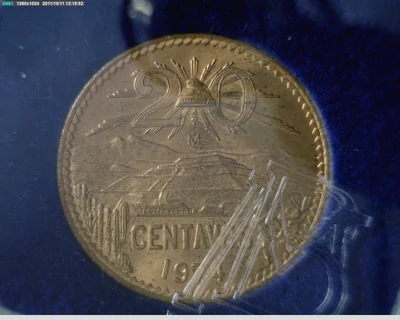
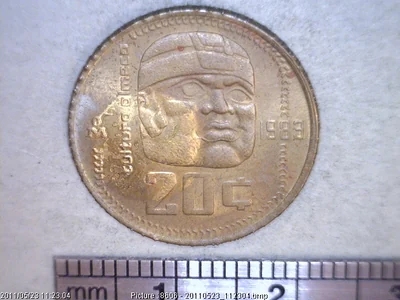
Frequently asked questions
How much is a 1971 Mexican 20 centavos worth?
Circulated and without a mint error, it is worth roughly under 1 dollar to about 3 dollars in USD depending on condition. An uncirculated coin with original luster can reach 5 to 15 dollars. The hundreds-of-thousands figures you see in viral posts refer to specific error coins, not the common piece.
Is the 1971 date rare?
No. 1971 was a transition year when two types were struck side by side, the Type 2 (KM#440) and the Type 3 (KM#441). Both were minted in large quantities and neither is scarce, so the date does not make the coin rare.
Is it made of silver?
No. It is bronze, a high-copper alloy sometimes cataloged as brass. It contains no silver or gold, so it has no precious-metal value. Its worth is purely collector demand and condition.
How do I know if my coin has a valuable error?
Look for concrete, visible flaws: doubling in the numerals or letters, an off-center strike, or repeated marks and die cracks. Compare your coin to reference photos and show it to a specialist if it looks promising. Most 1971 coins have no error at all, and wear or cleaning does not count as one.
Where can I sell a 1971 20 centavos?
You can sell through Mexican coin dealers in the Pesoteca shop directory at /tiendas and on general marketplaces. Since the coin is common, compare price and grade first. If you believe yours has a genuine mint error, confirm it before listing, because that is where value can change.
Conversation
0 comments
Sources
Images for informational and educational purposes, attributed to their original source. Reference values; the real price depends on the grade, the specific variant and demand.
Loading comments…