
5 Pesos 2009 Iturbide (Bicentenario): Value Guide
The 5 Pesos 2009 Iturbide : Value Guide is worth between $40 and $100 MXN depending on its grade of preservation.
Prices updated: August 2026
Bicentennial of Independence. Consummator of Independence, first emperor.
Bicentennial of Independence. Consummator of Independence, first emperor.
The 5 Pesos 2009 Iturbide : Value Guide is worth between $40 and $100 MXN depending on its grade of preservation.
Prices updated: August 2026
How much is the 5 Pesos 2009 Iturbide (Bicentenario): Value Guide worth?
The estimated value of the 5 Pesos 2009 Iturbide (Bicentenario): Value Guide ranges from $40 (circulated, XF) up to $100 (official blister pack), with $78 as a reference for an uncirculated (UNC) piece. The estimate is based on the official mintage and the historical behavior of the family.
The real price depends on four factors: the grade of preservation (a circulated piece is worth the low end of the range; an uncirculated one, or one still in its official blister pack, the high end), the finish (satin vs mirror/proof), the rarity within the series based on the mintage, and the metal spot price on the day of the deal when the piece is silver or gold. Check the value-by-grade table above and compare with equivalent pieces before buying or selling.
Where to buy or sell this coin?
Browse the national directory of numismatic shops or the community forum to trade directly with other collectors.
Description
If you inherited a Mexican 5 pesos coin dated 2009 with Agustín de Iturbide on it, here is the honest answer: the version that came out of everyday change is worth roughly its face value, around 25 to 30 US cents in 2026. The proof version, struck in .925 silver and sold in a Banxico case, is the one worth real money, and telling the two apart is the whole game.
There are two completely different coins that look almost identical, and most people who find one in a drawer have the common, low-value type.
What this coin actually is
Mexico issued a large series of bimetallic 5 pesos coins in 2008 and 2009 to mark the bicentennial of its independence (celebrated in 2010) and the centennial of its revolution. Each coin honors a different historical figure. This one features Agustín de Iturbide, the general who finalized Mexican independence in 1821 and briefly served as the country's first emperor.
The coin is bimetallic: an outer ring of aluminum-bronze around a center disc. That center disc is where the value question lives.
Two versions, two very different values
1. The circulating version. This is the one that went into general circulation and turned up in pocket change. The center is a plain base-metal alloy. Millions of people across Mexico ended up with these, and they trade at or near face value. In 2026, expect roughly 0.25 to 0.50 USD, and only toward the high end if it is uncirculated and a collector wants it to complete the 37-coin bicentennial set.
2. The silver proof version. Banxico also struck a proof edition with a center disc of .925 sterling silver, sold in an official presentation case (estuche). This is the collectible one. It carries a real silver content, a mirror-like proof finish, and a limited mintage. Depending on condition and whether it is still sealed with its case and certificate, the proof typically trades in the range of 20 to 60 USD.
The difference is not subtle once you know what to look for. If your coin came loose in a jar of change, it is almost certainly the circulating type.
Specifications (both versions)
| Spec | Detail |
|---|---|
| Face value | 5 pesos |
| Year | 2009 |
| Weight | 9.76 g |
| Diameter | 30.52 mm |
| Edge | Plain (smooth) |
| Composition | Aluminum-bronze ring; center is .925 silver (proof) or base alloy (circulating) |
| Issuer | Banco de México (Banxico) |
| Series | Bicentennial of Independence / Centennial of the Revolution |
Value by version and condition
| Version | Condition | Approximate value (USD, 2026) |
|---|---|---|
| Circulating | Worn | Face value (~0.25) |
| Circulating | Uncirculated | 0.25 to 0.50 |
| Silver proof | Loose, no case | 15 to 30 |
| Silver proof | Sealed, with Banxico case and certificate | 30 to 60 |
These are collector-market ranges. A graded, high-grade proof from a service like NGC or PCGS can sit at the top of that range or slightly above, but do not expect four-figure numbers. This is not a rare coin; it is a modern commemorative with a modest silver premium.
The myth to ignore
Social media posts love to claim modern Mexican commemoratives are worth hundreds or thousands of dollars. For this coin, that is false. The circulating 5 pesos 2009 is common, and even the silver proof is a mass-produced collectible, not a rarity. If a listing shows an eye-popping price, it is a hopeful seller, not the market. Sold prices, not asking prices, tell the truth.
How to tell which version you have
- Where you got it. From change or a coin jar: circulating. From a family member's collection in a plastic case: likely the proof.
- The finish. Proof coins have deep mirror fields and frosted devices. Circulating coins look flat and matte.
- The center disc. The silver proof center has a bright white sterling tone. The circulating center is a duller base metal.
- Weight and diameter. Check against the table above with a jewelry scale and a caliper. Both versions share the 9.76 g weight and 30.52 mm diameter, so weight alone will not separate them, but a coin far off these numbers may be damaged or counterfeit.
Errors and varieties
Genuine mint errors (off-center strikes, die rotation, doubled strikes) can multiply the value of any coin. Be skeptical, though. Most "errors" people spot on modern coins are post-mint damage: hits, scratches, corrosion. Those lower value, they do not raise it. If you think you have a real error, get more eyes on it before you get excited.
Where to sell it
- A verified numismatic shop from the Pesoteca shop directory will appraise it in person and tell you fast whether it is silver or base metal.
- The Pesoteca buy-and-sell forum connects you with collectors who actually want the bicentennial series, which matters if you are trying to sell the proof or a full set.
- Photograph the obverse, reverse, and edge, and note whether you have the original case before you list it anywhere. Do not dump it to the first Facebook offer.
If you are working through a whole inherited collection, it helps to see how this coin fits the broader picture of Mexican coin values and the rest of the commemorative peso series.
Got one of these and not sure if it's the silver proof or just pocket change? Post clear photos of the center disc on the Pesoteca forum and the community will tell you which version you're holding.
Historical context
Agustín Cosme Damián de Iturbide y Aramburu: royalist officer, consummator of Independence, and emperor of Mexico
Agustín Cosme Damián de Iturbide y Aramburu (1783-1824) was a royalist officer, consummator of Independence, and emperor of Mexico during the War of Independence.
Iturbide fought against Hidalgo and Morelos as a royalist officer until 1816. In 1820, after the restoration of the Constitution of Cádiz in Spain, he negotiated with Vicente Guerrero the Plan of Iguala (February 24, 1821), which consummated Independence under the Three Guarantees: religion, independence, and union. He entered Mexico City on September 27, 1821, at the head of the Army of the Three Guarantees.
Context of the year. The piece is from 2009 and honors the consummator of the movement. His figure is controversial because of his brief reign as Agustín I between 1822 and 1823, but his role in the military closing of the struggle is undeniable.
The reverse of the coin. The reverse of this 5-peso piece shows the portrait of Agustín Cosme Damián de Iturbide y Aramburu, his engraved signature, and the year 2009, per the Bank of Mexico's official catalog for the commemorative series of the Bicentennial of the start of Independence (1810-2010).
Legacy. His remains rest in the Metropolitan Cathedral. The city of Iturbide, in Nuevo León, and the municipality of Iturbide del Cauto, in Zacatecas, bear his name.
This piece belongs to the era
Nuevos Pesos y actualidad →Explore all the Mexican coins of this era, their historical context and how they connect to the monetary system of the period.
Value range of this piece
Market estimate: $40 - $100 MXN depending on the grade of preservation (typical range between a circulated and an uncirculated piece).
See the full breakdown by grade (VG, F, VF, EF, AU, MS-60, MS-63, MS-65) for the whole series →
Other denominations from 2009
5 Pesos Bicentenario Independencia y Centenario Revolución · Bimetálica
Same denomination, other years
5 pesos Bimetálica · 5 Pesos Bicentenario Independencia y Centenario Revolución
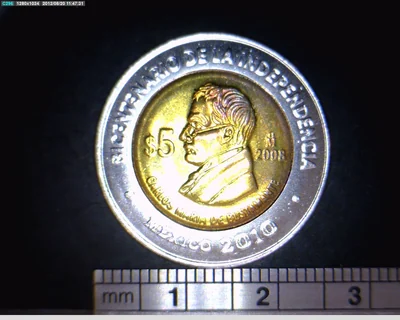
5 Pesos Bicentenario de la Independencia de México: Carlos María de Bustamante
2008
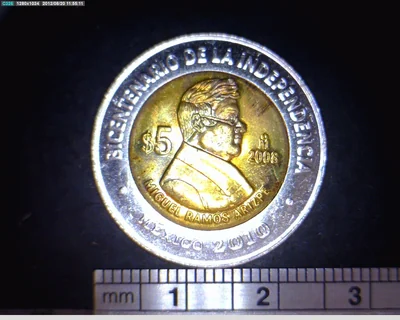
5 Pesos Bicentenario de la Independencia de México: Miguel Ramos Arizpe
2008
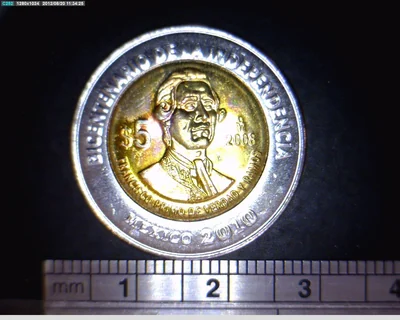
5 Pesos Bicentenario de la Independencia de México: Francisco Primo de Verdad y Ramos, sin puntos
2008
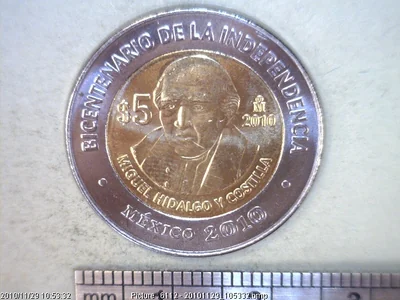
5 Pesos Bicentenario de la Independencia de México: Miguel Hidalgo y Costilla
2010
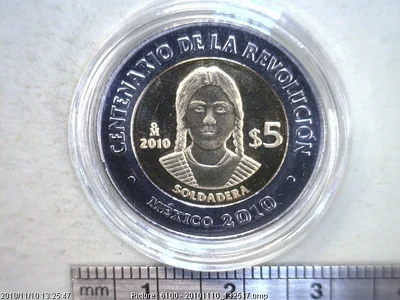
5 Pesos Centenario de la Revolución Mexicana: Soldadera
2010
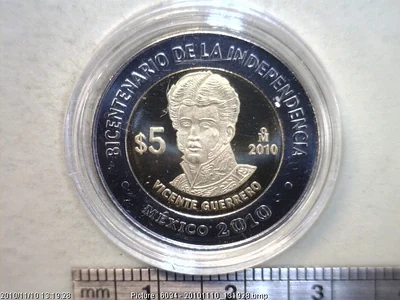
5 Pesos Bicentenario de la Independencia de México: Vicente Guerrero
2010
Official sources
Frequently asked questions
How much is the 5 pesos 2009 Iturbide coin worth?
It depends on the version. The circulating coin that came out of change is worth about face value, roughly 0.25 to 0.50 USD. The .925 silver proof version, sold in a Banxico case, typically trades between 20 and 60 USD depending on condition and whether it still has its original case and certificate.
Is the 5 pesos 2009 Iturbide coin rare?
No. The circulating version is common and was made in large numbers for general use. The silver proof edition has a limited mintage and a modest silver premium, but it is still a mass-produced modern commemorative, not a rarity. Ignore listings claiming it is worth hundreds or thousands of dollars.
Where can I sell the 5 pesos 2009 Iturbide coin?
For the silver proof, a verified numismatic shop from the [Pesoteca directory](/tiendas) can appraise it on the spot, or you can reach collectors directly through the [Pesoteca buy-and-sell forum](/foro/compra-venta). Photograph the obverse, reverse, and edge, and note whether you have the original Banxico case before listing.
How do I know if mine is the valuable silver version?
Check the center disc. The silver proof has a bright white sterling tone, deep mirror fields, and frosted design elements, and it usually comes in an official Banxico case. The circulating version has a duller base-metal center and a flat matte finish. If it came loose from pocket change, it is almost certainly the common version.
Conversation
0 comments
Loading comments…