
8 Escudos Fernando VI 1747: Value & Real Prices (2026)
The 8 Escudos Fernando VI 1747: Value & Real Prices is worth between $51,308 and $86,414 MXN depending on its grade of preservation.
Prices updated: August 2026
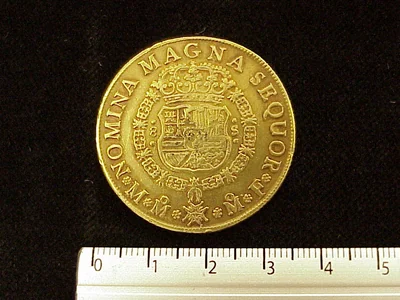
First type; with denomination.
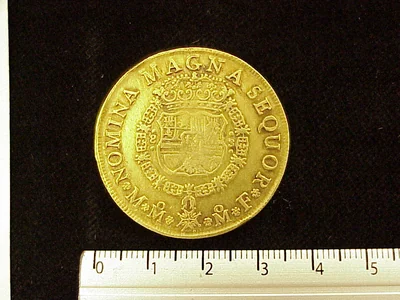
First type; with denomination.
The 8 Escudos Fernando VI 1747: Value & Real Prices is worth between $51,308 and $86,414 MXN depending on its grade of preservation.
Prices updated: August 2026
How much is the 8 Escudos Fernando VI 1747: Value & Real Prices (2026) worth?
The estimated value of the 8 Escudos Fernando VI 1747: Value & Real Prices (2026) ranges from $51,308 (circulated, XF) up to $86,414 (official blister pack), with $73,648 as a reference for an uncirculated (UNC) piece. The estimate is based on the official mintage and the historical behavior of the family.
The real price depends on four factors: the grade of preservation (a circulated piece is worth the low end of the range; an uncirculated one, or one still in its official blister pack, the high end), the finish (satin vs mirror/proof), the rarity within the series based on the mintage, and the metal spot price on the day of the deal when the piece is silver or gold. Check the value-by-grade table above and compare with equivalent pieces before buying or selling.
Where to buy or sell this coin?
Browse the national directory of numismatic shops or the community forum to trade directly with other collectors.
Description
If you inherited a large gold coin dated 1747 with a Spanish king's portrait and "8 S" on it, you have something with real value. This is the 8 Escudos of Fernando VI, struck at the Mexico City Mint (Casa de Moneda de México). It contains nearly a full troy ounce of gold, so its worst-case value is the metal itself, currently around 1,600 to 1,800 USD depending on gold prices. A genuine, well-preserved example is worth several times that.
In 2026, this is one of the most sought-after Spanish colonial gold coins for a simple reason: high gold content, real age (nearly 280 years old), and a short reign that limits how many exist.
What you actually have
The 8 Escudos was the largest gold denomination in the Spanish monetary system, and Mexico City was the most productive mint in Spanish America. Collectors call it the onza de oro (gold ounce). Here are the hard facts, which you can use to check yours:
| Feature | Specification |
|---|---|
| Denomination | 8 Escudos (gold) |
| Ruler | Fernando VI (Ferdinand VI) |
| Year | 1747 |
| Mint | Mexico City (Casa de Moneda de México) |
| Weight | 26.98 grams |
| Diameter | 37 mm |
| Edge | Reeded (grooved) |
| Fineness | .917 gold (22 karat) |
| Actual gold content | ~24.7 grams (~0.795 troy oz) |
The 1747 date matters. Fernando VI took the throne in 1746 after the death of his father Felipe V, so 1747 is a first-year-of-reign type. First years of a short reign tend to have lower survival numbers, and that scarcity is part of why this coin commands a premium over its melt value.
Is it worth money? The honest answer
Yes, but the number depends almost entirely on condition and authenticity.
Melt floor. Because it holds roughly 0.8 troy ounce of pure gold, no genuine example is ever worth less than its metal. At current gold prices that floor sits near 1,600 to 1,800 USD. That alone puts this coin far above the typical inherited coin, most of which are worth a few dollars.
Collector value. A genuine 8 Escudos of Fernando VI in average circulated condition trades well above melt, often in the 2,000 to 4,000 USD range. Sharp, well-centered examples with clean surfaces and full detail climb higher, and top-grade certified pieces of this type have reached five figures at auction. Because grading swings the price so much, do not accept a flat quote from anyone who has not examined the actual coin.
Condition drivers that raise the price:
- Crisp, high relief on the portrait and the shield/pillars
- Well-centered strike (the design not cut off by the edge)
- Original surfaces with no cleaning, tooling, or filing
- An intact reeded edge (a tampered edge suggests gold was shaved)
The myth to ignore
A very old gold coin does not automatically mean "worth millions." Social media inflates that idea constantly. The 8 Escudos is genuinely valuable, but its value is set by gold content, grade, and real scarcity, not by age alone. A worn, cleaned, or (worse) counterfeit example can be worth little more than melt, and a fake is worth nothing. Age is not the price driver here; condition and authenticity are.
How to tell if yours is genuine
Spanish colonial gold is heavily counterfeited, so verify before you celebrate or sell.
- Weigh it. Use a jewelry scale. A genuine coin is very close to 26.98 grams. A significant miss in either direction is a red flag.
- Measure it. Diameter should be about 37 mm, checked with a caliper.
- Check the edge. It should be reeded (grooved). A smooth or altered edge often means someone shaved gold off, or the piece is cast.
- Look at the engraving, mint mark, and assayer initials. Colonial dies have a distinct style; casts and modern fakes look mushy or too uniform. Compare against verified references.
- Be suspicious of any offer far below melt. No honest buyer sells real gold under its metal value.
For anything valuable, the safe move is third-party certification. Grading services like NGC or PCGS authenticate and grade the coin, which both protects you and raises what a buyer will pay.
Where to sell it
Because this is a precious-metal coin, only deal with buyers who examine and weigh the piece in front of you.
- A verified numismatic shop in the Pesoteca directory can appraise it on the spot, city by city, without middleman markups.
- The Pesoteca buy-and-sell forum connects you directly with collectors who understand colonial gold.
- For a top-grade example, a major auction house often gets the strongest result.
Before selling, photograph the obverse, reverse, and edge in good light, and compare your figures to the table above. Do not dump it on Facebook to the first bidder, and do not sell to anyone quoting a price without seeing the coin.
If you want to know where your specific example lands, related colonial gold like the Centenario and Mexican gold coins sit in the same market. Post clear photos in the Pesoteca forum and let collectors help you pin down the grade before you accept any offer.
Have a 1747 8 Escudos in the family? Share the weight and both sides in the forum, and we can help you separate melt value from collector value.
Historical context
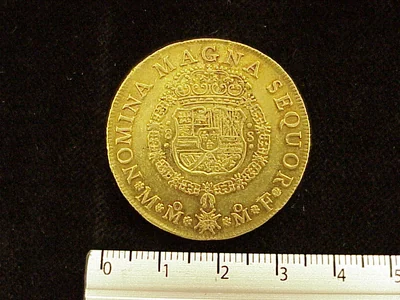
Eight escudos Ferdinand VI, 1747, Mexico City mint. The first full year of the reign of Ferdinand VI, son of Philip V and older brother of Charles III. Ferdinand VI ascended the throne in July 1746 after his father's death, and his reign was characterized by external neutrality and internal administrative reforms guided by the Marquis of Ensenada. The record lists the piece as the first type with a visible denomination, a sign that the reverse die included the value mark VIII over the pillar design. In Mexico, Francisco de Guemes y Horcasitas, Count of Revillagigedo, governed as viceroy from 1746 to 1755. His administration introduced stamped paper and reinforced coastal defense against English privateering. The ounce weighs 27.06 grams at 0.916 fineness. Produced by mill with a round planchet, with the classic pillar reverse. Krause references KM#149 as the first Ferdinand VI type in New Spain, distinguished from Philip V's KM#148 by the change of the royal name in the obverse legend and subtle modifications to the crowned shield.
This piece belongs to the era
Colonial / Virreinato →Explore all the Mexican coins of this era, their historical context and how they connect to the monetary system of the period.
Value range of this piece
Market estimate: $51,308 - $86,414 MXN depending on the grade of preservation (typical range between a circulated and an uncirculated piece).
See the full breakdown by grade (VG, F, VF, EF, AU, MS-60, MS-63, MS-65) for the whole series →
Same denomination, other years
8 escudos Oro 0.875 (21k) · 8 Escudos Fernando VI
Frequently asked questions
How much is a 1747 Fernando VI 8 Escudos worth?
It holds about 0.8 troy ounce of gold, so its melt floor is roughly 1,600 to 1,800 USD depending on gold prices. A genuine circulated example usually trades between 2,000 and 4,000 USD, and top-grade certified pieces of this type have reached five figures at auction. Condition and authenticity set the final number.
Is the 1747 8 Escudos rare?
It is scarce and desirable. It is a first-year-of-reign type for Fernando VI (crowned 1746), struck at the Mexico City Mint, and few high-grade examples survive. It is not a common coin, but genuine pieces do appear at auction, so it is scarce rather than one of a kind.
How can I tell if my 8 Escudos is genuine?
Weigh it (should be close to 26.98 grams) and measure it (about 37 mm) with a jewelry scale and caliper. Check for a reeded edge, and examine the engraving, mint mark, and assayer initials against verified references. Counterfeits are common, so for anything valuable get it certified by NGC or PCGS. Be suspicious of any offer below melt value.
Where can I sell a 1747 8 Escudos safely?
Use a verified numismatic shop from the Pesoteca directory for an on-the-spot appraisal, or the Pesoteca buy-and-sell forum to reach collectors directly. Because it is gold, only deal with buyers who weigh and examine it in person, and photograph the obverse, reverse, and edge before selling. Avoid selling to the first Facebook bidder.
Conversation
0 comments
Loading comments…