
8 Escudos Fernando VII 1814 (Mexico Gold): Value Guide
The 8 Escudos Fernando VII 1814 : Value Guide is worth between $51,441 and $86,638 MXN depending on its grade of preservation.
Prices updated: August 2026
Viceroyalty · Mexico City Mint · Assayer JJ
Viceroyalty · Mexico City Mint · Assayer JJ
The 8 Escudos Fernando VII 1814 : Value Guide is worth between $51,441 and $86,638 MXN depending on its grade of preservation.
Prices updated: August 2026
How much is the 8 Escudos Fernando VII 1814 (Mexico Gold): Value Guide worth?
The estimated value of the 8 Escudos Fernando VII 1814 (Mexico Gold): Value Guide ranges from $51,441 (circulated, XF) up to $86,638 (official blister pack), with $73,839 as a reference for an uncirculated (UNC) piece. The estimate is based on the official mintage and the historical behavior of the family.
The real price depends on four factors: the grade of preservation (a circulated piece is worth the low end of the range; an uncirculated one, or one still in its official blister pack, the high end), the finish (satin vs mirror/proof), the rarity within the series based on the mintage, and the metal spot price on the day of the deal when the piece is silver or gold. Check the value-by-grade table above and compare with equivalent pieces before buying or selling.
Where to buy or sell this coin?
Browse the national directory of numismatic shops or the community forum to trade directly with other collectors.
Description
If you inherited or found an 8 Escudos Fernando VII dated 1814, you are holding a real gold coin, not a novelty. It contains roughly 24.4 grams of pure gold, which gives it a hard floor of well over 1,600 USD at current gold prices, before any collector premium. Nice examples sell for considerably more. Here is what it is actually worth and how to check yours.
Quick answer: what it's worth in 2026
The 8 Escudos was the largest gold coin struck at the Mexico City Mint under Spanish rule. Because it is nearly a full ounce of gold (27.05 grams total weight at .875 fineness), it can never be worth "just a few dollars." Its baseline is melt value. On top of that, collector demand for genuine, well-preserved 1814 pieces pushes prices into the thousands.
- Worn, circulated example: roughly 1,700 to 2,500 USD (driven mostly by gold content).
- Attractive, lightly circulated: roughly 2,500 to 4,000 USD.
- High grade, certified (About Uncirculated to Mint State): 4,000 to 8,000 USD and up, depending on the mint mark and eye appeal.
These are ranges. The exact figure depends on grade, the assayer initials, and whether the coin is certified. Fernando VII 8 Escudos were struck at several Spanish colonial mints (Mexico, Lima, Santiago, and others), and Mexico City strikes are the most commonly encountered.
What this coin actually is
"8 Escudos" was the top gold denomination of the Spanish colonial system. Collectors and dealers often call this coin a gold onza ("onza" means ounce in Spanish) because it is close to a troy ounce of metal. The 1814 date matters: Fernando VII had just returned to the Spanish throne after the Napoleonic occupation, and New Spain (colonial Mexico) was in the middle of its war of independence. American gold coins like this one circulated internationally and were trusted as a store of value across Europe and Asia.
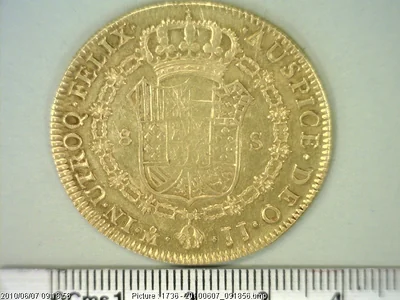
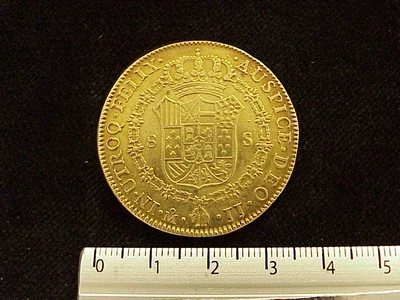
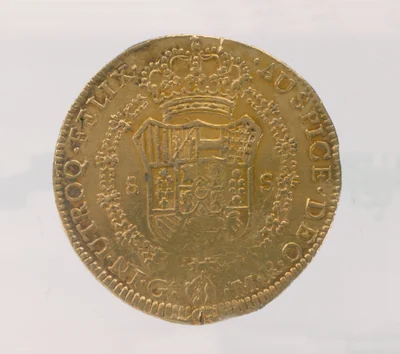
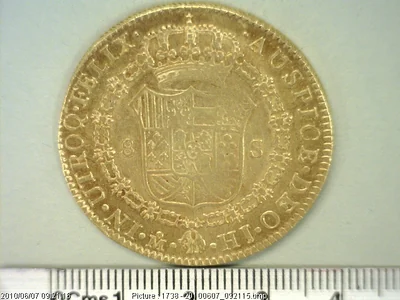
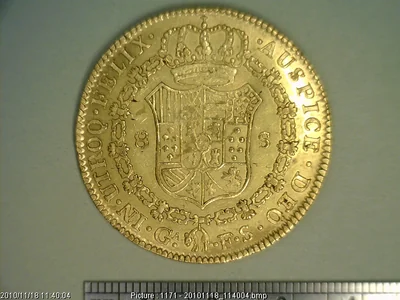
The portrait on the front (obverse) is the official bust of King Fernando VII, imposed from Spain. The reverse carries the Spanish coat of arms. It is cataloged as KM#161.
Specifications (keep these exact)
| Feature | Detail |
|---|---|
| Denomination | 8 Escudos (gold) |
| Year | 1814 |
| Total weight | 27.05 grams |
| Diameter | 37 mm |
| Fineness | .875 gold (approx. 24.4 g pure gold) |
| Edge | Diagonal reeded |
| Catalog | KM#161 |
| Mint | Mexico City (Casa de Moneda de México) |
If your coin does not match this weight and diameter closely, treat it as suspect until proven otherwise.
What drives the price
Three things decide the number:
- Gold content. This is the floor. Even a beat-up example is worth its melt. Around 24.4 grams of pure gold sets a value that moves with the spot price.
- Grade and eye appeal. Full detail in the king's hair and in the shield, sharp legends, and original luster separate a 2,000 USD coin from a 6,000 USD coin. Wear, cleaning, scratches, and mount marks (from being worn as jewelry) drag the value down.
- Certification. A coin graded and slabbed by NGC or PCGS sells for more and sells faster, because the buyer does not have to trust your judgment on authenticity or grade.
How to tell if yours is genuine
Gold fakes are common, and this is a high-value target. Start with the basics:
- Weigh it. It must be very close to 27.05 grams. Counterfeits are almost always made in a lower fineness or a base metal core, and the weight gives them away.
- Measure it. 37 mm diameter. A wrong size is an immediate red flag.
- Check the edge. It should have a diagonal reeded (grooved) pattern. Cast fakes often have a soft, mushy, or seamed edge.
- Look for mount or solder marks. Many of these coins were worn as jewelry. That damage reduces value but does not make the coin fake.
If the coin passes weight and size and you are dealing in the thousands, get it authenticated. NGC or PCGS certification is the definitive safeguard for a piece at this value level. It costs money, but it protects both you and any future buyer.
The myth to ignore
Being over 200 years old does not automatically make this coin "priceless" or worth six figures. Plenty of these were struck and survive. The value is real and substantial, but it is anchored to gold content plus a collector premium, not to a fantasy number. Anyone quoting you a life-changing sum for an average, circulated example is either mistaken or trying to overcharge a buyer. Conversely, a dealer offering you only melt value for a sharp, high-grade coin is lowballing you.
Where to sell it (and get a fair price)
Because this is a precious-metal coin, only deal with people who will handle it in person or on documented photos. Your realistic options:
- A verified numismatic dealer who can appraise it on the spot and pay you the same day. Check the Pesoteca dealer directory to find one by city.
- The Pesoteca buy-and-sell forum, where collectors trade directly and you can compare offers.
- Coin shows and reputable collector groups, where informed buyers pay real numbers for real gold.
Before you sell: photograph the obverse, reverse, and edge in good light, confirm the weight, and compare against the ranges above. If the coin is high grade, getting it graded first will usually more than pay for itself. Avoid dumping it to the first buyer on a general marketplace, which is where lowball offers and counterfeits cluster.
Have an 8 Escudos and not sure of the grade or the assayer initials? Post clear photos of both sides and the edge on the Pesoteca forum and let the community help you pin down what yours is really worth.
Historical context
Eight escudos of Ferdinand VII, 1814, Mexico mint, assayer JJ, Krause KM#161. The year of Ferdinand VII's return to Spain in March after the end of the Napoleonic occupation. In May he abolished the Constitution of Cádiz and restored absolutism. Krause records the type change to KM#161 precisely because, from the king's return, updated and better-documented portraits began to be used at the American mints, although the imaginary bust survived in simultaneous issues. In New Spain, Félix María Calleja had been governing as viceroy since March 1813. In November 1813 José María Morelos had promulgated the Constitution of Apatzingán, and in 1814 the insurgency maintained control of broad areas of the south and the Bajío. The ounce weighs 27.06 grams at 0.875 fineness. Produced by mill press with a round planchet. The assayers' signature JJ appears in the field.
This piece belongs to the era
Colonial / Virreinato →Explore all the Mexican coins of this era, their historical context and how they connect to the monetary system of the period.
Value range of this piece
Market estimate: $51,441 - $86,638 MXN depending on the grade of preservation (typical range between a circulated and an uncirculated piece).
See the full breakdown by grade (VG, F, VF, EF, AU, MS-60, MS-63, MS-65) for the whole series →
Same denomination, other years
8 escudos Oro 0.875 (21k) · Escudos Coloniales (oro)
Frequently asked questions
How much is an 8 Escudos Fernando VII 1814 worth?
It depends heavily on grade, but because it is a gold coin it always has a floor. A worn, circulated example runs roughly 1,700 to 2,500 USD, driven mostly by its gold content (about 24.4 grams pure). Attractive lightly circulated pieces reach 2,500 to 4,000 USD, and high-grade certified examples can bring 4,000 to 8,000 USD or more. For a firm number on your exact coin, get it appraised by a reputable dealer or certified by NGC or PCGS.
Is the 8 Escudos Fernando VII 1814 rare?
It is scarce and valuable, but not impossibly rare. Many were struck at the Mexico City Mint and a fair number survive, which is why the value is anchored to gold content plus a collector premium rather than a fantasy number. What makes an individual coin rare and pricey is high grade with full detail and original luster, plus certification. Circulated examples are more common and sell closer to melt value.
How can I tell if my 8 Escudos Fernando VII 1814 is genuine?
Start with the physical specs: it must weigh very close to 27.05 grams and measure 37 mm across, with a diagonal reeded edge. Counterfeits are usually the wrong weight or a lower fineness, so a scale often exposes them immediately. Watch for mount or solder marks from jewelry use, which lower value but do not mean it is fake. For a coin worth thousands, NGC or PCGS certification is the definitive safeguard.
Where can I sell an 8 Escudos Fernando VII 1814?
Your safest options are a verified numismatic dealer who can appraise and pay in person (find one in the Pesoteca dealer directory), or the Pesoteca buy-and-sell forum where collectors trade directly. Because it is precious metal, only deal with buyers who will handle the coin or review documented photos of the obverse, reverse, and edge plus the weight. Photograph everything and compare against real price ranges before you sell, and avoid taking the first lowball offer on a general marketplace.
Conversation
0 comments
Sources
Images for informational and educational purposes, attributed to their original source. Reference values; the real price depends on the grade, the specific variant and demand.
Loading comments…