
8 Reales 'Resplandor' Álamos 1876: Value & How to Sell
The 8 Reales 'Resplandor' Álamos 1876: Value & How to Sell is worth between $745 and $1,961 MXN depending on its grade of preservation.
Prices updated: August 2026
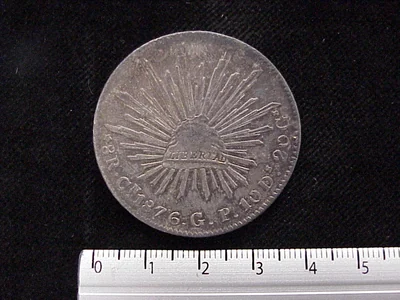
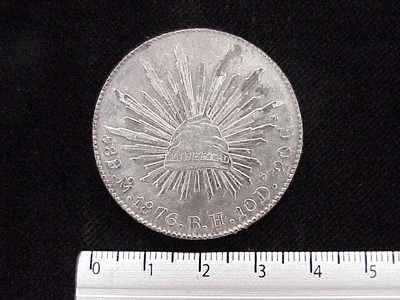
Strong silver peso .9028, Álamos Mint, struck in 1876.
Strong silver peso .9028, Álamos Mint, struck in 1876.
Design
Banxico
Reverse
Reverse with a facing republican eagle devouring a serpent on a cactus, legend "REPÚBLICA MEXICANA". Piece attributed to the Álamos mint, 1876.
Obverse
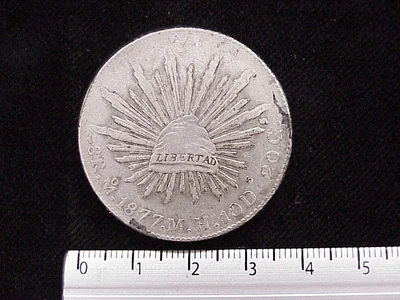
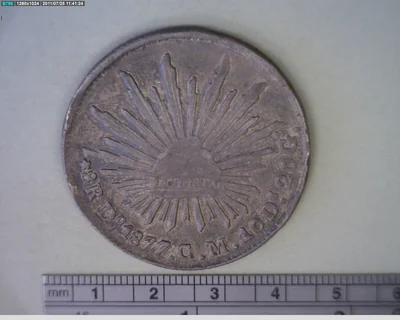
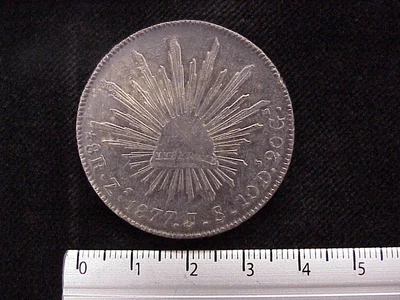
Obverse with a Phrygian cap over solar rays (resplandor) and the legend "LIBERTAD". Struck in 0.9028 silver following the republican eight-real standard in force until the monetary reform of 1905.
The 8 Reales 'Resplandor' Álamos 1876: Value & How to Sell is worth between $745 and $1,961 MXN depending on its grade of preservation.
Prices updated: August 2026
How much is the 8 Reales 'Resplandor' Álamos 1876: Value & How to Sell worth?
The estimated value of the 8 Reales 'Resplandor' Álamos 1876: Value & How to Sell ranges from $745 (circulated, XF) up to $1,961 (official blister pack), with $1,519 as a reference for an uncirculated (UNC) piece. The estimate is based on the official mintage and the historical behavior of the family.
The real price depends on four factors: the grade of preservation (a circulated piece is worth the low end of the range; an uncirculated one, or one still in its official blister pack, the high end), the finish (satin vs mirror/proof), the rarity within the series based on the mintage, and the metal spot price on the day of the deal when the piece is silver or gold. Check the value-by-grade table above and compare with equivalent pieces before buying or selling.
Where to buy or sell this coin?
Browse the national directory of numismatic shops or the community forum to trade directly with other collectors.
Price today
How much is the gold in a Centenario worth?
The Centenario is Mexico's main gold investment piece. Its price follows the gold spot in USD adjusted for MXN.
Description
If you inherited an 1876 8 Reales stamped with a radiant cap and a small "A" mint mark, you have a real silver coin worth money, though probably not a fortune. In 2026, a circulated example trades from roughly USD 40 to USD 80, driven mostly by its silver content, while a sharp, well-preserved piece from this specific mint can reach several hundred dollars because of where it was struck.
Here is the honest breakdown of what you have, why the mint matters, and how to sell it without getting shortchanged.
What you actually have
The 8 Reales "Resplandor" (Spanish for "radiance" or "sunburst") was the workhorse silver coin of 19th-century Mexico, the direct descendant of the old Spanish colonial piece of eight that circulated worldwide. The nickname comes from the radiant Phrygian cap design on the front.
Yours was struck at the Álamos mint, in what is today the state of Sonora in northwestern Mexico. That small "A" (or "As") mint mark is the detail that matters most for value. Álamos was a regional mint that produced far smaller quantities than the giant operations in Mexico City or Zacatecas, so collectors who assemble the Resplandor series by mint actively chase these.
Specifications
| Feature | Detail |
|---|---|
| Denomination | 8 Reales |
| Year | 1876 |
| Mint | Álamos (Sonora), mint mark "A" |
| Metal | Silver |
| Weight | 27.07 grams |
| Diameter | 39 mm |
| Edge | Reeded |
| Catalog reference | KM#377 |
Because it is a large silver coin, it has a floor value: even a worn, heavily cleaned example is worth its silver melt, which at current prices sits around USD 18 to USD 22. No genuine 1876 Álamos 8 Reales is worth "just a dollar."
What it's worth in 2026
Value splits into two questions: how much silver is in it (the floor) and how rare and well-preserved the specific piece is (the premium). For 8 Reales, condition and mint are everything.
| Condition | Approximate value (USD) |
|---|---|
| Heavily worn / cleaned | 25 to 45 (near melt) |
| Circulated, clear details | 50 to 100 |
| Lightly circulated, sharp | 120 to 300 |
| Uncirculated / high grade | 400 and up |
These are ranges, not promises. A coin certified by NGC or PCGS in a high mint-state grade sells for a strong multiple of a raw, un-graded example, because buyers trust the grade and the authentication. The Álamos mint mark adds a premium over the same year from a common mint like Mexico City.
Two things move a coin toward the top of these ranges: strike sharpness (crisp, fully struck details from a fresh die) and original surfaces (no cleaning, no polishing, no scratches).
The myth to ignore
Social media is full of claims that any old Mexican 8 Reales is worth thousands. Almost none are. The overwhelming majority are circulated coins worth their silver plus a modest collector premium. The genuinely valuable examples are the scarce mint-and-year combinations in top condition, and the Álamos 1876 is desirable but not a five-figure coin in average shape. Anyone quoting you thousands for a worn piece is either mistaken or working an angle.
Same goes for "error" claims. Real mint errors (off-center strikes, die rotation, double strikes) can multiply value if genuine and verifiable. But most "errors" people post online are post-mint damage: dings, corrosion, and cleaning marks, which lower value, not raise it.
How to tell if yours is genuine
Colonial and republican Mexican silver is heavily counterfeited, so verify before you buy or sell.
- Weigh it on a jewelry scale. It should be very close to 27.07 grams. A wide miss is a red flag.
- Measure it with calipers. Diameter should be about 39 mm.
- Check the edge: it should be reeded (fine vertical ridges).
- Study the engraving, the mint mark, and the assayer's initials against known genuine examples. Fakes often get the style or letter spacing wrong.
- Be suspicious of any deal priced well below the silver value. Nobody sells real silver at a loss by accident.
If you want certainty, submit it to NGC or PCGS for authentication and grading. It costs money, but for a potentially high-grade piece it pays for itself.
Where to sell it
To sell an 1876 Álamos 8 Reales without leaving money on the table:
- A verified numismatic shop from the Pesoteca dealer directory can appraise it on the spot, by city, without a middleman markup.
- The Pesoteca buy-and-sell forum connects you directly with collectors who value the Álamos mint mark.
- For a certified high-grade example, a major auction house (Heritage, Stack's Bowers) reaches the deepest pool of serious buyers.
Before you sell, photograph the obverse, reverse, and edge in good light, and check your grade against the ranges above. Avoid dumping it on a marketplace at the first offer.
Not sure whether your coin is circulated or uncirculated, or whether that mark is an error or just damage? Post clear photos in the Pesoteca forum and let collectors who handle these coins weigh in before you set a price.
Historical context
The year 1876 was one of political transition in Mexico: Sebastián Lerdo de Tejada left the presidency after Porfirio Díaz's Plan de Tuxtepec, with José María Iglesias serving as interim. The end of the Restored Republic.
The Álamos mint (As) reopened in 1862 during the French Intervention to provide liquidity to the silver mining region of southern Sonora. It worked until 1895, when the Porfirian centralization concentrated minting in Mexico City and Zacatecas.
This is the first documented issue of this series at the Álamos mint, coinciding with the political transition of the Plan de Tuxtepec.
As a catalog reference, this mint's variety is listed as KM#377 in Krause. The piece is .9028 fineness silver with a reeded edge and a theoretical weight of 27.07 grams. The 1876 example from Álamos, Sonora corresponds to the mint's middle stage (1862-1895) and is identified on the coin by the As mint mark.
In the Mexican numismatic market the As-1876 resplandor peso appears regularly at auction and in central Mexico flea markets. When hunting it, it's worth verifying a clean reeded edge, without trimming, and that the As mint mark is sharp. Before paying a middleman markup, check the reference range by grade in public catalogs and on the Pesoteca forum; many examples from this decade (1870s) can be had at par pricing without speculative intermediaries.
This piece belongs to the era
República Restaurada y Porfiriato →Explore all the Mexican coins of this era, their historical context and how they connect to the monetary system of the period.
Value range of this piece
Market estimate: $745 - $1,961 MXN depending on the grade of preservation (typical range between a circulated and an uncirculated piece).
See the full breakdown by grade (VG, F, VF, EF, AU, MS-60, MS-63, MS-65) for the whole series →
Other denominations from 1876
8 Reales Republicanos (Resplandor) · Plata 0.900
Same denomination, other years
8 reales Plata 0.900 · 8 Reales Republicanos (Resplandor)
Frequently asked questions
How much is an 1876 Álamos 8 Reales worth?
It depends almost entirely on condition. A worn or cleaned example trades near its silver value, roughly USD 25 to 45. A clear circulated coin runs USD 50 to 100, a sharp lightly circulated piece USD 120 to 300, and an uncirculated or high-grade certified example can reach USD 400 or more. The Álamos mint mark adds a premium over common mints.
Is the 1876 Álamos 8 Reales rare?
It is scarcer than 8 Reales from big mints like Mexico City or Zacatecas. Álamos was a small regional mint with modest output, so collectors building the Resplandor series by mint actively seek these. That makes it desirable, though not a five-figure coin in average worn condition.
How can I tell if my 1876 Álamos 8 Reales is genuine?
Weigh it (it should be about 27.07 grams) and measure it (around 39 mm) with a jewelry scale and calipers, then compare to the specs above. Check for a reeded edge and study the mint mark, engraving style, and assayer's initials against known genuine coins. Counterfeits are common, so be suspicious of any price far below the silver value, and consider NGC or PCGS certification.
Where is the safest place to sell it?
A verified shop from the Pesoteca dealer directory can value it on the spot, or you can list it in the Pesoteca buy-and-sell forum among collectors who appreciate the Álamos mint. For a certified high-grade piece, a major auction house reaches the most serious buyers. Photograph the obverse, reverse, and edge, and verify the grade before selling.
Conversation
0 comments
Sources
- Ejemplar de la Coleccion Numismatica Banco de Mexico . inv. 5716
- Ejemplar de la Coleccion Numismatica Banco de Mexico . inv. 5715
- Ejemplar de la Coleccion Numismatica Banco de Mexico . inv. 5714
Images for informational and educational purposes, attributed to their original source. Reference values; the real price depends on the grade, the specific variant and demand.
Loading comments…