
8 Reales Chihuahua 1881 (Resplandor): Value & Prices
The 8 Reales Chihuahua 1881 : Value & Prices is worth between $745 and $1,961 MXN depending on its grade of preservation.
Prices updated: August 2026
Strong silver peso .9028, Chihuahua Mint, struck in 1881.
Strong silver peso .9028, Chihuahua Mint, struck in 1881.
Design
Banxico
Reverse
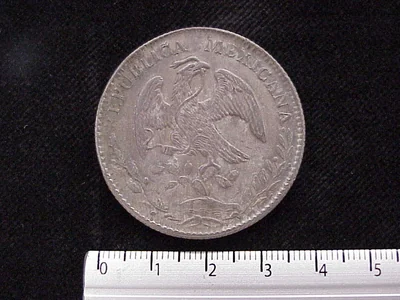
Reverse with a facing republican eagle devouring a serpent atop a nopal cactus, legend "REPÚBLICA MEXICANA". Piece attributed to the Chihuahua mint, 1881.
Obverse
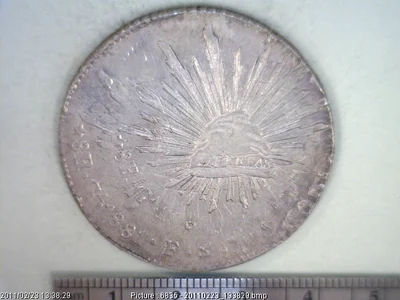
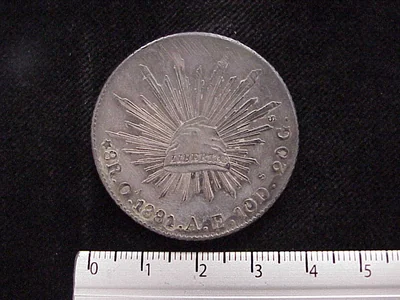
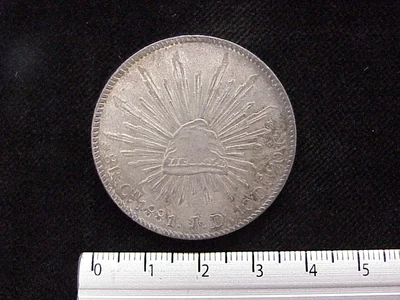
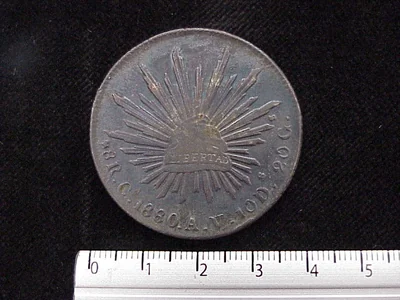
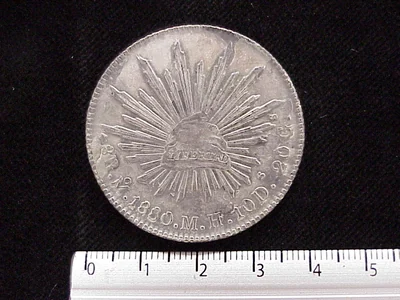
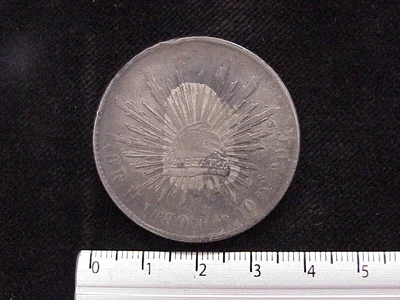
Obverse with a Phrygian cap over solar rays (cap and rays) and the legend "LIBERTAD". Struck in .9028 silver following the republican eight-real standard in force until the 1905 monetary reform.
The 8 Reales Chihuahua 1881 : Value & Prices is worth between $745 and $1,961 MXN depending on its grade of preservation.
Prices updated: August 2026
How much is the 8 Reales Chihuahua 1881 (Resplandor): Value & Prices worth?
The estimated value of the 8 Reales Chihuahua 1881 (Resplandor): Value & Prices ranges from $745 (circulated, XF) up to $1,961 (official blister pack), with $1,519 as a reference for an uncirculated (UNC) piece. The estimate is based on the official mintage and the historical behavior of the family.
The real price depends on four factors: the grade of preservation (a circulated piece is worth the low end of the range; an uncirculated one, or one still in its official blister pack, the high end), the finish (satin vs mirror/proof), the rarity within the series based on the mintage, and the metal spot price on the day of the deal when the piece is silver or gold. Check the value-by-grade table above and compare with equivalent pieces before buying or selling.
Where to buy or sell this coin?
Browse the national directory of numismatic shops or the community forum to trade directly with other collectors.
Price today
How much is the gold in a Centenario worth?
The Centenario is Mexico's main gold investment piece. Its price follows the gold spot in USD adjusted for MXN.
Description
If you inherited or found an 1881 Mexican 8 Reales from the Chihuahua mint, here is the honest answer: most circulated examples are worth their silver content, which is a real floor of roughly 20 to 30 US dollars depending on the silver spot price. Clean, high-grade examples sell for meaningfully more. This is not a million-dollar coin, but it is genuine silver with steady collector demand.
This is the coin US collectors call the "Cap and Rays" 8 Reales (the Spanish name is Resplandor, meaning "radiance," for the sunburst behind the liberty cap). It was struck in 1881 at the Chihuahua mint in northern Mexico. The design ran for decades across many mints, so the year and mint mark matter a lot for value.
What it is worth right now
The 1881 Chihuahua 8 Reales contains real silver, so it can never be worth less than its metal. Value climbs from there based on how worn the coin is (its grade) and whether collectors are chasing that specific date and mint.
| Condition (grade) | Typical value range (USD) |
|---|---|
| Heavily worn / damaged | Melt value, about 20 to 30 |
| Circulated (Fine to Very Fine) | 30 to 60 |
| Lightly circulated (Extra Fine) | 60 to 120 |
| About Uncirculated | 120 to 250 |
| Uncirculated (Mint State, certified) | 250 to 800+ |
These are practical selling ranges, not fantasy prices. A common circulated example changes hands close to its silver value. Where you make real money is a piece with sharp detail, original luster, and a clean strike. Certification by NGC or PCGS (the two grading services US collectors trust) pushes the top examples higher because buyers pay a premium for a guaranteed grade and guaranteed authenticity.
The silver content (your price floor)
This is what protects your downside:
- Total weight: 27.07 grams
- Fineness: .900 silver (also cited historically as .9028 under the old Republican standard)
- Pure silver content: roughly 24.4 grams, about 0.78 troy ounces
- Diameter: 39 millimeters
- Edge: reeded
Because it holds nearly eight tenths of an ounce of silver, the melt value tracks the silver spot price. Multiply the current price of silver per troy ounce by 0.78 and you have your absolute minimum. No honest buyer should offer below that for a genuine coin.
How to identify yours
- Front (obverse): a Phrygian liberty cap over a sunburst (the resplandor), with the word LIBERTAD across the rays.
- Back (reverse): the Mexican eagle facing forward, wings spread, gripping a serpent while standing on a cactus, with the legend REPÚBLICA MEXICANA and the denomination 8 R (or 8 REALES).
- Mint mark: look for the letters that identify Chihuahua (usually Ca or CH) plus the assayer initials next to the denomination. The mint mark and date together are what make it an 1881 Chihuahua specifically.
The coin is dated 1881 and was struck under the old eight-reales system that stayed in use until Mexico's 1905 monetary reform.
Is it rare?
Be realistic. This design was produced in enormous numbers over many years and at many mints. That means most examples are common and trade near melt. Rarity comes from three things: a specific low-mintage date-and-mint combination, exceptional preservation, or a verifiable minting error. An ordinary worn 1881 Chihuahua is not rare. A crisp certified Mint State example is genuinely scarce and priced accordingly.
The myth about "worth thousands"
Social media is full of claims that any old Mexican silver coin is worth thousands. For this piece, that is almost always false. The typical 1881 Chihuahua 8 Reales is a silver coin worth silver-plus-a-little. The exceptions are top-grade certified examples and true error coins, and both are uncommon. If someone tells you your worn, cleaned, or scratched example is worth thousands, they are wrong.
A warning on cleaning: never polish or scrub this coin. Bright, scrubbed surfaces destroy collector value. A naturally toned original coin outsells a shiny cleaned one every time.
Watch for fakes
Colonial and Republican silver coins are among the most counterfeited in the world. Check the basics against the specs above:
- Weigh it on a jewelry scale. It should be close to 27.07 grams. A fake in base metal or a plated copy will usually be off.
- Measure it. Diameter should be 39 millimeters.
- Study the engraving. Cast fakes look soft, mushy, or grainy under magnification. Genuine strikes have sharp, defined detail.
- Be suspicious of any deal far below silver value. If it is too cheap for the metal alone, it is probably not silver.
When in doubt, get it authenticated by NGC or PCGS, or have a reputable dealer verify it in hand.
Where to sell it
- A verified coin shop will weigh it, grade it on the spot, and make an offer. Bring the coin and check the current silver price first so you know your floor.
- Collector marketplaces and the Pesoteca forum connect you with buyers who understand the series and often pay more than a general buyer.
- For a high-grade example, get it certified first. A slabbed NGC or PCGS coin sells faster and higher because the buyer trusts the grade.
Photograph the front, back, and edge in good light before you sell, and compare your grade against a coin grading guide so you are not talked down. This piece belongs to the broader Republic-era 8 Reales silver series, so browsing similar dates helps you set expectations.
Got an 1881 Chihuahua 8 Reales and not sure what grade it is? Post clear photos of both sides on the Pesoteca forum and get a read from collectors before you accept any offer.
Historical context
In 1881 Manuel González, a close ally of Porfirio Díaz, was governing during the 1880-1884 term. A period of financial crisis and of the debate over nickel as fractional currency.
The Chihuahua mint (Ca) operated from the War of Independence and produced hard pesos for the mining north. It closed in 1895 in the monetary reform of the late Porfiriato.
Ca pieces circulated in Chihuahua, Coahuila, and along the Texas border. Mintages were irregular depending on the availability of silver from Santa Eulalia and Batopilas.
For catalog reference, this mint's variety is listed as KM#377.2 in Krause. The piece is silver of .9028 fineness with a reeded edge and a theoretical weight of 27.07 grams. The 1881 example from Chihuahua corresponds to the mint's mature stage, near its closing (1811-1895), and is identified on the coin by the mint mark Ca.
To hunt down this Ca piece without overpaying, check both regional fairs and professional auction listings. Examples from the 1880s cycle in Ca are available in sufficient supply to compare edges, original luster, and strike among three or four options before closing a deal. Verify the absence of filing on the edge and that the rays around the Phrygian cap are not weak from wear; both are marks of circulated examples presented as higher quality.
This piece belongs to the era
República Restaurada y Porfiriato →Explore all the Mexican coins of this era, their historical context and how they connect to the monetary system of the period.
Value range of this piece
Market estimate: $745 - $1,961 MXN depending on the grade of preservation (typical range between a circulated and an uncirculated piece).
See the full breakdown by grade (VG, F, VF, EF, AU, MS-60, MS-63, MS-65) for the whole series →
Other denominations from 1881
8 Reales Republicanos (Resplandor) · Plata 0.900
Same denomination, other years
8 reales Plata 0.900 · 8 Reales Republicanos (Resplandor)
Frequently asked questions
How much is an 1881 Chihuahua 8 Reales worth?
A circulated example is typically worth 30 to 60 US dollars, with a hard floor at its silver melt value of roughly 20 to 30 dollars (it holds about 0.78 troy ounces of pure silver). Uncirculated, certified examples can reach 250 to 800 dollars or more. Grade drives everything, so check the value table above against your coin's condition.
Is the 1881 Chihuahua 8 Reales rare?
Ordinary worn examples are common and trade near silver value, because this design was produced in large numbers across many years and mints. What is genuinely scarce is a high-grade Mint State example or a verifiable minting error. A crisp certified coin is worth far more than a common circulated one.
Where can I sell my 1881 Chihuahua 8 Reales?
The safest options are a verified coin shop that appraises it in hand, or a collector marketplace like the Pesoteca forum where buyers understand the series. Photograph the front, back, and edge, and check the current silver price so you know your minimum before selling. For a high-grade coin, get it certified by NGC or PCGS first to sell higher.
How can I tell if my 8 Reales is genuine silver and not a fake?
Weigh it (should be near 27.07 grams) and measure it (39 millimeters diameter) against the specs. Genuine strikes show sharp engraving, while cast fakes look soft or grainy under magnification. Be suspicious of any coin priced below its silver value. For certainty, have it authenticated by NGC, PCGS, or a reputable dealer.
Conversation
0 comments
Sources
- Ejemplar de la Coleccion Numismatica Banco de Mexico . inv. 6582
- Ejemplar de la Coleccion Numismatica Banco de Mexico . inv. 6583
- Ejemplar de la Coleccion Numismatica Banco de Mexico . inv. 6584
Images for informational and educational purposes, attributed to their original source. Reference values; the real price depends on the grade, the specific variant and demand.
Loading comments…