
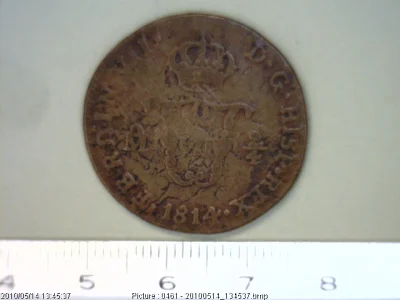
1/4 Real Realista 1814 (Sierra de Pinos): Value & Prices
Prices updated: August 2026
Independence · Sierra de Pinos Mint
Independence · Sierra de Pinos Mint
How much is the coin 1/4 Real Realista 1814 (Sierra de Pinos): Value & Prices worth?
The market value of the coin 1/4 Real Realista 1814 (Sierra de Pinos): Value & Prices is not yet documented with enough data to give a firm range. Weigh and measure your piece, compare it against the specifications, and check the forum for a second opinion.
The real price depends on four factors: the grade of preservation (a circulated piece is worth the low end of the range; an uncirculated one, or one still in its official blister pack, the high end), the finish (satin vs mirror/proof), the rarity within the series based on the mintage, and the metal spot price on the day of the deal when the piece is silver or gold. Check the value-by-grade table above and compare with equivalent pieces before buying or selling.
Where to buy or sell this coin?
Browse the national directory of numismatic shops or the community forum to trade directly with other collectors.
Description
If you inherited or found a small copper coin dated 1814 marked as a Mexican quarter real (1/4 real) from Sierra de Pinos, here is the honest answer: most circulated examples are worth from a few dollars to roughly 25 to 50 USD, and only sharp, high-grade certified pieces reach several hundred dollars. It is a genuine piece of Mexican War of Independence history, but it is not a rare fortune-maker for most people who own one.
What this coin actually is
The 1/4 real realista of 1814 is a low-denomination copper coin struck in Sierra de Pinos, in what is today the state of Zacatecas. "Realista" means royalist, meaning it was issued by authorities loyal to the Spanish crown during the fight for Mexican independence. It is a coin of necessity: when the regular supply of silver was cut off during the war, local mining districts minted small copper coins so everyday trade could keep going.
Core specs to confirm you have the right coin:
- Metal: copper (no silver, no gold, no bullion value)
- Weight: 3.68 grams
- Diameter: 22 mm
- Edge: plain (smooth)
- Catalog reference: Krause KM#A172
- Date: 1814, the only year of issue
If your coin does not match that weight and diameter, you probably have a different piece or a reproduction. Weigh it first.
What it is worth in USD
Because it is copper and circulated heavily during a war economy, most surviving examples show real wear. Value tracks condition almost entirely.
| Condition | What it looks like | Approx. value (USD) |
|---|---|---|
| Heavily worn (Good/VG) | Date barely readable, flat design | 5 to 20 |
| Circulated (Fine/VF) | Legible date, moderate detail | 25 to 75 |
| Sharp (XF/AU) | Strong detail, light wear | 100 to 250 |
| Uncirculated / certified MS | Full crisp relief, slabbed | 300 and up |
The premium is in the detail. Copper war-issue coins that survived with a nitid strike and a clean, readable date are genuinely scarce, which is why the top of the range pulls away sharply. A worn brown lump with a fuzzy date is a common survivor and priced accordingly.
There is no bullion floor here. This is not silver, so melt value is negligible. Everything you get is collector value.
The mintage question (and why nobody has a firm number)
There is no officially documented mintage for this issue. That in itself tells you something: these were emergency local strikes, produced in limited runs by a mining town under wartime pressure, not a controlled national coinage with published figures. Collector forums float estimates, but none are confirmed. Treat any exact "only X ever made" claim you see online as unverified.
What matters more than raw mintage is survivors in high grade, and those are legitimately few for the reasons above.
How to tell if yours is genuine
- Weigh and measure it. It must be very close to 3.68 grams and 22 mm. Off by a lot means fake or a different coin.
- Check the relief. Authentic strikes have depth in the design. Cast fakes look flat, mushy, or have a grainy surface and a seam on the edge.
- Inspect the edge. It should be plain and smooth, not reeded.
- Get it graded for the valuable ones. If yours looks sharp and you think it could be in the higher range, certification by NGC or PCGS is the definitive answer. A certified slab both authenticates and grades the coin, and it materially raises resale value.
Be aware: most "error coins" people spot on these are actually post-mint damage (corrosion pits, strike marks, environmental damage), not real mint errors. Genuine mint errors like off-center strikes or die rotation can add value, but they need to be verified by an expert, not guessed at from a phone photo.
Where to sell it
Since this coin sits in the pesos-to-low-hundreds range for most owners, your selling channel depends on grade:
- A verified numismatic dealer is the safest route. They value the coin on the spot and, for a genuine older piece like this, will pay fairly without the guesswork.
- Collector marketplaces and forums for Mexican coins can get you strong prices between hobbyists. Always post clear photos of the obverse, reverse, and edge, and state the exact weight.
- General auction sites can work but attract the most fakes, so buyers will discount an ungraded coin. If yours is worth over a couple hundred dollars, pay for certification first; the slab pays for itself.
Rule of thumb: if a single coin might clear several hundred dollars, spend the money to have it graded before you sell. It removes every doubt for the buyer.
Where this fits in Mexican numismatics
Royalist coins of necessity from the independence era are a respected corner of the field. Because they were struck locally, in copper, under scarcity, they carry real historical weight even at modest prices. The 1814 Sierra de Pinos quarter real is one of the more accessible ways to own an authentic piece of that period, which is part of its appeal to collectors who cannot chase the six-figure silver rarities.
Got one in the drawer and not sure what grade it is? Post front, back, and edge photos on the Pesoteca forum and let the community weigh in before you sell.
Historical context
During the War of Independence (1810-1821), the disruption of trade and of the silver supply forced numerous mining camps in the center and north of the country to strike their own emergency money. Sierra de Pinos, in present-day Zacatecas, was one of those mining centers that issued low-denomination copper pieces under the royalist administration.
The quarter-real of 1814 belongs to those local issues: copper instead of silver, small values, and simple workmanship, intended to keep the everyday transactions of a mining region isolated by the conflict.
Today these provincial coins are a material testimony of the viceroyalty's war economy in its final years and form part of the collecting of Mexican Independence numismatics.
This piece belongs to the era
Colonial / Virreinato →Explore all the Mexican coins of this era, their historical context and how they connect to the monetary system of the period.
Value range of this piece
Value range without enough data for this piece.
See the full breakdown by grade (VG, F, VF, EF, AU, MS-60, MS-63, MS-65) for the whole series →
Other denominations from 1814
Reales Coloniales (1/2 a 4 reales) · Cobre
Frequently asked questions
How much is an 1814 1/4 Real Realista worth?
It depends almost entirely on condition. Heavily worn copper examples run from a few dollars to about 20 USD, circulated pieces with a legible date sit around 25 to 75 USD, and sharp XF/AU coins reach 100 to 250 USD. Certified uncirculated examples can bring 300 USD or more. For an exact figure, have your specific coin appraised or graded.
Is the 1814 1/4 Real Realista rare?
There is no officially published mintage, since it was an emergency local wartime issue from Sierra de Pinos. Common worn survivors are not rare, but high-grade examples with a crisp strike and clean date are genuinely scarce. Any online claim of an exact rarity number is unverified.
How do I tell if my 1814 quarter real is genuine?
Weigh and measure it first: it should be very close to 3.68 grams and 22 mm with a plain (smooth) edge. Authentic strikes have real depth in the relief, while cast fakes look flat or grainy and may show an edge seam. For any coin you think is valuable, certification by NGC or PCGS confirms authenticity and grade.
Where can I sell an 1814 1/4 Real Realista?
The safest option is a verified numismatic dealer who can value it on the spot, or a serious Mexican-coin collector forum where you can reach hobbyists directly. Photograph the obverse, reverse, and edge and list the exact weight. If yours could clear a couple hundred dollars, get it graded before selling to remove any doubt for buyers.
Conversation
0 comments
Sources
Images for informational and educational purposes, attributed to their original source. Reference values; the real price depends on the grade, the specific variant and demand.
Loading comments…