
En resumen
Mexico made it official: the center of the 10 peso coin switches from nickel silver to nickel-plated steel. Here is what changes, why, and the part no one covers: whether your current coins are worth anything to collectors.
If you have Mexican 10 peso coins and keep hearing that "the coin is changing," here is the straight version, pulled from Mexico's official gazette, the Diario Oficial de la Federación (DOF). The short answer for collectors and inheritors: your current coins keep their full value, most are worth face value, and only a few specific versions carry a premium. We will show you which ones.
The change is official. On January 19, {{AÑO adjust}} the decree reforming the characteristics of the 10 peso coin was published, and a confirming resolution followed. In between, the Bank of Mexico's governing board approved the composition change. This is signed government paper, not a social media rumor.
Before anything else, here is the value picture in plain terms. A worn 10 peso coin from circulation is worth 10 pesos, roughly half a US dollar at recent exchange rates. It will not make you rich, no matter how old it looks. The versions that carry real collector value are the silver-center coins from 1992 to 1995, uncirculated pieces, and mint errors. Everything else is spending money.
What actually changes
Only the metal of the center of the coin changes. It goes from nickel silver (an alloy of copper, nickel and zinc, sometimes called "German silver") to nickel-plated steel.
That is it. Everything else stays identical:
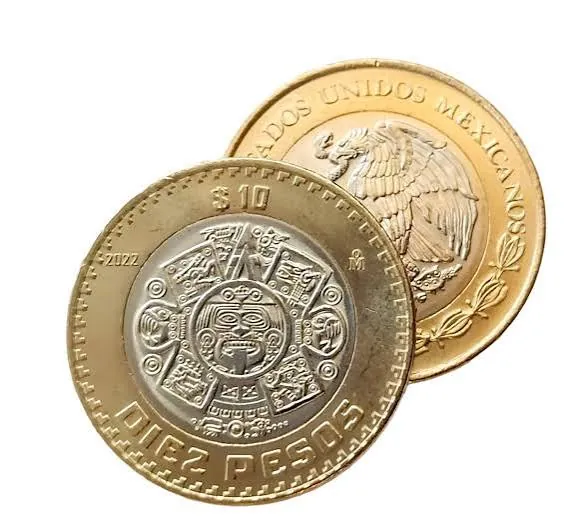
- The design is untouched: the National Coat of Arms on the obverse, the Aztec Sun Stone (Piedra del Sol, Tonatiuh) on the reverse, the "10" denomination, the year, and the "Mo" mint mark of the Casa de Moneda de México.
- The diameter stays at 28.0 mm.
- The face value is the same: ten pesos, legal tender.
- It is still a bimetallic coin, with an outer ring and a center of a different metal.
The January decree is broader than the headlines suggest. It authorizes the center to be sterling silver (.925), nickel silver, or nickel-plated steel, and allows several ring combinations. The later resolution locks in steel as the chosen option. Put a new coin next to an old one and you will not spot the difference by eye. That similarity is exactly what a collector needs to learn to see through.
Why the Bank of Mexico switched the metal
Two reasons, neither mysterious:
- Production cost. Steel is cheaper than nickel silver. When the metal in a coin costs close to or more than its face value, minting it becomes a losing proposition for the issuer. Plated steel lowers the cost per coin without changing what it buys you.
- Anti-counterfeiting. A nickel-plated steel center behaves differently from the old alloy. It is magnetic, which helps vending machines and coin validators separate real coins from fakes.
This is not new in the history of the peso. It is the same kind of decision made when the earliest silver 10 peso coins dropped the precious metal. The central bank adjusts the raw material; the purchasing power of the coin does not move.
When it circulates and what happens to your current coins
Here we stick to what the document says and, just as important, what it does not say.
The new version can be struck starting in the 2026 mint cycle, once the technical adjustments at the mint are done. The official gazette does not set an exact circulation date, so distrust any post that swears a coin "drops on day X." They are making it up.
The key point for anyone holding coins: your current 10 peso coins remain valid. They keep legal tender status and full value until the Bank of Mexico decides to withdraw them, which it has not announced. There is no need to spend or exchange them in a hurry. The nickel silver and steel versions will circulate side by side for years, the same way coins of different years already do.
For collectors: is your old 10 peso worth more?
Straight talk, no smoke. The short version: it depends which 10 peso you have.
A new circulating version does not automatically turn the older coins into treasure. There are hundreds of millions of nickel silver 10 peso coins in circulation. The worn one in your pocket is still worth ten pesos. Anyone who tells you otherwise probably wants to buy it from you cheap.
Here is what is genuinely worth hunting for:
- The N$10 silver coins (1992-1995). When the "Nuevo Peso" launched in 1992, the first 10 peso coins had a sterling silver .925 center. Those carry real value, both for silver content and age. If one turns up, set it aside.
- Uncirculated (UNC) pieces. A nickel silver coin of any year in uncirculated condition, with mint luster and no wear, is worth more than a worn one. Condition drives the premium.
- Errors and varieties. Off-center strikes, rotated dies, double strikes. These are what actually move the collector market.
This change also opens a new angle. The first strikes of the 2026 steel version in uncirculated grade may become collectible as a "transition year." No one serious guarantees prices, but the hobby logic is clear: put aside a couple of UNC examples of the old nickel silver coin and, once it is out, of the new steel one. Assembling the three-composition set (silver, nickel silver, steel) at the same face value is an honest, achievable project.
To compare against reference examples of the current bimetallic version, see the 10 pesos bimetallic 2017 and the 10 pesos bimetallic 2016.
How to tell the compositions apart (magnet, color, weight)
This is the test no news segment gives you, and it is the best part because you can do it at home in seconds.
The magnet test is the fastest and most reliable:
- Nickel-plated steel (new 2026): magnetic. It sticks to a magnet.
- Nickel silver (today's common coin): not magnetic. The magnet slides off.
- Sterling silver .925 (N$10 1992-1995): not magnetic. It does not stick either.
So, in short: if your 10 peso sticks to a magnet, it is one of the new steel coins. If it does not stick, it is nickel silver or silver.
Color and luster. The silver center shows a warmer, more noble white; nickel silver is a cooler, duller silver-gray; nickel-plated steel leans to a brighter, harder metallic white. With practice and good light you can tell them apart, but the magnet is safer.
Weight. Depending on the alloy, these combinations weigh roughly 9.97 to 11.66 grams. A jewelry or precise kitchen scale helps you sort borderline cases, especially the silver ones. It is not foolproof alone, but paired with the magnet it gives you certainty.
The collector's rule of thumb: magnet first, color second, scale last. Those three steps classify any 10 peso that comes your way.
Quick reference table
| Version | Years | Center metal | Magnetic? | Collector value |
|---|---|---|---|---|
| N$10 silver | 1992-1995 | Sterling silver .925 | No | Highest; silver content plus age |
| Nickel silver bimetallic | 1996-present | Copper-nickel-zinc | No | Face value; UNC and errors carry a premium |
| Nickel-plated steel | 2026 onward | Nickel-plated steel | Yes | Face value now; first UNC strikes may become collectible |
Where to buy or sell
If you have a batch of Mexican 10 peso coins and want to know whether any are the silver 1992-1995 issues, run the magnet test first, then check the year. For anything you think is silver, uncirculated, or shows an error, get it looked at before you sell. Deal with established dealers rather than someone offering to "take them off your hands" at the door. Browse our store directory to find reputable sellers and appraisers.
Have a 10 peso coin you cannot classify, or think you found a silver-center 1992? Post a clear photo of both sides in the Pesoteca forum and we will help you identify it and tell you whether it carries a premium.

Loading comments…