
En resumen
Someone told you a 2,000 peso Mexican banknote exists. Half true, half false. Banxico approved the design years ago, featuring Octavio Paz and the Tequila agave landscape, but it has never been printed and does not circulate.
If someone offers you a 2,000 peso Mexican banknote, or you spotted one online and want to know if it is real, here is the direct answer: it does not circulate, and any physical copy you touch is a fake. Banxico, Mexico's central bank, approved the design years ago (front: Octavio Paz and Rosario Castellanos; back: the Tequila agave landscape), but it has never printed a single note. Its collectible value today is zero, because no authentic piece exists.
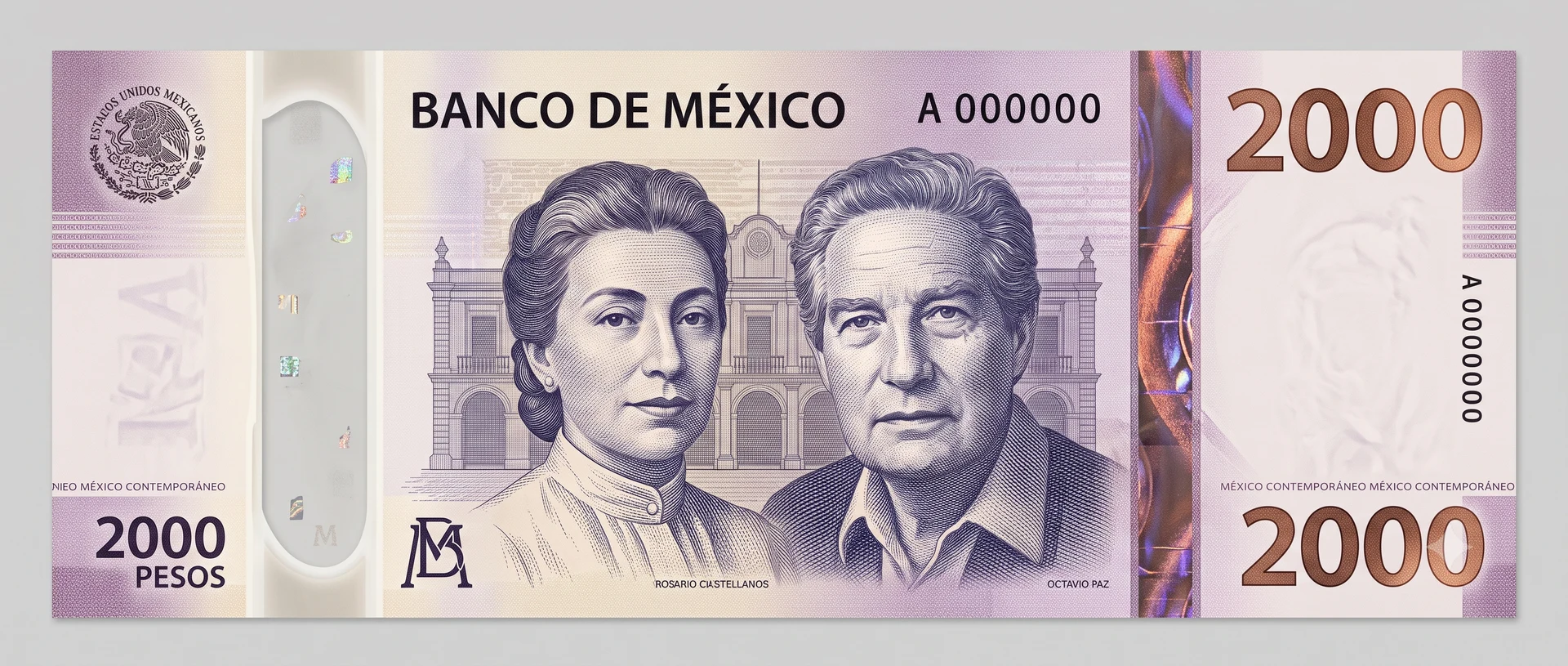
Important note: the image above is an editorial conceptual design created by Pesoteca from the official plan published by Banxico. It is not a real banknote, it is not in circulation, and no physical copy has ever been printed. We use it as a visual reference for the design described in the technical document for the Familia G series.
Is it worth anything? No, and here is why
Old age or high denomination does not make a banknote valuable. Rarity, demand, and authenticity do. The 2,000 peso note fails the most basic test: authenticity. Banxico has not printed one, so nothing on the market can be genuine. What people photograph and share online falls into three categories:
- Images of Banxico's official document (the design plans, legitimate as a document but not banknotes).
- Counterfeits that copy those plans onto ordinary paper. They are usually poor, with wrong colors and dimensions.
- Social media jokes made to confuse or amuse.
If someone tries to sell you one as a collectible, it is a scam. The only thing you can "collect" today related to the 2,000 peso note is the free PDF from Banxico that describes it.
Where NOT to buy it
Do not buy a 2,000 peso Mexican note from anyone, on any platform, at any price. There is no authentic version to buy. Sellers on marketplaces and social media who list "rare 2,000 peso banknotes" are moving counterfeits or novelty prints. If you inherited a box of Mexican currency and found something that looks like this denomination, treat it as fake until a certified expert says otherwise.
The official document almost no one has read
Banxico published a PDF titled "Nueva familia de billetes" (New Banknote Family) when it launched the Familia G series, the current polymer-and-themed-design generation. On page 20, Table 3, sits the full list of planned denominations. At the very bottom is the 2,000 peso note.
| Denomination | Front (figure) | Back (ecosystem/motif) | Status |
|---|---|---|---|
| 20 pesos | (transitioning to coin) | Quetzalcóatl (replaced) | Being phased out |
| 50 pesos | Axolotl | Lakes and rivers | Circulating |
| 100 pesos | Sor Juana Inés de la Cruz | Temperate forests | Circulating |
| 200 pesos | Independence (Hidalgo and Morelos) | Dry forests | Circulating |
| 500 pesos | Benito Juárez | Humid jungles | Circulating |
| 1,000 pesos | The Revolution (Madero, Hermila Galindo, Carmen Serdán) | Calakmul Jaguar | Circulating |
| 2,000 pesos | Octavio Paz and Rosario Castellanos | Agave Landscape (Tequila) | Issued only if deemed necessary |
That last row is why you are here. Banxico left the note fully designed but conditional: it will be issued "if deemed necessary." In central bank language, that means not today, not tomorrow, possibly never.
Why design a note you never plan to print?
Banknote families are designed as complete sets, not piece by piece. When Banxico planned the Familia G series around 2017 and 2018, it covered the full range of possible denominations, including a higher one held in reserve for inflationary emergencies or operational needs. Several countries keep "ceiling" notes prepared but unused. The United States, for example, printed 500, 1,000, 5,000, and 10,000 dollar bills that exist but now trade only among collectors and were long ago pulled from public circulation.
The 2,000 peso note fills that reserve role. If the peso were to depreciate sharply, or if interbank cash operations grew significantly, Banxico would only need to authorize printing. The design is ready, the processes are ready, the inks and polymers are already defined.
What the official plan actually specifies
Banxico's document lays out the following for the 2,000 peso note:
- Conceptual theme: contemporary Mexico
- Front figures: Octavio Paz (Nobel Prize in Literature, 1990) and Rosario Castellanos (poet and essayist from Chiapas)
- Back ecosystem: Mexican dry forests
- Emblematic wildlife: the agave bat and the agave plant
- Landscape: the Agave Landscape and historic industrial facilities of Tequila, a UNESCO World Heritage Site since 2006
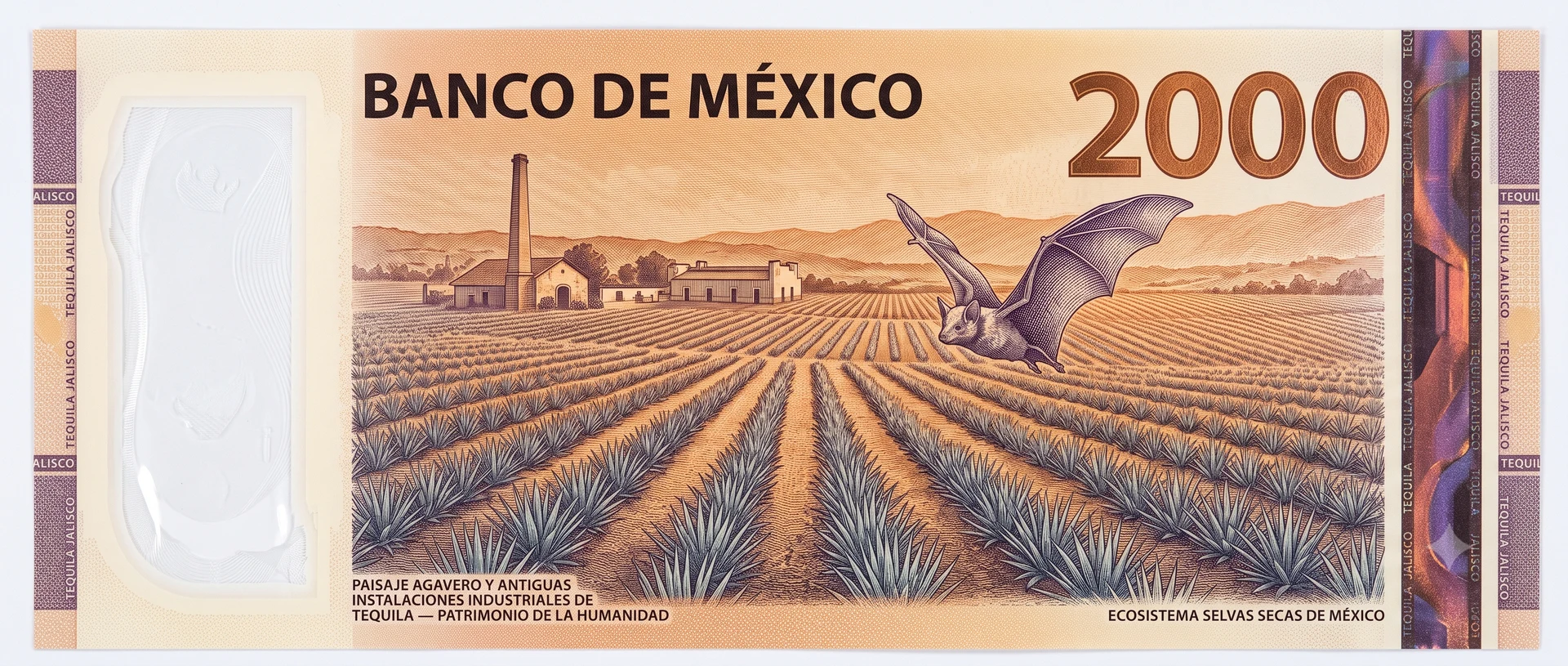
Conceptual back of the ghost note: the Tequila Agave Landscape (UNESCO World Heritage since 2006) with the agave bat (Leptonycteris) and fields of blue agave. Editorial rendering based on the official Banxico plan, not a circulating note.
It is a note with a strong cultural narrative: a Nobel laureate and a celebrated poet, the agave that produces tequila, and a landscape recognized worldwide. It was designed to be the symbolic ceiling of the Familia G series.
What circulates and what stays asleep
The distinction matters:
- Alive: the 50, 100, 200, 500, and 1,000 peso Familia G notes circulate today.
- Being retired: the 20 peso note. Banxico announced its withdrawal, replaced by the circulating 20 peso coin with the Kukulcán motif.
- Asleep: the 2,000 peso note, designed but conditional.
This is the first time in Banxico's recent history that a design has been published with such an explicit condition attached. That is what makes it worth understanding.
How to know if Banxico ever issues it
If Banxico decides to print the note, it would announce it through three channels:
- An official statement on its website.
- A decree published in the Diario Oficial de la Federación (DOF), Mexico's official gazette, with exact specifications and a circulation date.
- Coverage in financial media (El Financiero, Reforma, Expansión) shortly after.
Until you see all three together, what you are hearing is a rumor or a setup for a scam. As of 2026, none of that has happened, and no issue date has been announced. If it changes, we update this page.
If you inherited a box of Mexican currency
Plenty of readers land here because they found a stash of Mexican banknotes and are trying to sort the real from the fake. General rule: circulating Familia G notes (50 through 1,000) are worth their face value unless a specific piece has a printing error or a rare serial number. A 2,000 peso note is never worth anything, because it is never genuine. Before paying anyone for a supposedly rare Mexican note, have it checked by a certified numismatic appraiser.
Have you been offered one?
Have you seen this note in circulation or had someone try to sell it to you? Share your story in the Pesoteca forum so others do not fall for it. If you have a photo of what you saw, post it, and we can quickly tell whether it is an official plan, a counterfeit, or a joke.
If you just want the reference sheet with the official specs (figures, back design, family, and status), we keep it separate: the 2,000 peso Familia G ghost note fact sheet.
Loading comments…