
Mexico 10 Pesos Banknote (1969): Value & Prices
Familia A · algodón
Period: México Contemporáneo
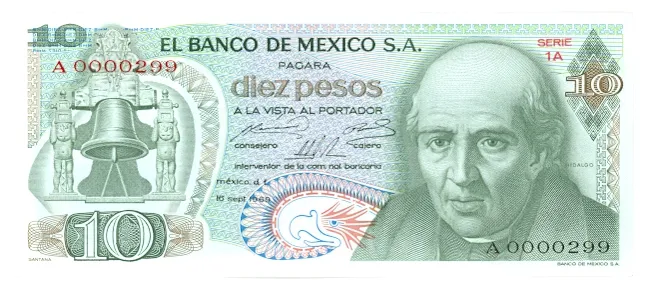
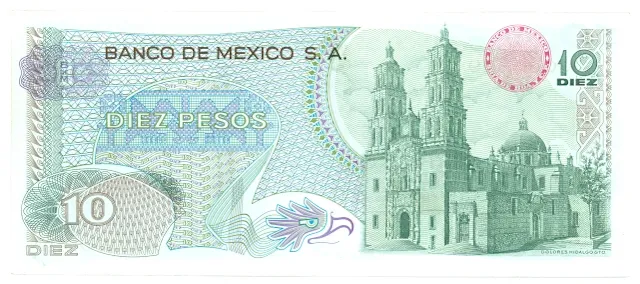
Design
Banxico
Obverse
Miguel Hidalgo
Portrait of Miguel Hidalgo and the Dolores bell
Reverse
The cathedral of Morelia
About this banknote
Most 1969 Mexican 10 peso notes are worth a few dollars, not a fortune. The green Hidalgo note from the Banco de México "Series A" family was printed in huge numbers, so a used example trades for roughly 2 to 5 US dollars among collectors. The pieces that command real money are the exceptions: crisp uncirculated notes, low or radar serial numbers, and genuine printing errors.
If you inherited a stack of these or found one in a drawer, this page tells you what yours is likely worth in 2026, what makes some copies special, and how to check it is genuine before you buy or sell.
What this note is
The green 10 peso note features Miguel Hidalgo y Costilla, the priest who launched Mexico's War of Independence in 1810 (Mexicans call him the Father of the Nation). Beside him is the bell of Dolores, which he rang to call the people to arms on the morning of September 16, 1810.
The back shows the Cathedral of Morelia in the state of Michoacán, built in the region's characteristic pink stone. Hidalgo studied and later served as rector in that city, so the front and back tell one connected story.
Key identifying data:
- Issuer: Banco de México
- Denomination: 10 pesos
- Family / series: Series A (the letter appears in the serial number prefix)
- Dominant color: green
- Front: Miguel Hidalgo and the Dolores bell
- Back: Cathedral of Morelia
The 10 peso denomination in this design was printed across many dates and signature combinations through the 1960s and 1970s. The 1969 date is one of the more common ones.
How much is it worth in 2026
This note is fully demonetized. It no longer has any face value, so everything it is worth is collector value. Condition drives the price more than the date does.
| Condition | Description | Typical value (USD) |
|---|---|---|
| Circulated (worn) | Folds, soft corners, some soiling | 2 to 5 |
| Extra fine | Light handling, still bright | 6 to 12 |
| Uncirculated (crisp) | No folds, sharp corners, no stains | 15 to 40 |
| Low serial / radar / error | Special serials or genuine misprints | 50 to several hundred |
Those figures are collector-to-collector ranges for common dates. Prices online are often inflated: most Series A notes are plentiful, and a single worn 10 peso note is not a rare object. Do not expect hundreds of dollars for an average example, no matter what a marketplace listing claims.
The premium copies are the ones that stand out for a reason:
- Uncirculated grade. A note with no folds, full corners, and original crispness is worth several times a used one. Third-party grading (PMG in the US) can add confidence and value on the best examples.
- Special serial numbers. A low serial (like 0000123), a radar / palindrome serial (reads the same forwards and backwards, such as 1234321), or a solid serial (all the same digit) attracts collectors who specialize in "fancy" serials.
- Printing errors. Miscuts, ink smears, misaligned printing, and folded-through-print errors turn a common note into a scarce one worth several times face.
The ones people think are worth a fortune but aren't
Age alone does not make a Mexican banknote valuable. A 1969 date sounds old, but millions of these were printed and plenty survive. A worn note with folds and rounded corners is a common note in below-average condition, and it is worth a few dollars regardless of how old it looks.
Normal wear is not an error. Fading, tears, and handling damage lower the value; they do not create a rarity. Only genuine factory errors count as errors.
How to tell if yours is genuine
Reproductions and reprints of old Mexican notes do circulate. Check these points against official Banco de México images:
- Watermark. Hold the note to the light and look for a watermark image. Reproductions usually have flat, smooth paper with no watermark.
- Paper feel. Genuine notes are printed on cotton-based paper with a distinct texture. Copies often feel slick or thin.
- Ink and color depth. Original intaglio printing has slight relief you can feel; reprints tend to have flat, uniform color.
- Signatures and design. Compare the signature combination and fine engraving lines with reference images. Copies often show blurred lines and wrong fonts.
When in doubt, post clear photos of both sides in the Pesoteca forum and the community will help you confirm it.
Where to sell it
To sell the 1969 10 peso note safely, use a route where the buyer knows the market:
- A verified numismatic shop from the Pesoteca directory, which can appraise it on the spot.
- The Pesoteca buy-and-sell forum, where you deal directly with collectors.
Photograph both faces in good light and check whether the serial is low, a radar, or shows any error, since those raise the price. Do not dump it on a general marketplace to the first bidder before you know what you have.
If you want context on what makes Mexican paper money desirable, read about the most counterfeited Mexican banknotes.
Got one with an unusual serial or a possible error? Post it in the forum and let the community weigh in on what it is worth.
Historical context
The 10 pesos of 1969 honors Miguel Hidalgo y Costilla, the priest of Dolores considered the Father of the Nation. In the early hours of September 16, 1810, he issued the call to arms that began the War of Independence; that is why the note accompanies his portrait with the Bell of Dolores, the same one he rang and which is kept today in the National Palace.
The reverse shows the Cathedral of Morelia, the monumental Baroque seat of the former Valladolid, birthplace of Hidalgo. It is a linked tribute: the hero and the Michoacán land that shaped him.
The piece belongs to Family A of the Banco de México, that of the "old pesos" prior to the 1993 reform. In 1969 a ten-peso note represented a considerable real value for the average pocket, far removed from the high-denomination paper that the inflation of the 1980s would eventually impose.
Frequently asked questions
How much is the 1969 Mexican 10 peso note worth?
It no longer has face value since it is demonetized, so it is worth only collector value. A worn example trades for about 2 to 5 US dollars, an uncirculated one for roughly 15 to 40 dollars, and copies with low or radar serial numbers or genuine printing errors can reach 50 dollars to several hundred.
Is the 1969 10 peso banknote rare?
No. The green Hidalgo note from the Banco de México Series A family was printed in large quantities and many survive, so it is common. What is scarce is a note in uncirculated condition, one with a special serial number (low, radar, or solid), or one with a real factory printing error.
Where can I sell my 1969 Mexican 10 peso note?
The safest options are a verified numismatic shop from the [Pesoteca directory](/tiendas), which can appraise it in person, or the [Pesoteca buy-and-sell forum](/foro/compra-venta) among collectors. Photograph both sides in good light and check for a low or radar serial or any error before selling, since those raise the value.
How do I tell if the 1969 10 peso note is genuine?
Check the watermark by holding it to the light, feel the cotton-based paper texture, and look for slight raised relief from the original intaglio printing. Compare the signatures and fine engraving with official Banco de México images. Reproductions usually have smooth, flat paper and blurred, flat-colored printing. If unsure, post photos in the [Pesoteca forum](/foro).
Familia A
This banknote belongs to the BIL-A family within the Sistema PSM . Explore all the banknotes that share origin, era and design with this piece.
Ver todos los billetes de la familia A →