
Mexico 100 Pesos, 1974 (Miguel Hidalgo): Value & Rarity
Familia A · algodón
Period: México Contemporáneo
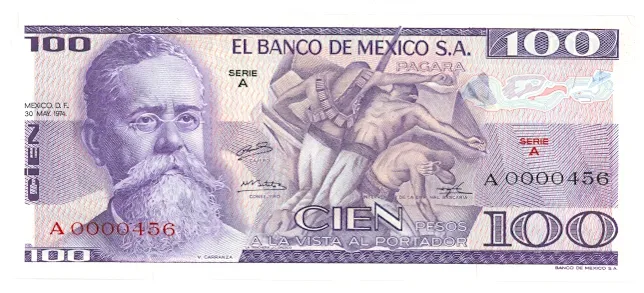
Design
Banxico
Obverse
Miguel Hidalgo
Portrait of Miguel Hidalgo y Costilla
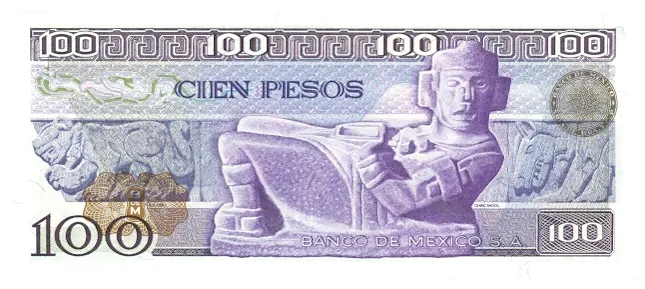
Reverse
The National Coat of Arms
About this banknote
Most 1974 Mexican 100 pesos notes are worth a few dollars to collectors, not a fortune. Banco de México printed this Miguel Hidalgo note in huge quantities, so common examples trade for little. The value jumps only for uncirculated notes, low or radar (palindrome) serial numbers, and genuine printing errors.
If you inherited a stack of old Mexican paper money, this is one of the notes you will see most often. Here is what it actually is, what drives the price, and how to sell it without getting shortchanged.
What this note is
The 100 pesos note issued in 1974 belongs to Banco de México's Family A, the first modern family of Mexican banknotes. The front (obverse) shows Miguel Hidalgo y Costilla, the priest who launched Mexico's War of Independence in 1810. The back (reverse) carries the Escudo Nacional, the national coat of arms with the eagle and serpent.
The note is denominated 100 pesos in old currency (before the 1993 revaluation that cut three zeros off the peso). It has long been out of circulation, so it holds no face value you can spend. What it holds now is collector value.
How much it's worth in 2026
Be realistic. This was a common circulating note, and millions survive. Condition and serial number decide almost everything.
- Well-circulated (folds, stains, soft corners): roughly 1 to 4 USD. Filler grade.
- Crisp uncirculated (no folds, sharp corners, no handling): typically 8 to 25 USD depending on eye appeal.
- Low serial number, radar/palindrome serial, or first-series prefix: a premium on top of the above, sometimes several times the base price.
- Genuine printing error (misalignment, ink smear, mismatched or shifted serials): these turn a common note into a scarce one and can bring several times face-grade value, judged case by case.
Ignore the inflated numbers you see on some listing sites. Family A 100 pesos notes are common. Unless yours has a specific feature that makes it scarce, it sits in the low range above. There is no realistic scenario where an ordinary circulated example is worth hundreds of dollars.
Quick reference
| Detail | Value |
|---|---|
| Country | Mexico (Banco de México) |
| Denomination | 100 pesos (old currency) |
| Issue year | 1974 |
| Family / series | Family A |
| Obverse | Miguel Hidalgo y Costilla |
| Reverse | Escudo Nacional (national coat of arms) |
| Typical circulated value | 1 to 4 USD |
| Typical uncirculated value | 8 to 25 USD |
| Premium features | Low/radar serial, first series, printing errors |
What makes one worth more
Check three things on your note:
- Condition. Hold it flat under light. No folds, no soft or rounded corners, no stains, and paper that still has body and snap. That is uncirculated, and it is where the money is.
- Serial number. Low numbers (think many leading zeros), radar serials that read the same forwards and backwards, and early series prefixes all draw collectors.
- Printing errors. Genuine factory errors like shifted cuts, ink runs, or misprinted serials are scarce and command a premium. Normal wear and post-issue damage are not errors and add nothing.
The myths to ignore
Old does not mean valuable. A 1974 note feels old to a US reader, but in world paper money terms it is recent and abundant. "Discontinued" also does not mean rare, since Banco de México printed enormous quantities. If a seller tells you a plain circulated 100 pesos Hidalgo is worth a large sum, they are quoting a fantasy price.
How to tell if it's genuine
Compare your note against official Banco de México imagery for Family A. Genuine notes show a watermark visible when held to light, a security thread, subtle relief you can feel where the intaglio ink sits, and crisp fine-line printing. Reproductions and photocopies give themselves away with smooth flat paper, dull solid colors, and no relief. If you are unsure, post clear photos of both sides in the Pesoteca forum and the community will weigh in.
Where to sell it
World paper money (notaphily) is an active English-language market, so you have options. For a fast in-person appraisal, use a verified dealer from the Pesoteca shop directory. To sell peer to peer among collectors, the Pesoteca buy/sell forum is the safer route. Photograph both faces in good light, note the serial number, and flag any low/radar serial or possible error before you set a price. Avoid dumping it to the first buyer on social media.
For context on which Mexican notes get faked most, read the most counterfeited banknotes in Mexico.
Got one with an unusual serial or in sealed packaging? Post it in the forum and let the community help you value it.
Historical context
The 1974 100-peso note once again repeats Miguel Hidalgo y Costilla, the priest of Dolores and Father of the Nation, whose cry of 1810 opened the struggle for Independence. That his effigy was kept issue after issue on the hundred-peso denomination speaks of a well-established visual identity in family A.
The reverse preserves the National Coat of Arms, the eagle devouring the serpent on the nopal, an emblem that points to the founding myth of Tenochtitlan and to the sovereignty of the Mexican state.
Struck among the "old pesos," this note circulated nearly two decades before the 1993 reform. In the mid-1970s the 100-peso note was still a denomination of real value; the inflationary spiral that would lead to printing notes of twenty thousand, fifty thousand, and one hundred thousand pesos had not yet begun.
Frequently asked questions
How much is the 1974 Mexican 100 pesos note worth?
A well-circulated example is worth roughly 1 to 4 USD as a collectible. A crisp uncirculated note usually brings 8 to 25 USD. Notes with low or radar serial numbers, first-series prefixes, or genuine printing errors can sell for several times more. Condition and serial drive the price.
Is the 1974 100 pesos Hidalgo note rare?
No. Banco de México printed the Family A 100 pesos in large quantities and millions survive, so common examples are inexpensive. Rarity only comes from a specific feature: an uncirculated grade, a low or radar serial number, or a genuine factory printing error.
Where can I sell my 1974 Mexican 100 pesos note?
Use a verified dealer from the Pesoteca shop directory for an on-the-spot appraisal, or the Pesoteca buy/sell forum to reach collectors directly. Photograph both sides in good light and note the serial number and any error before setting a price. Don't sell to the first social-media buyer.
How do I know if my 1974 100 pesos note is genuine?
Check for a watermark visible against light, a security thread, and raised intaglio ink you can feel with your fingertip. Compare the design, paper, and signatures against official Banco de México images. Reproductions have smooth flat paper and dull solid colors. When in doubt, ask in the Pesoteca forum.
Familia A
This banknote belongs to the BIL-A family within the Sistema PSM . Explore all the banknotes that share origin, era and design with this piece.
Ver todos los billetes de la familia A →