
Mexico 1,000 Pesos Banknote (1977): Value & Guide
Familia A · algodón
Period: México Contemporáneo
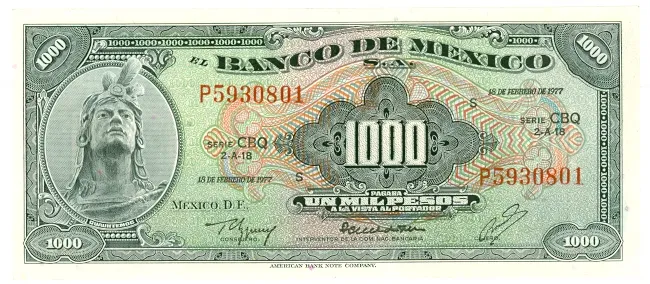
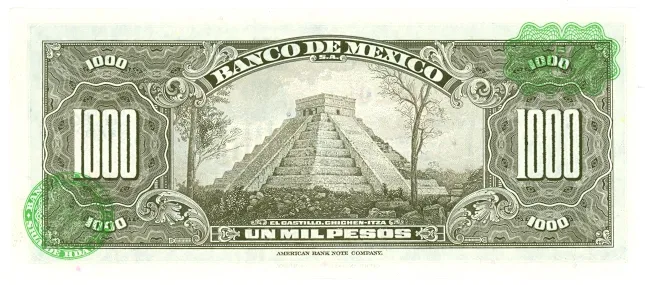
Design
Banxico
Obverse
Cuauhtémoc
Bust of Cuauhtémoc, the last Mexica tlatoani
Reverse
The El Castillo pyramid at Chichén Itzá
About this banknote
Most 1977 Mexican 1,000 pesos notes are worth a few dollars, not a fortune. They are no longer legal tender, so the value is collector value, not face value, and the vast majority are common. A small number, uncirculated examples, low or radar serial numbers, and genuine printing errors, sell for meaningfully more. Here is what actually drives the price and how to check yours.
This is the Cuauhtémoc note from the Banco de México "Familia A" (Family A) series, the country's first modern banknote family after the currency reforms of the 1970s. The Spanish word familia refers to a design family or series, the way collectors group notes that share artwork and format. If you inherited a box of old Mexican paper money, this large brown note is one of the more common pieces you will find.
What it looks like
The front (obverse) shows Cuauhtémoc, the last Aztec (Mexica) ruler, or tlatoani, who defended Tenochtitlan against the Spanish siege until the city fell in 1521. His profile bust in a feathered headdress anchors the design.
The back (reverse) shows El Castillo at Chichén Itzá, the famous Maya step pyramid in Yucatán where, at each equinox, the shadow of a serpent appears to descend the staircase. The all pre-Hispanic theme makes it one of the more attractive notes in Family A.
What it's worth in 2026
Because this note is demonetized (no longer spendable in Mexico), it has no face value to a US collector. What you have is a collectible, and condition is the single biggest factor.
- Circulated, with folds and wear: typically a few US dollars. These are common, and no amount of age changes that.
- Uncirculated (crisp, no folds, no stains, sharp corners): several times more than a worn example, though still a modest figure for standard varieties.
- Low serial numbers, radar/palindrome serials, or early series: a premium on top of the condition value.
- Genuine printing errors: the real money, and still usually tens of dollars rather than hundreds unless the error is dramatic.
Be skeptical of the inflated asking prices you see on the open web. Most Family A notes are common, and a common note is worth what a collector will actually pay, not what an optimistic seller lists it for.
| Note | Series | Condition | Realistic collector value (USD) |
|---|---|---|---|
| 1,000 pesos Cuauhtémoc | Family A | Circulated (folds/wear) | A few dollars |
| 1,000 pesos Cuauhtémoc | Family A | Uncirculated (crisp) | Low tens of dollars |
| 1,000 pesos Cuauhtémoc | Family A | UNC + low/radar serial or error | Higher, case by case |
The ones people think are worth a fortune (and aren't)
Age alone does not make a banknote valuable. A worn 1977 note that passed through thousands of hands is common, no matter how old it looks. The pieces that break out of the few-dollars range are the ones with a specific reason: uncirculated preservation, a special serial number, or a real factory error. Everyday wear and tear is not an error, and it lowers value rather than raising it.
How to check what yours is worth
Check three things:
- Condition. Hold it flat. No folds, no soft corners, no stains, and the paper still crisp means uncirculated, which is where the premium lives.
- Serial number. A low number (early in the print run) or a radar/palindrome number (reads the same forwards and backwards) is what collectors chase.
- Errors. Misaligned cuts, ink smears, factory folds, or repeated/off-center serials turn a common note into a genuine rarity.
To confirm your note is authentic, compare it against official Banco de México imagery. Look at the watermark held to the light, the security thread, the paper texture, and the signatures. Reproductions and reprints usually give themselves away with smooth, flat paper and dull, flat colors. If you are unsure, post clear photos of both sides in the Pesoteca forum and the community will weigh in.
Where to sell it
The safest routes are a verified numismatic dealer from the Pesoteca shop directory, who can appraise it on the spot, or the Pesoteca buy and sell forum where you deal directly with collectors. Photograph both faces in good light, note the serial number, and flag any low/radar serial or error before you agree a price. Do not dump it to the first bidder on a general marketplace.
For context on what circulates in the counterfeit market, see our data-backed piece on the most counterfeited banknotes in Mexico.
Got one with an unusual serial number or still in a bank wrapper? Post it in the forum and let the community take a look before you sell.
Historical context
The 1977 1,000-peso note features Cuauhtémoc, the last Mexica tlatoani, who defended Tenochtitlan during the Spanish siege of 1521 and resisted with dignity the torture that followed the city's fall. In national iconography his figure embodies Indigenous resistance in the face of the Conquest.
The reverse shows the pyramid of El Castillo at Chichén Itzá, the great temple of Kukulcán on the Yucatán peninsula, one of the crowning works of Maya architecture and today a World Heritage Site.
The piece belongs to family A of the "old pesos." That a thousand-peso note was already being issued in 1977 foreshadows the peso's erosion: by the late 1970s the country was carrying heavy debts, and the inflation of the following decade would end up imposing even larger denominations, up to one hundred thousand pesos, before the 1993 reform.
Frequently asked questions
How much is the 1977 Mexican 1,000 pesos banknote worth?
It is demonetized, so it has collector value only, not face value. A worn, circulated note is worth a few US dollars because most are common. An uncirculated example, or one with a low or radar serial number or a genuine printing error, can sell for several times more. Condition and rarity decide the price.
Is the 1977 1,000 pesos Cuauhtemoc note rare?
As a standard circulated note, no. It belongs to the Banco de México Family A series and was produced in large numbers, so most examples are common. What is scarce is a crisp uncirculated note, an early or radar serial number, or a real factory error. Any of those makes it worth more to collectors.
Where can I sell my 1977 Mexican 1,000 pesos banknote?
The safest options are a verified dealer from the Pesoteca shop directory, who can value it in person, or the Pesoteca buy and sell forum, where you deal directly with collectors. Photograph both sides in good light and check for a low or radar serial number or printing error before agreeing a price.
How can I tell if my 1,000 pesos Cuauhtemoc note is genuine?
Check the security features against official Banco de México images: the watermark held to the light, the security thread, the paper texture, and the signatures. Reproductions usually have smooth, flat paper and dull, flat colors. If in doubt, post clear photos of both sides in the Pesoteca forum for a second opinion.
Características Banxico
2-A-18
Familia A
This banknote belongs to the BIL-A family within the Sistema PSM . Explore all the banknotes that share origin, era and design with this piece.
Ver todos los billetes de la familia A →