
10,000 Pesos Banknote (1978, Matías Romero)
Familia A · algodón
Period: México Contemporáneo
Design
Banxico
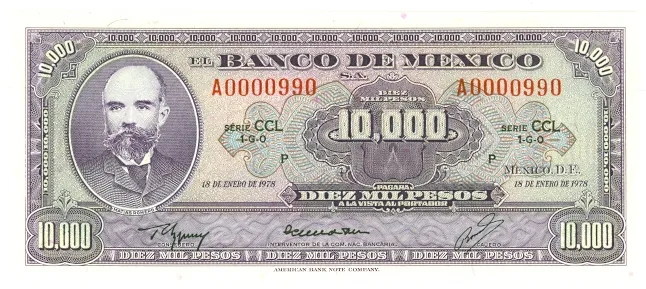
Obverse
Matías Romero
Portrait of Matías Romero
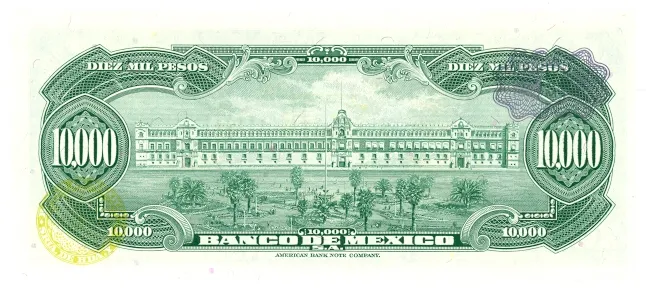
Reverse
The National Palace
About this banknote
Most 1978 Mexican 10,000 pesos notes are worth only a few dollars in circulated condition. The value comes from grade, not age. A crisp uncirculated example, a low or radar serial number, or a genuine printing error is what turns this common note into something collectors will pay real money for.
This is a Banco de México note from the Family A (Familia A) series, the peso family in use before Mexico dropped three zeros from its currency in 1993. "Family" here is just the design generation the note belongs to, marked by a letter. The 10,000 pesos was a high denomination for its time, and it no longer circulates, so any value today is collector value.
What it is
The front (anverso) shows Matías Romero, the Oaxaca-born diplomat and politician who shaped Mexico's relations with the United States during the Reforma period and under President Benito Juárez. He served several times as Secretary of the Treasury (Hacienda).
The back (reverso) shows the Palacio Nacional on the Zócalo, the main square of Mexico City, seat of the executive branch.
How much is it worth in 2026
The note is demonetized, so there is no face value to redeem. Everything rides on condition and any special feature.
- Circulated (folds, soft corners, handling): a few US dollars. These are common. Do not expect a windfall from a worn note just because it says 10,000.
- Uncirculated (crisp, no folds, sharp corners, no stains): several times more than a circulated example, typically in the low tens of dollars depending on the buyer and the grade.
- Low serial numbers, radar/palindrome serials (a number that reads the same both ways), or early series: these carry a premium with collectors and can push the price well above a standard note.
- Genuine printing errors: the real money is here. Misaligned cuts, ink smears, factory folds, duplicated or badly off-center serials can make a common note worth many times its normal price.
Ignore the inflated listings you see online. Most Family A notes are common and sell for a modest sum. The exceptions are the scarce variants above, and they are the exception, not the rule.
| Feature | Typical value range (USD) |
|---|---|
| Circulated, no special features | A few dollars |
| Uncirculated, standard serial | Low tens of dollars |
| Low serial / radar serial | Higher premium, varies by buyer |
| Genuine printing error | Several times a standard note |
Ranges are given honestly because world paper money prices swing with grade, buyer and demand. A certified grade from a paper-money grader tightens the number a lot.
The myth to drop
An old high-denomination note is not automatically a jackpot. Age alone does not create value in notaphily (the collecting of paper money). Scarcity, condition and demand do. A 1978 note that spent years in a wallet is worth what any common circulated note is worth: not much. What you want to find is a note that never circulated, or one with a serial or error that makes it stand out.
How to check what yours is worth
- Grade it honestly. Hold it flat. Any fold, crease, pinhole or stain drops it out of the uncirculated bracket. Sharp corners and a crisp feel matter.
- Read the serial number. A low number, a repeated pattern, or a palindrome (radar) serial is worth flagging.
- Look for real errors. Misaligned printing, cutting errors, duplicated serials and factory folds are collectible. Normal wear and use damage are not errors.
- Confirm it is genuine. Check the watermark against the light, the security thread, the paper texture and the signatures against official Banco de México references. Reproductions tend to have smooth paper and flat, lifeless colors. When in doubt, post clear photos of both sides in the Pesoteca forum.
For context on what fakes look like, see our data-backed piece on Mexico's most counterfeited banknotes.
Where to sell it
Photograph both sides in good, even light before you talk to anyone. To sell safely, use a verified numismatic shop from the Pesoteca directory, which can appraise it on the spot, or the Pesoteca buy-and-sell forum where collectors trade directly. Note any low serial, radar serial or error, since those raise the price. Avoid dumping it to the first buyer on social media.
Have a 10,000 pesos note with an odd serial or still in its original wrap? Post it in the forum and let the community weigh in on what it is really worth.
Historical context
The 10,000 pesos of 1978 is one of the most memorable notes of Family A, in part because of its unusual figure: Matías Romero, a nineteenth-century diplomat and politician from Oaxaca, a trusted man of Benito Juárez and Minister of Finance on several occasions. He was key to Mexico's relations with the United States during the Reform and the Restored Republic; his appearance on the currency, instead of the usual heroes like Hidalgo or Morelos, makes it singular.
The reverse shows the National Palace, seat of executive power in the Plaza de la Constitución, portrayed with the appearance it had in the early twentieth century.
The piece belongs to the "old pesos." A ten-thousand-peso note in 1978 anticipated the inflationary escalation: high for its denomination and little within reach of the common purse, it would later become one of the most sought-after pieces by collectors of Family A, prior to the 1993 reform.
Frequently asked questions
How much is the 1978 Mexican 10,000 pesos note worth?
In circulated condition, a few US dollars. It is a demonetized Family A note with no redeemable face value. An uncirculated example runs into the low tens of dollars, and a low or radar serial number, or a genuine printing error, can push it several times higher. Condition and scarcity drive the price, not age.
Is the 1978 10,000 pesos note rare?
Standard notes are common and sell for a modest amount. Rarity comes from specific features: an uncirculated grade, an early series, a low or palindrome (radar) serial number, or a genuine factory error. Any one of those makes collectors compete for it. A worn, ordinary note is not rare regardless of its high denomination.
Where can I sell my 1978 10,000 pesos banknote?
The safest options are a verified shop from the Pesoteca directory at /tiendas, which appraises it in person, or the Pesoteca buy-and-sell forum at /foro/compra-venta among collectors. Photograph both sides in good light and note any low serial, radar serial or error, since those raise the value. Avoid selling to the first bidder on social media.
How can I tell if my 10,000 pesos note is genuine?
Check the security features: the watermark against the light, the security thread, the paper texture and the signatures, all compared to official Banco de México images. Reproductions usually have smooth paper and flat colors. If you are unsure, post clear photos of the front and back in the Pesoteca forum at /foro for a second opinion.
Características Banxico
1-G-O
Familia A
This banknote belongs to the BIL-A family within the Sistema PSM . Explore all the banknotes that share origin, era and design with this piece.
Ver todos los billetes de la familia A →