
Mexico 100,000 Pesos Banknote (1988): Value & Prices
Familia A · algodón
Period: México Contemporáneo
Design
Banxico
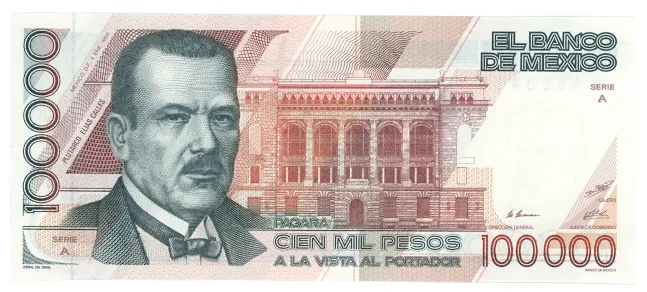
Obverse
Plutarco Elías Calles
Portrait of Plutarco Elías Calles and a building
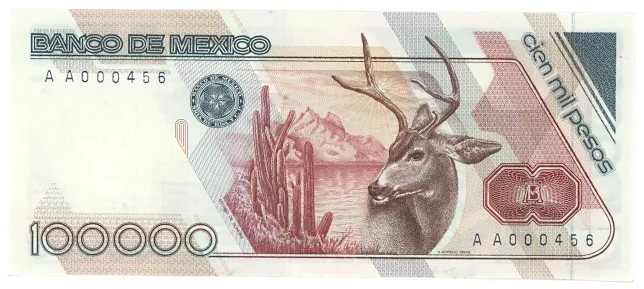
Reverse
A mule deer in a desert landscape of Baja California
About this banknote
Most 1988 Mexico 100,000 pesos banknotes are worth a few dollars in circulated condition, not a fortune. But an uncirculated note, a low or radar serial number, or a genuine printing error can sell for several times that. Here is what actually drives the price and how to check yours.
This was the highest denomination that ever entered circulation in Mexico, printed during the runaway inflation of the late 1980s. It belongs to what Banco de México calls Series A (the "A family"), the pre-1993 peso notes. In 1993 Mexico dropped three zeros from its currency, so this 100,000 pesos note became worth 100 "new pesos" overnight. It is no longer legal tender, which means its value today is purely collector value, not face value.
What it looks like
The front (anverso) shows Plutarco Elías Calles, president of Mexico from 1924 to 1928 and founder of the party that later became the PRI. The back (reverso) features a mule deer (venado bura) in the desert landscape of Baja California, one of the few nature scenes in the entire A family, which makes it a favorite among theme collectors.
What it's worth in 2026
Because the note is demonetized, forget face value. What collectors pay depends on three things: condition, serial number, and errors.
- Condition (grade). A circulated note with folds, soft corners, or stains is common and trades for a modest sum. An uncirculated (UNC) example, crisp, no folds, sharp corners, full original color, commands a real premium. This is the single biggest price driver.
- Serial number. Low serials (early production), radar/palindrome serials (reads the same forwards and backwards, like 1234321), and first-series prefixes attract bidding wars among specialists.
- Printing errors. Genuine factory errors (misaligned cuts, ink smears, foldovers, duplicated or off-center serials) turn a common note into a rarity worth several times the norm.
Be skeptical of the inflated listings you see online. Most Series A notes are common. A typical circulated 100,000 pesos note is worth roughly a handful of US dollars, while a clean uncirculated example or a note with a special serial can reach the low tens of dollars or more. Certified error notes and top-grade rarities go higher.
| Note | Series | Approx. value (USD) | What drives it |
|---|---|---|---|
| 100,000 pesos, circulated | A | a few dollars | worn, folded, common |
| 100,000 pesos, uncirculated (UNC) | A | low tens of dollars | crisp, sharp corners |
| Low serial / radar serial | A | multiples of common | serial appeal |
| Genuine printing error | A | several times face norm | true rarity |
These are guide ranges for the US and international paper-money market; a professional grade and the specific serial will move the number.
How to tell if yours is genuine
Compare your note against official Banco de México images before you pay or sell. On a real Series A note, check the watermark (hold it to the light), the security thread, the crispness of the printed detail, and the feel of the paper. Reproductions and reprints usually give themselves away with smooth, flat paper and dull, flat colors, and they lack the fine intaglio texture. If the deer, the portrait, or the signatures look soft compared to reference photos, treat it with caution. When in doubt, post clear photos of both sides on the Pesoteca forum and let the community weigh in.
How to check what yours is worth
- Photograph both sides in good, even light, front and back, and capture the serial number clearly.
- Grade honestly. Any fold, even a light one, drops it out of uncirculated. Look for stains, pinholes, and corner wear.
- Read the serial. Note anything low, repeating, or palindromic.
- Look for real errors, not everyday wear. Normal handling damage is not a factory error.
For context on what to watch out for, see our guide to the most counterfeited banknotes in Mexico.
Where to sell it
The safest route is a verified dealer from the Pesoteca shop directory, who can appraise it on the spot, or the Pesoteca buy-and-sell forum, where collectors trade directly. Show clear photos of both sides and flag any low or radar serial or error, since those raise the price. Avoid dumping it to the first buyer on social media.
Got a 100,000 pesos note with an unusual serial or something that looks like a printing error? Post it on the Pesoteca forum and let the community help you spot whether you're holding a common note or a genuine rarity.
Historical context
The 1988 100,000-peso note is the highest denomination of family A and the most eloquent portrait of the Mexican inflationary crisis. It honors Plutarco Elías Calles, a Sonoran revolutionary general, president from 1924 to 1928, and founder in 1929 of the National Revolutionary Party, the seed of the political system that would dominate Mexico for decades; he is known as the Supreme Chief of the Revolution.
The reverse shows a mule deer in a desert landscape of Baja California, a turn toward the fauna and territory of northwestern Mexico.
That a one-hundred-thousand-peso note existed in 1988 sums up the scale of the problem: the decade's inflation had swollen prices to such a degree that colossal denominations were needed for everyday transactions. It was precisely this situation that led to the monetary reform of January 1993, when each new peso came to be worth one thousand of these "old pesos."
Frequently asked questions
How much is a 1988 Mexico 100,000 pesos banknote worth?
Because it was demonetized in 1993, it has no face value today, only collector value. A circulated note is worth a few US dollars. An uncirculated example, a low or radar serial number, or a genuine printing error can sell for several times that. Condition and rarity decide the price.
Is the 100,000 pesos note rare?
As a type, no. Most Series A notes are common and easy to find. What makes a specific example scarce and valuable is uncirculated condition, a low or palindrome serial number, an early series prefix, or a real factory printing error.
Where can I sell my 1988 Mexico 100,000 pesos note?
The safest options are a verified dealer from the [Pesoteca shop directory](/tiendas), who appraises it in person, or the [Pesoteca buy-and-sell forum](/foro/compra-venta) among collectors. Photograph both sides in good light and note any low serial, radar serial, or error, since those raise the value.
How can I tell if my 100,000 pesos note is genuine?
Check the watermark against the light, the security thread, the sharpness of the printed detail, and the paper feel. Reproductions tend to have smooth paper and flat, dull colors and lack the fine intaglio texture. Compare against official Banco de México images, and if unsure, post photos on the [Pesoteca forum](/foro).
Familia A
This banknote belongs to the BIL-A family within the Sistema PSM . Explore all the banknotes that share origin, era and design with this piece.
Ver todos los billetes de la familia A →