
Mexican 200 Pesos Banknote (1992): Value & Prices
Familia A · algodón
Period: México Contemporáneo
Design
Banxico
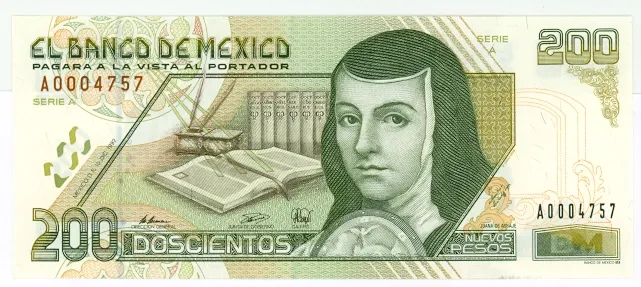
Obverse
Sor Juana Inés de la Cruz
Portrait of Sor Juana Inés de la Cruz with books and a quill pen
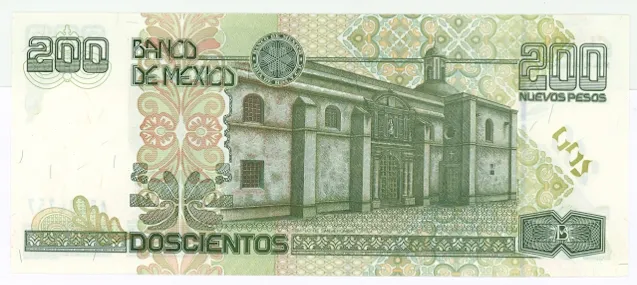
Reverse
The former convent of San Jerónimo
About this banknote
Most 1992 Mexican 200 nuevos pesos notes are worth only a few US dollars, not a fortune. This is a common note from the Banco de México "A" family, and the online listings that claim hundreds of dollars are almost always wishful pricing. The exceptions that actually command a premium are uncirculated notes, low or palindrome serial numbers, and genuine printing errors.
If you inherited or found one of these green notes featuring a nun with books and a quill pen, here is what it actually is, what it sells for, and how to tell if yours is one of the few worth more.
What this note is
The 200 nuevos pesos note from 1992 shows Sor Juana Inés de la Cruz on the front, the 17th-century poet and nun known as the "Tenth Muse," one of the great writers in the Spanish language during the colonial-era Golden Age. She appears surrounded by books and a quill, symbols of her intellectual world.
The back shows the former Convent of San Jerónimo in Mexico City, where she lived and wrote. This note belongs to the Banco de México "A" family (the series identifier printed on Mexican notes). It is the direct predecessor of the later green "F" family 200-peso note.
The "nuevos pesos" (new pesos) label comes from Mexico's 1993 currency reform, which dropped three zeros from the old peso. That transition is exactly why notes like this one left circulation.
How much it's worth
This note is no longer legal tender, so its value is collector value, not face value. In collector terms, condition drives everything.
- Circulated, with folds and wear: typically the equivalent of a few US dollars. Common as dirt.
- Uncirculated (crisp, no folds, no stains, sharp corners): a modest premium, often several US dollars up to low double digits depending on the buyer.
- Low serial numbers, palindrome (radar) serials, or early series: these carry a real premium among specialists and can bring multiples of a common note.
- Genuine printing errors: the true wildcards, worth several times the ordinary value.
| Note | Year | Condition | Approximate value (USD) |
|---|---|---|---|
| 200 nuevos pesos (Sor Juana) | 1992 | Circulated | 1 to 5 |
| 200 nuevos pesos | 1992 | Uncirculated | 5 to 15 |
| 200 nuevos pesos | 1992 | Low/radar serial | 15 to 50+ |
| 200 nuevos pesos | 1992 | Confirmed printing error | Varies, several times face |
Treat these as guide ranges for the world paper money (notaphily) market, not fixed prices. A graded note in a professional holder (PMG or PCGS Banknote) at a high grade like 66 or above will beat a raw note, sometimes substantially. If yours is common and circulated, the honest answer is that it is a nice piece of history worth a couple of dollars, not a windfall.
The features that add value
Check three things:
- Condition. No folds, no soft corners, no stains, no writing. A truly crisp note is what collectors pay up for.
- Serial number. A very low number (like 0000123), a repeated pattern, or a palindrome that reads the same forwards and backwards (a "radar" note) all raise demand.
- Printing errors. Misaligned cuts, ink smears, factory folds, missing print, or off-center serials turn an ordinary note into a rarity. Normal wear and handling damage is not an error, so do not confuse the two.
Got one with an odd serial or still in factory packaging? Post it in the Pesoteca forum and the community can help you read it.
How to tell if yours is genuine
Reproductions and outright fakes do exist for older Mexican notes. To check authenticity, examine the security features against official Banco de México images:
- Watermark visible when held to the light.
- Security thread embedded in the paper.
- Microprinting that stays sharp under magnification.
- Intaglio relief you can feel with your fingertips on the printed design.
Reproductions usually give themselves away with smooth, flat paper and dull, flat colors, and they lack the raised feel of genuine intaglio printing. Compare the signatures and design details too. If anything looks off, ask before you buy or sell in the forum. For context on which Mexican notes get faked most, see our guide to the most counterfeited banknotes in Mexico.
Where to sell it
To sell the 1992 200 nuevos pesos note without leaving money on the table:
- A verified numismatic dealer from the Pesoteca directory can appraise it on the spot, by city, without middleman markups.
- The Pesoteca buy-and-sell forum connects you directly with collectors.
Before you list it, photograph both sides in good light, note the serial number, and flag anything unusual like a low serial or a possible error, since those move the price. Avoid dumping it to the first bidder on social media, where common notes and rare ones get lumped together at the same lowball price.
Still not sure what you have? Post clear photos of the front and back in the Pesoteca forum and let collectors weigh in before you buy or sell.
Historical context
The 200 pesos of 1992 honors Sor Juana Inés de la Cruz, the Hieronymite nun, poet, and thinker of the seventeenth century, considered the greatest figure of New Spanish letters and an early defender of women's right to knowledge. Author of First Dream and of the celebrated Reply to Sor Filotea, her genius made her an intellectual emblem of Mexico. The note surrounds her with books and a quill, attributes of her life of study.
The reverse shows the former convent of San Jerónimo, in Mexico City, the site where she took her vows, wrote, and died in 1695.
This is a late denomination within Family A, born in response to the inflation of the 1980s that pushed Banco de México to create intermediate values. Issued in 1992, it barely circulated before the 1993 reform divided all pesos by a thousand.
Frequently asked questions
How much is the 1992 Mexican 200 pesos note worth?
A circulated note is worth the equivalent of a few US dollars, since it is a common note from the Banco de México "A" family and no longer legal tender. An uncirculated example can bring several dollars to low double digits, while low or palindrome serial numbers and genuine printing errors can push the value to multiples of that. Condition and rarity are what matter.
Is the 1992 200 pesos (Sor Juana) note rare?
No, most 1992 200 nuevos pesos notes are common. The design features poet Sor Juana Inés de la Cruz on the front and the former Convent of San Jerónimo on the back. Only specific variants are scarce: uncirculated notes, very low or radar serial numbers, early series, and confirmed printing errors. Online listings claiming hundreds of dollars for a plain circulated note are inflated.
Where can I sell my 1992 Mexican 200 pesos note?
The safest options are a verified numismatic dealer from the Pesoteca directory, who can appraise it in person, or the Pesoteca buy-and-sell forum where you deal directly with collectors. Photograph both sides in good light, record the serial number, and note any low serial or error before selling. Avoid dumping it on social media to the first bidder.
How can I tell if my 1992 200 pesos note is genuine?
Check the security features: a watermark visible against the light, an embedded security thread, sharp microprinting, and raised intaglio relief you can feel on the design. Reproductions usually have smooth, flat paper and dull colors with no raised feel. Compare the design and signatures to official Banco de México images, and if in doubt, ask in the Pesoteca forum before buying or selling.
Familia A
This banknote belongs to the BIL-A family within the Sistema PSM . Explore all the banknotes that share origin, era and design with this piece.
Ver todos los billetes de la familia A →