
20,000 Pesos Banknote (1985): Value & Rarity Guide
Familia A · algodón
Period: México Contemporáneo
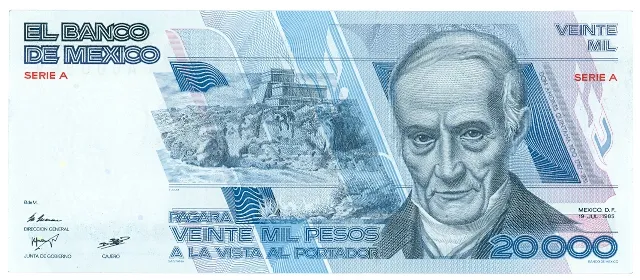
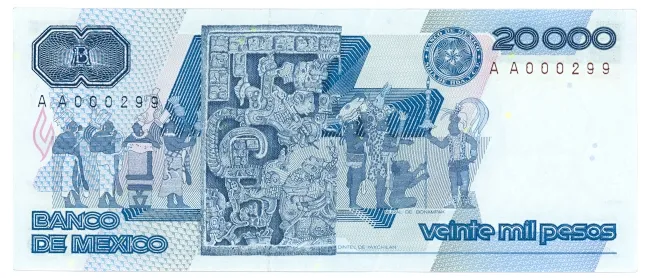
Design
Banxico
Obverse
Andrés Quintana Roo
Portrait of Andrés Quintana Roo and an archaeological site
Reverse
A pre-Hispanic mural relief from Cacaxtla
About this banknote
Most 1985 Mexican 20,000 pesos notes are worth only a few US dollars today, not the hundreds some listings claim. This is a demonetized note, so its value is collector value, not face value, and the vast majority in circulated condition trade for pocket change. A truly uncirculated example, a low or radar serial number, or a genuine printing error is where the real money is. Here is what yours is actually worth and how to check.
What this note is
The 20,000 pesos note is a blue banknote issued by the Banco de México as part of the Type A family (familia A), the design series in use during the high-inflation years of the 1980s when denominations climbed fast. On the front it features Andrés Quintana Roo, the Yucatán-born lawyer and poet, a deputy at the Congress of Chilpancingo and a signer of the 1813 Act of Independence. The Mexican state of Quintana Roo is named after him.
The reverse shows a pre-Hispanic mural relief from Cacaxtla, an archaeological site in Tlaxcala known for its Mesoamerican battle paintings. If you inherited a stack of old Mexican paper money, this large blue note is a common one to find, and that is exactly why condition matters so much.
How much the 1985 20,000 pesos note is worth
This note no longer circulates, so it has no spendable value in Mexico. Its worth is entirely collector-driven, and condition is the single biggest factor.
- Circulated (folds, creases, soft corners): typically a few US dollars, often the equivalent of 1 to 5 dollars. This describes most surviving examples.
- Uncirculated (crisp, no folds, sharp corners, no stains): several times more. Grading and demand set the ceiling.
- Special serial numbers: low serials (like 0000001 range), radar/palindrome serials (reads the same backward, called capicúa in Spanish), and first-series prefixes command premiums.
- Genuine printing errors: misaligned cuts, ink smears, factory folds, and off-center or repeated serials can multiply the value.
| Note | Year | Family | Condition | Approx. value (USD) |
|---|---|---|---|---|
| 20,000 pesos | 1985 | Type A | Circulated | 1 to 5 |
| 20,000 pesos | 1985 | Type A | Uncirculated | 10 to 40+ |
| 20,000 pesos | 1985 | Type A | Radar / low serial | Premium over the above |
| 20,000 pesos | 1985 | Type A | Genuine error | Several times face collector value |
These are collector-market ranges, not fixed prices. A note graded by PMG or PCGS Banknote in a high grade will always outperform a raw note, and truly scarce serial or error variants can jump well beyond the table.
The myth: "it's worth thousands"
A lot of online listings and social posts price common Type A notes at wildly inflated numbers. In 2026, the reality is that most 20,000 pesos notes are common. Millions were printed during the inflation era. Age alone does not make a banknote valuable; rarity, condition, and demand do. Do not assume yours is the exception just because it is old and looks impressive. Check the condition and serial first.
How to tell if yours is genuine
Before assigning any value, confirm the note is real. Compare it against official Banco de México references and look for:
- Watermark: hold it to the light. A genuine note shows a watermark integrated into the paper, not printed on top.
- Security thread: an embedded strip visible against light.
- Intaglio relief: run a finger over the portrait and lettering; real notes have raised, tactile printing.
- Paper feel: authentic cotton-based banknote paper has a distinct texture. Reproductions and reprints tend to have smooth, flat paper and dull, uniform colors.
Reprints and "souvenir" copies of old Mesican notes circulate online. If the paper feels like a photocopy or the colors look flat, treat it as a reproduction. When in doubt, post clear photos of both sides in the Pesoteca forum and let the community weigh in.
How to check what yours is worth
- Grade it honestly. Any fold, crease, stain, or rounded corner drops it from uncirculated. Be strict.
- Read the serial number. Low numbers, radar/palindrome serials, and early prefixes add value.
- Look for genuine errors. Misaligned cuts, ink runs, and off-center serials are factory faults worth money. Normal wear and use damage are not errors.
- Photograph both faces in good, even light before you ask for a valuation or offer it for sale.
Where to sell it
To sell the 1985 20,000 pesos note safely, use a verified numismatic shop from the Pesoteca directory, where you get an on-the-spot valuation, or the Pesoteca buy-and-sell forum where collectors trade directly. Always show clear photos of both sides, the serial number, and note the exact condition before agreeing on a price. Avoid dumping it to the first buyer on general marketplaces, where you will usually get less than a collector would pay.
To place your note in context, see our data on the most counterfeited banknotes in Mexico.
Got a 20,000 pesos note with an unusual serial or a possible error? Post it in the Pesoteca forum and let collectors help you pin down what it's really worth.
Historical context
The 1985 20,000-peso note honors Andrés Quintana Roo, a Yucatecan lawyer, poet, and politician, a prominent figure of Independence and of the early years of independent Mexico. A deputy at the Congress of Chilpancingo alongside Morelos, he was one of the drafters of the 1813 Act of Independence; the state of Quintana Roo bears his name today. His portrait is accompanied by an archaeological site.
The reverse shows a pre-Hispanic mural relief from Cacaxtla, in Tlaxcala, famous for its vividly colored paintings that revealed the artistic richness of that central Mexican culture.
This denomination was born amid an inflationary storm. By 1985, with inflation soaring after the 1982 crisis, the Banco de México was forced to issue twenty-thousand-peso notes, figures unthinkable a decade earlier. It is among the last "old pesos," preceding the 1993 reform that would drop three zeros from the peso.
Frequently asked questions
How much is the 1985 Mexican 20,000 pesos note worth?
Most circulated examples are worth only a few US dollars, roughly 1 to 5 dollars, since millions were printed and the note no longer circulates. A crisp uncirculated note can bring several times more, and rare serial numbers or genuine printing errors push the value higher. Condition and rarity decide the price.
Is the 1985 20,000 pesos banknote rare?
No, the standard Type A (familia A) 20,000 pesos note is common. It was issued in large quantities during Mexico's high-inflation years of the 1980s. What is scarce, and therefore valuable, is an uncirculated example, a low or radar (palindrome) serial number, an early series prefix, or a genuine factory printing error.
Where can I sell my 1985 20,000 pesos note?
The safest options are a verified numismatic shop from the Pesoteca directory, which gives an on-the-spot valuation, or the Pesoteca buy-and-sell forum where collectors trade directly. Photograph both faces in good light, note the serial number and condition, and don't sell to the first bidder on a general marketplace.
How do I tell if my 20,000 pesos note is genuine?
Check the security features: hold it to the light for the watermark and embedded security thread, feel the raised intaglio printing on the portrait, and examine the paper texture. Genuine notes use cotton-based paper with tactile relief and rich color. Reproductions have smooth, flat paper and dull colors. When unsure, post photos in the Pesoteca forum.
Familia A
This banknote belongs to the BIL-A family within the Sistema PSM . Explore all the banknotes that share origin, era and design with this piece.
Ver todos los billetes de la familia A →