
Mexico 5 Pesos Banknote (1970): Value Guide
Familia A · algodón
Period: México Contemporáneo
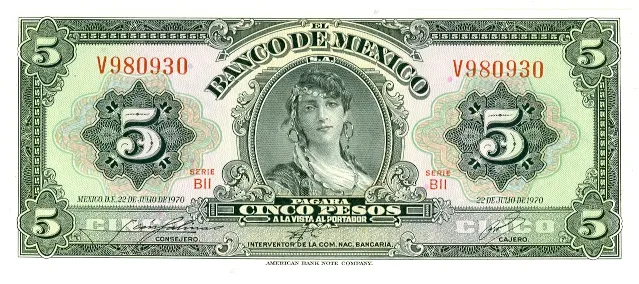
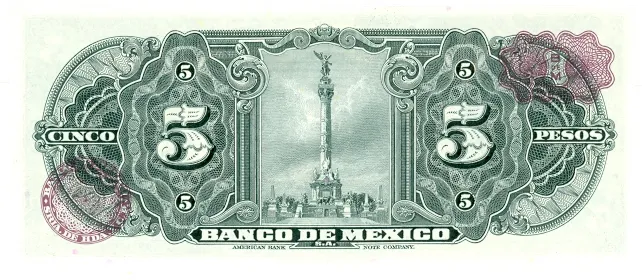
Design
Banxico
Obverse
Josefa Ortiz de Domínguez
Portrait of Josefa Ortiz de Domínguez, la Corregidora
Reverse
The aqueduct and a view of the city of Querétaro among maguey plants
About this banknote
Most 1970 Mexican 5 pesos notes are worth only a few US dollars. This is a common note from the Banco de Mexico Series A family, and the "worth a fortune" listings you see online almost never match reality. A circulated example trades for pocket change to collectors. What actually adds value is uncirculated condition, a low or radar (palindrome) serial number, or a genuine printing error.
This note features Josefa Ortiz de Dominguez, known as "La Corregidora" of Queretaro, a key figure in Mexico's War of Independence. She warned the conspirators that the independence plot had been discovered, and that warning pushed forward the famous "Grito de Dolores" in 1810. The reverse shows the Queretaro aqueduct flanked by maguey (agave) plants. It shares the same design as the 1969 issue; for collectors, the difference is the date and the series letter.
What it's worth in 2026
This note no longer circulates, so its value is collector value, not face value. Condition drives everything. Here is a realistic range for the 1970 issue:
| Grade / Feature | Description | Approximate value (USD) |
|---|---|---|
| Circulated (VG-VF) | Folds, soft corners, light soiling | 1 to 4 USD |
| Uncirculated (crisp, no folds) | Sharp corners, no handling marks | 5 to 20 USD |
| Low serial or radar (palindrome) | e.g. serial ending 000012 or reading the same both ways | 20 to 100+ USD |
| Genuine printing error | Miscut, ink smear, mismatched serials, factory fold | 50 to several hundred USD |
These are collector-market figures for world paper money (notaphily), which is an active English-language hobby. Do not trust the inflated listings that ask hundreds of dollars for an ordinary circulated note. Most Series A notes are common. A worn 1970 5 pesos is a few dollars, period.
Why the myth of the "rare" 5 pesos falls apart
Millions of these were printed and many survived, so age alone does nothing for value. The reader who inherited a stack of them usually has common circulated notes. Rarity here comes from a specific fact about the individual note: an unusually low serial number, a radar or solid serial, or a true factory error. Ordinary wear and damage from use is not an error and does not add value.
The note at a glance
- Country / issuer: Mexico, Banco de Mexico
- Denomination: 5 pesos
- Issue date: 1970 (same design as the 1969 issue)
- Family / series: Series A
- Front (obverse): Josefa Ortiz de Dominguez, "La Corregidora"
- Back (reverse): Queretaro aqueduct with maguey plants
How to check what yours is worth
Check three things. First, condition: is it uncirculated (no folds, crisp paper, sharp corners) or circulated? Second, the serial number: look for a low number, a radar (reads the same forward and backward), or a solid repeating digit. Third, the printing: look for misaligned cuts, smeared or offset ink, mismatched serials, or a factory fold. Any one of those makes the note more desirable.
To authenticate an older note like this, compare it against official Banco de Mexico images. Study the paper texture, the printed detail, and the signatures. Reproductions tend to have smooth paper and flat, lifeless colors, while a genuine note shows the fine engraving lines of intaglio printing. If you have any doubt, post clear photos of both sides in the Pesoteca forum and let the community weigh in. For context on what fakes look like, read our guide to Mexico's most counterfeited banknotes.
Where to sell it
The safest routes are a verified dealer from the Pesoteca shop directory, who can appraise it on the spot, or the buy-and-sell forum where you deal directly with collectors. Photograph both sides in good light, note the serial number, and describe the condition honestly. Do not dump it on the first social-media buyer. A genuinely special serial or error can be worth many times more than the ordinary note, so it pays to have it seen by people who know the series.
Have a 1970 5 pesos with an odd serial or something that looks like an error? Post it in the forum and we'll take a look together.
Historical context
This 1970 5-peso note repeats the portrait of Josefa Ortiz de Domínguez, la Corregidora, a fundamental figure of the 1810 independence conspiracy. Her timely warning to the plotters, when the conspiracy was about to be betrayed, hastened the start of the struggle for Independence and fixed her forever in Mexican civic memory.
As in the 1969 issue, the reverse recovers the aqueduct of Querétaro among magueyes, those colonial arches that are the hallmark of the city where she lived and acted. The design remained stable from one year to the next, something common in family A when a denomination stayed in use.
Issued just a year after its predecessor, this note is part of the "old pesos," those that circulated until the 1993 monetary reform that divided all values by one thousand. In 1970 the 5-peso note was still money for everyday spending, far from the giant denominations that the inflation of the 1980s would end up imposing.
Frequently asked questions
How much is the 1970 Mexico 5 pesos note worth?
A circulated example is worth roughly 1 to 4 USD to collectors. A crisp uncirculated note runs about 5 to 20 USD. A low serial number, a radar (palindrome) serial, or a genuine printing error can push it to 50 USD or more. Age alone adds nothing; condition and rarity drive the value.
Is the 1970 5 pesos note rare?
No. It is a common Banco de Mexico Series A note; millions were printed and many survived. It becomes rare only when a specific note has an unusually low or radar serial number, or a true factory printing error. Ordinary wear is not an error and does not make it rare.
Where can I sell my 1970 5 pesos banknote?
Use a verified dealer from the Pesoteca shop directory for an on-the-spot appraisal, or the Pesoteca buy-and-sell forum to reach collectors directly. Photograph both sides in good light, note the serial number, and describe the condition honestly before agreeing on a price.
How do I tell if my 1970 5 pesos note is genuine?
Compare it against official Banco de Mexico images. Check the paper texture, the fine engraved detail, the colors, and the signatures. Genuine notes show sharp intaglio printing; reproductions usually have smooth paper and flat colors. When in doubt, post clear photos of both sides in the Pesoteca forum for a second opinion.
Familia A
This banknote belongs to the BIL-A family within the Sistema PSM . Explore all the banknotes that share origin, era and design with this piece.
Ver todos los billetes de la familia A →