
500 Pesos Banknote (1979): Madero Green Note Value
Familia A · algodón
Period: México Contemporáneo
Design
Banxico
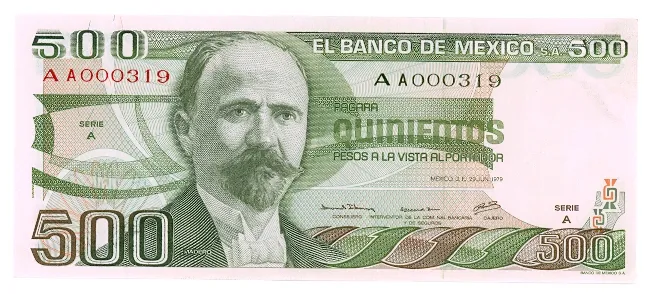
Obverse
Francisco I. Madero
Effigy of Francisco I. Madero, a Coahuilan hero of the Revolution
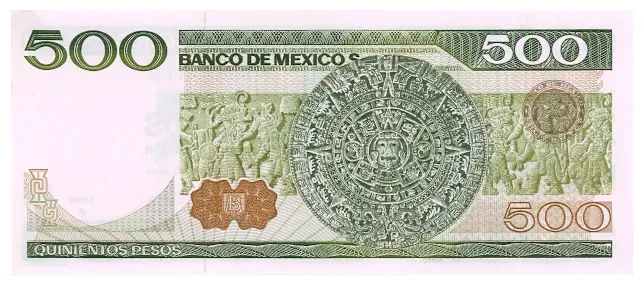
Reverse
The Sun Stone and the Stone of Tízoc of the Mexica culture
About this banknote
Most 1979 Mexican 500 pesos notes are worth a few US dollars, sometimes less than one. The green Francisco I. Madero note was printed by the millions and circulated hard, so a worn example is a common collectible, not a windfall. The exceptions that bring real money are crisp uncirculated notes, low or repeating serial numbers, and genuine printing errors. Here's how to tell which one you have.
What it is
This is a 500 pesos note from the Banco de México, part of the Type A family (familia A), first issued on November 20, 1979. That date is the anniversary of the start of the Mexican Revolution, and the note honors Francisco I. Madero, the reformer who launched the revolution in 1910 with his Plan de San Luis and served as president from 1911 until he was assassinated in 1913.
The note is green. The back carries pre-Hispanic Mexica (Aztec) imagery: the Piedra del Sol (the stone often miscalled the Aztec Calendar) and the Piedra de Tízoc, with the Ollin symbol. This was the first Mexican banknote fully designed and printed at the Banco de México's own facilities rather than by a foreign printer, which is why it matters to collectors of world paper money (a hobby called notaphily).
One thing to get straight: this 1979 note shows Madero. There is a separate 500 pesos note from 1978 that shows José María Morelos and the Palacio de Minería. They are different notes with different values, so confirm the date and the portrait before you compare prices.
What it's worth in 2026
The note no longer circulates, so its value is collector value, not face value. Condition drives almost everything.
- Circulated (folds, soft corners, light soiling): typically 1 to 5 USD. Very common.
- Uncirculated (crisp, no folds, sharp corners, no stains): usually 8 to 25 USD depending on eye appeal, and more for early series letters.
- Low serial numbers (like 0000123), repeating or palindrome serials (capicúa), or first-series notes: command a premium over the ranges above, often several times a normal note in the same grade.
- Genuine printing errors: the real money. See below.
These are collector-market ranges for a widely traded note. A worn 1979 Madero 500 is a keepsake, not a payday. The value lives in the top grades and the oddities.
| Note | Year | Condition | Typical value (USD) |
|---|---|---|---|
| 500 pesos, Madero (Type A) | 1979 | Circulated | 1 to 5 |
| 500 pesos, Madero (Type A) | 1979 | Uncirculated | 8 to 25 |
| 500 pesos, Madero (Type A) | 1979 | Low/repeating serial | Several times normal |
| 500 pesos, Madero (Type A) | 1979 | Genuine printing error | Multiples of face; case by case |
The ones people overvalue
The common belief is "old banknote equals fortune." With this note, that's rarely true. Millions were printed and many survived, so age alone adds little. A note with heavy folds, tape, writing, or trimmed edges is worth little regardless of how old it looks. Normal wear is not a factory error, and a torn or stained note is not "rare," just damaged.
Where the exceptions live:
- Printing errors. Misaligned cuts, ink smears, factory folds, and mismatched or off-center serial numbers turn a common note into something collectors chase. These sell for multiples of face value, priced case by case.
- Serial number oddities. Very low serials, palindromes (capicúa), and solid or ladder patterns pull real premiums.
- Top-grade uncirculated. A note that has never been folded, with full original paper and no handling, is the version worth grading.
How to check what yours is worth
- Grade it honestly. Hold it flat. Any fold, even one, drops it out of uncirculated. Check the corners and edges under good light.
- Read the serial. Look for low numbers, repeats, or palindromes. Note the series letter as well; earlier series can carry a premium.
- Look for errors. Compare front and back alignment, check the serials match on both prints, and look for ink or cut anomalies. Distinguish a factory error from ordinary damage.
- Consider third-party grading. For a genuinely high-grade or error note, professional certification (PMG is the main service for world paper money) can confirm the grade and add resale confidence.
How to tell if it's genuine
Check the security features against official Banco de México images: the watermark visible when held to light, the security thread, the raised feel of the ink (intaglio relief), and the fine detail of the portrait and lettering. Reproductions usually give themselves away with smooth, flat paper and dull, printed-looking color instead of the texture and depth of the real note. Compare the signatures and design elements to a verified reference. If anything looks off, post clear photos of both sides in the forum before you buy or sell.
Where to sell
For the best result, get it in front of collectors rather than dumping it to the first buyer. A verified dealer from the Pesoteca shop directory can value it on the spot, and the Pesoteca buy-and-sell forum puts it in front of people who actually collect world paper money. Photograph both sides in good light, note the serial, and mention any error or oddity, since those move the price.
Got a crisp one, a strange serial, or something that looks like a printing error? Post it in the forum and the community will help you read it. To learn what fakes look like, see our breakdown of the most counterfeited banknotes in Mexico.
Historical context
This 500 pesos of 1979 changes its subject and presents Francisco I. Madero, the Coahuila-born hero who led the Mexican Revolution of 1910 against the long regime of Porfirio Díaz. An apostle of democracy with his motto "Effective suffrage, no re-election," he reached the Presidency in 1911 and was assassinated during the Ten Tragic Days of 1913, becoming a martyr of the democratic cause.
The reverse looks to the pre-Hispanic past with the Sun Stone and the Stone of Tízoc, two major monoliths of Mexica culture kept at the National Museum of Anthropology.
The piece belongs to the "old pesos" of Family A. Its appearance coincides with the onset of crisis: the debt and inflation of the late 1970s already signaled the escalation of denominations that would mark the 1980s, before the 1993 monetary reform.
Frequently asked questions
How much is the 1979 Mexican 500 pesos note worth?
A circulated example is usually worth 1 to 5 USD, since it was printed in large numbers. A crisp uncirculated note typically brings 8 to 25 USD, and notes with low or repeating serial numbers, early series letters, or genuine printing errors sell for several times more. Condition and rarity decide the price.
Is the 1979 500 pesos Madero note rare?
Not in worn condition. Millions were printed and many survived, so a used example is common and inexpensive. Rarity kicks in with top-grade uncirculated notes, low or palindrome serial numbers, and factory printing errors, which are the versions collectors actually compete for.
Where can I sell my 1979 500 pesos note?
The safest options are a verified dealer from the [Pesoteca shop directory](/tiendas), who can appraise it in person, or the [Pesoteca buy-and-sell forum](/foro/compra-venta) among collectors. Photograph both sides in good light and note the serial number and any error before you sell, since those details raise the value.
How can I tell if my 1979 500 pesos note is genuine?
Check the security features against official Banco de México references: the watermark held to light, the security thread, the raised feel of the ink, and the fine detail of Madero's portrait and the lettering. Fakes usually have smooth, flat paper and dull, printed-looking color. If you're unsure, post clear photos of both sides in the [forum](/foro).
Familia A
This banknote belongs to the BIL-A family within the Sistema PSM . Explore all the banknotes that share origin, era and design with this piece.
Ver todos los billetes de la familia A →