
En resumen
You found a '1947 Centenario' and heard it's worth a fortune. The truth: Mexico's Centenario gold coin was originally struck only from 1921 to 1925. The 1947 is a restrike worth its gold, and here's how to spot the difference.
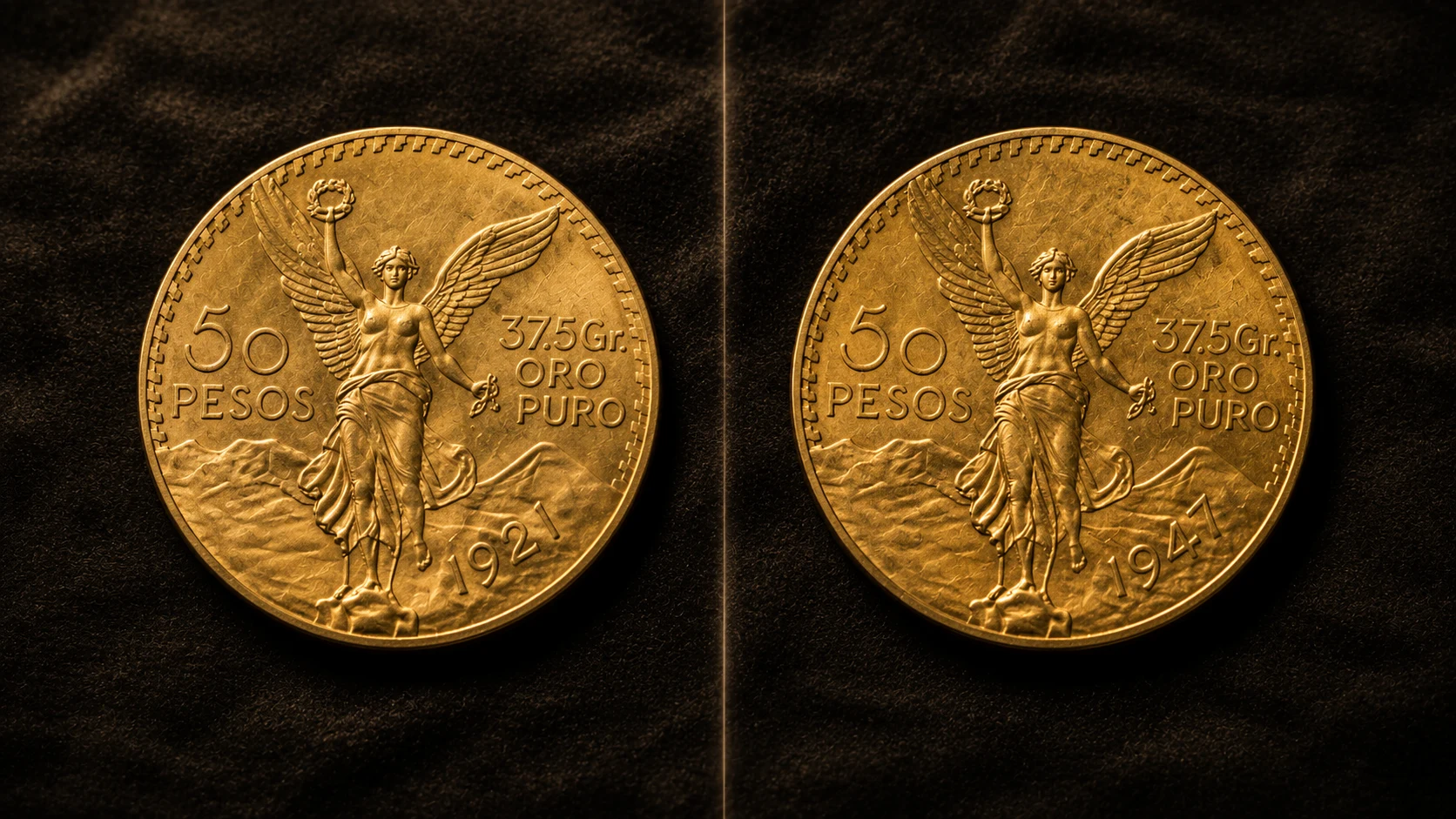
If you searched "1947 Centenario" or "Mexican 50 peso gold coin value" because someone told you it's worth a fortune, part of that is a myth and part is real. Here's the fact that matters: the Centenario 50 pesos gold coin was originally struck only between 1921 and 1925, never in 1947. A coin dated 1947 (or 1944, 1945, 1946, 1971, 1972) is an official restrike from Banco de México, made decades later with the historic date as a tribute. And the key point: the restrike is worth only its gold content, with no premium for age.
There's upside too. If your Centenario happens to be from the original 1921-1925 run, it is worth 2 to 8 times more than a restrike depending on condition. And if it's a proof or a rare variety, it can bring millions of pesos at auction. In USD terms, an ounce-plus of gold plus a real numismatic premium.
Here's how to tell them apart in two minutes.
The "1947 Centenario" myth
Let's take this apart at the root. The Centenario 50 pesos gold coin was designed in 1921 to mark the 100th anniversary of Mexican independence (won in 1821). That's why it's called "Centenario," the Spanish word for centennial. It doesn't mean the coin itself is 100 years old. It commemorates 100 years of independence.
The Casa de Moneda struck it originally from 1921 through 1925, then stopped for years.
In 1943, the mint began restriking the coin with the date "1947" stamped on it (not as a counterfeit, as a deliberate tribute). It kept producing coins dated 1947 through 1972. That's why there are millions of "1947 Centenarios" in circulation today. Most are neither from 1947 nor from the 1921 originals. They are modern restrikes carrying a historic date.
Quick table: original vs restrike
| Feature | Original Centenario | Restrike Centenario |
|---|---|---|
| Actual year struck | 1921, 1922, 1923, 1924, 1925 | 1943-1972 (dated "1947" or variants) |
| Date shown on the coin | 1921, 1922, 1923, 1924, 1925 | 1944, 1945, 1946, 1947 (most), 1971, 1972 |
| Gold content | 33.75 g pure gold (37.5 g of 0.900 alloy) | 33.75 g pure gold (37.5 g of 0.900 alloy) |
| Mintage | Limited (exact figures vary by year) | Millions across the full period |
| Value, common UNC | Well above melt (strong numismatic premium) | Melt value plus 5-10% |
| Proof / varieties | Can reach the low millions of pesos | Not applicable, no modern proofs |
There is no visual difference in the coin itself. Both use the same dies, both weigh the same, both are the same gold. The only way to know whether you have an original 1921-1925 is to read the date on the reverse.
The dates that matter
Check the date on your Centenario:
- 1921, 1922, 1923, 1924, 1925 → Original. Worth 2 to 8 times more than a restrike depending on condition. Get it appraised.
- 1944, 1945, 1946, 1947, 1971, 1972 → Restrike. Worth gold spot. Nothing more, nothing less.
- Any other date → Almost certainly counterfeit. Banco de México never struck Centenarios with other dates.
You can see the originals from 1921-1925 in the Pesoteca catalog:
- Centenario 50 pesos gold 1921
- Centenario 50 pesos gold 1922
- Centenario 50 pesos gold 1923
- Centenario 50 pesos gold 1924
- Centenario 50 pesos gold 1925
What is a Centenario worth in 2026?
Value comes down to two things: the gold spot price and whether it's original or a restrike.
Gold content sets the floor
The Centenario contains 33.75 grams of pure gold (37.5 g of 0.900 alloy, 22 karat), a little over one troy ounce. Its minimum value is that gold weight at the current spot price. That's the floor for every Centenario, no matter the date.
Pesoteca updates the Centenario price today daily with real figures pulled from Mexican banks.
Original 1921-1925
On top of the gold value, an original commands 20% to 200% more depending on:
- Specific year: 1923 and 1925 are the most common; 1921 and 1922 are scarce.
- Condition: UNC adds roughly 50% to the price. MS-65 or higher can add 200% or more.
- Documented provenance: an NGC or PCGS certificate adds value.
A 1921 Centenario in MS-65 has sold at auction for the equivalent of roughly 30,000 USD. A common 1924 in UNC trades closer to gold value plus a modest premium.
Restrike (dated 1947)
Worth only gold spot plus a small product premium of 5 to 10%. It's essentially bullion, not a numismatic rarity.
How to avoid getting scammed on a "rare 1947 Centenario"
Here's the classic scam pattern seen at dealer shops and coin fairs:
- The seller shows you a Centenario dated 1947 and claims it's worth thousands of dollars "because it's one of the few."
- They apply pressure ("today only, tomorrow the price goes up").
- It's really worth its melt value, the gold spot price.
How to protect yourself:
- Check the Centenario price today on Pesoteca.
- Do the math: spot price times 33.75 g of pure gold equals the value floor.
- If the date is 1947 (or anything 1944-1972), the fair price is spot plus 5 to 10%, and no more.
- Do not pay more than spot plus 10% for a 1947 Centenario unless it carries specific NGC or PCGS certification for a documented rare variety.
Most sellers pushing "rare 1947" Centenarios are marking up bullion. If someone offers you one, ask for NGC or PCGS certification that documents the specific rarity. Without it, a 1947 Centenario is worth its gold and nothing more.
What to do if you have a Centenario
- Identify the date. Look on the reverse, below the eagle.
- If it's 1921-1925: don't clean it, photograph it (obverse, reverse, edge), and post it to the Pesoteca forum for a first opinion. If the community confirms it looks original, take it to a certified numismatic appraiser.
- If it's 1944-1972: it's worth gold spot. You can sell it to gold buyers and specialized banks, or hold it as physical gold. Don't expect a numismatic premium.
- If it's any other date: it's almost certainly a fake. Get it verified before doing anything else.
Have one? Tell us
Did you inherit a Centenario? What year is it? If you have one of the originals from 1921 to 1925, post it to the Pesoteca forum with photos of the obverse, reverse, and edge. The community can tell you fast whether you're holding something special or a common restrike. A clear photo settles it right away.
And if yours is a 1947 restrike, that's no letdown. It's still 33.75 grams of pure gold, a solid piece of physical bullion. If you're interested in the Centenario for the gold rather than the collectible, see whether it makes sense to invest in a Centenario, with today's price by bank.

Loading comments…